
The Dichotomy of Leadership: Comprehensive Book Review + 4 Laws of Combat!


Are you striving to become a better leader but struggling to find the right balance? In our comprehensive review of “The Dichotomy of Leadership” (buying from Amazon), discover how the principles of Extreme Ownership and the Four Laws of Combat can transform your leadership style.
Learn how to be aggressive yet cautious, disciplined yet adaptable, and effectively lead while empowering your team members. Dive into our detailed analysis and unlock the secrets to mastering leadership through equilibrium.
Content Overview of The Dichotomy of Leadership:
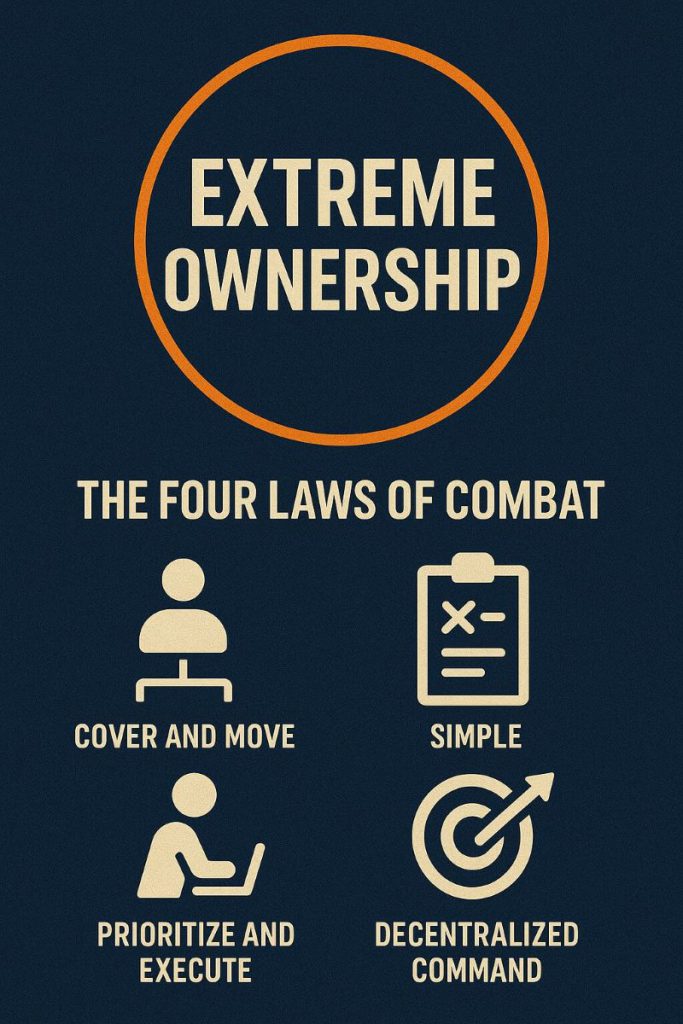
The mindset of Extreme Ownership and the four Laws of Combat: Cover and Move, Simple, Prioritize and Execute, and Decentralized Command.
The mindset of Extreme Ownership and the four Laws of Combat—Cover and Move, Simple, Prioritize and Execute, and Decentralized Command—emphasize fundamental principles of leadership and teamwork.
These concepts, derived from military experience, apply to various aspects of personal and professional life. Extreme Ownership means taking full responsibility for actions and outcomes, while the Laws of Combat provide guidance for effective performance in complex situations.
The first Law of Combat: Cover and Move.
This law highlights the importance of teamwork and coordination among team members. In combat, providing cover for teammates and moving in unison enhances safety and effectiveness.
In a work environment, collaboration and mutual support among team members contribute to achieving common goals.
The second Law of Combat: Simple.
Simplicity in planning and executing tasks prevents complexity and misunderstandings. When plans and instructions are straightforward and clear, the likelihood of errors decreases, facilitating successful execution. Simplicity helps focus on primary objectives and eliminates unnecessary details.
The third Law of Combat: Prioritize and Execute.
When faced with multiple tasks and limited resources, the ability to identify priorities is crucial. This law underscores the importance of focusing on the most critical tasks and executing them before addressing less important matters. This approach prevents wasting time and resources, enhancing efficiency.
The fourth Law of Combat: Decentralized Command.
Decentralized command involves distributing responsibilities and decision-making authority among team members.
This method demonstrates trust in individual capabilities and allows the team to react more quickly to changing conditions. By delegating authority, team members feel a greater sense of ownership, increasing their motivation and commitment.
Leaders must find the equilibrium between opposing forces that pull in opposite directions. Being aggressive but cautious, disciplined but not rigid, a leader but also a follower — it applies to almost every aspect of leadership.
Leaders must find the equilibrium between opposing forces that pull in opposite directions. In the complex realm of leadership, striking this balance is essential for success. A leader who can harmonize aggression with caution can pursue ambitious goals without overstepping bounds.
Balancing discipline with flexibility enables them to uphold standards while embracing new ideas. By being both a leader and a follower, they foster a collaborative environment where team members feel valued and empowered.
This equilibrium enhances decision-making and problem-solving and cultivates a dynamic and responsive leadership style that can navigate today’s ever-changing challenges.
Ready to lead, but also knowing when to follow.
In the ever-evolving landscape of modern teamwork and collaboration, exceptional leadership requires being ready to lead and knowing when to follow. It’s not merely about holding a position of authority but about embracing the fluid dynamics of group interactions.
Effective leaders understand that there are times when their guidance is crucial, and other times when supporting a colleague’s initiative can lead to greater innovation and success. By being attuned to these moments, they cultivate an environment of mutual respect and collective empowerment.
This approach enhances team performance and fosters personal growth, as individuals learn from one another and build on each other’s strengths.
Taking Extreme Ownership of everything that impacts the mission, but also empowering others to lead with Decentralized Command.
Embracing the philosophy of taking extreme ownership while empowering others through decentralized command creates a powerful dynamic within any mission-driven team. Leaders who wholeheartedly accept responsibility for all facets of the mission set a tone of commitment and integrity.
At the same time, by decentralizing command and encouraging team members to lead in their domains, they foster an environment of trust and innovation. This approach not only drives the team toward success but also develops future leaders, ensuring adaptability and resilience in the face of challenges.
The synergy of personal accountability and collective empowerment becomes the cornerstone of effective and sustainable leadership.

What makes the best leaders and best teams great is that when they make mistakes, they acknowledge them, take ownership, and make corrections to upgrade their performance.
What truly makes the best leaders and teams great is their response to mistakes. Instead of viewing errors as failures, they see them as valuable learning opportunities.
They acknowledge their missteps openly, take responsibility without shifting blame and implement corrective actions to prevent future occurrences. This proactive attitude not only resolves the immediate problem but also drives continuous improvement and innovation.
By embracing this mindset, they consistently upgrade their performance and set higher standards for excellence.





Responses