
Opportunity Cost Calculator: Comprehensive Guide and Ultimate tool + 2 Daily Uses!

Have you ever caught yourself wondering if you’re truly making the best decisions with your resources? I know I have, which is why I delved deep into understanding opportunity cost.
In this guide, I’m sharing everything I’ve learned along with an ultimate Opportunity Cost Calculator to help us both make smarter choices.
Content Overview:
Opportunity Cost Calculator
What is Opportunity Cost?
Opportunity cost refers to the value of the next best alternative that I forgo when I make a choice. In simpler terms, it’s what I sacrifice when I decide to pursue one course of action over another.
Every decision I make, whether it’s about spending money, investing time, or even choosing a career path, has an opportunity cost because it means I’m giving up the benefits that I could have received from the alternative option.
Understanding opportunity cost helps me make more informed decisions, as it allows me to weigh the real cost of my choices, not just in terms of financial value but also in terms of time, energy, and potential outcomes.
Essentially, every action comes with an unseen cost—it’s the path that I didn’t take, the opportunity I didn’t seize, and the benefits I chose to let go of. Recognizing this concept makes me more mindful of how I allocate my resources to maximize my overall satisfaction and success.
The History of Opportunity Cost
The concept of opportunity cost has an interesting history, rooted in the evolution of economic theory over centuries.
It was initially introduced by John Stuart Mill in the mid-19th century as part of his discussion on economic trade-offs, highlighting how every decision has an implicit cost—the value of the alternative not chosen.
Friedrich von Wieser, a notable figure in the Austrian School of Economics, formalized the term “opportunity cost” in the early 20th century, providing a more structured way to understand the concept of choosing between options.
This idea was crucial in shaping modern economics, helping me understand that no decision is made in isolation—each choice involves giving up the next best option.
Today, opportunity cost is an integral part of how I think about resource allocation, guiding me to evaluate the true cost of my decisions beyond just monetary expenses. This historical context shows how deeply embedded the idea of trade-offs is in our everyday decision-making and economic reasoning.
How to Calculate the Opportunity Cost?
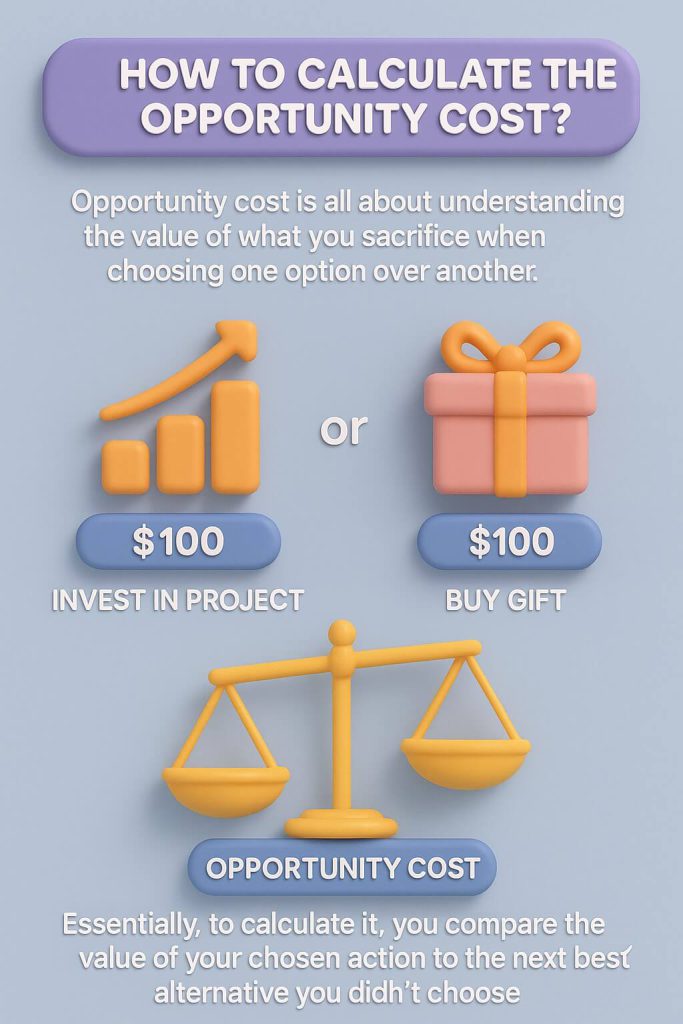
Opportunity cost is all about understanding the value of what you sacrifice when choosing one option over another.
Imagine you have $100 and two options: either invest it in a project or buy a gift. If you choose to buy the gift, the opportunity cost is the potential return you could’ve earned from investing that $100.
Essentially, to calculate it, you compare the value of your chosen action to the next best alternative you didn’t choose.
Opportunity Cost Formula
Opportunity Cost = Return on Best Foregone Option − Return on Chosen Option
To calculate it, you identify the next best alternative that you didn’t choose and subtract the return or benefit of the chosen option.
Opportunity Cost Example
For example, if you decide to invest $1,000 in Stock A with a return of 5%, while Stock B could have returned 7%, the opportunity cost would be:
Opportunity Cost= 7% − 5% = 2%
Using Opportunity Cost in Business Decisions
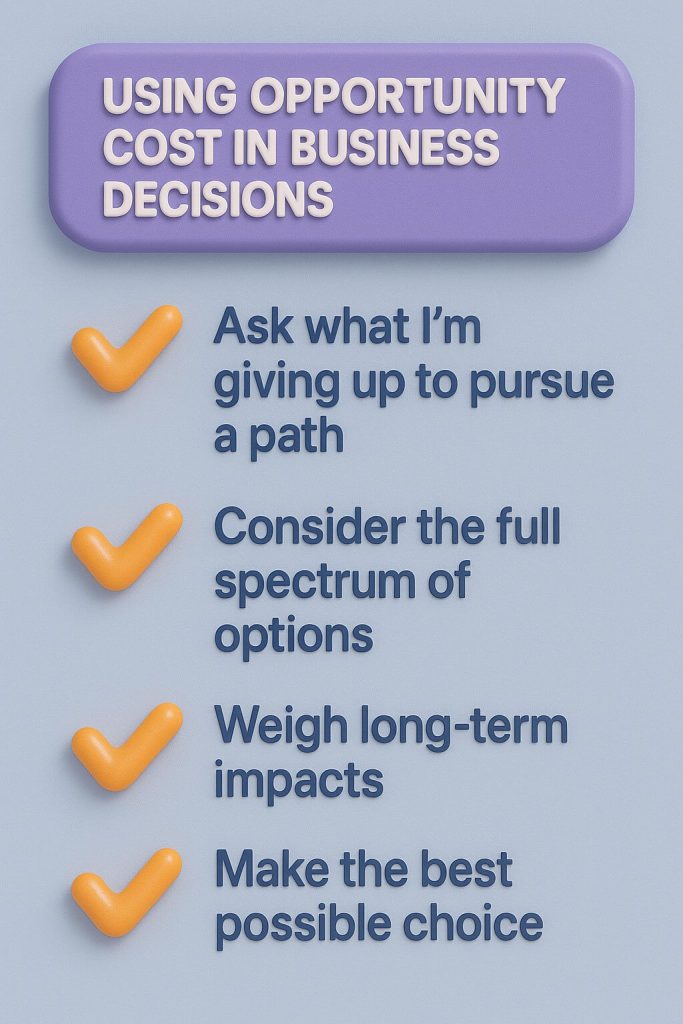
When it comes to business decisions, I constantly ask myself: what am I giving up to pursue this path? That’s where opportunity cost comes into play. It’s not just about the money I’m spending; it’s about the alternative opportunities I’m losing by making a particular choice.
Every time I decide to allocate resources—whether it’s time, capital, or energy—I recognize that there’s a cost to not investing in the next best alternative.
This concept pushes me to think beyond immediate gains and consider the full spectrum of options available. It forces me to weigh the long-term impacts and not just go for the apparent benefits.
By focusing on opportunity cost, I ensure that every decision isn’t only beneficial in itself but is the best possible choice when compared to others I could have made.
This mindset is crucial in avoiding the pitfalls of lost potential and making more informed, strategic decisions that truly align with the long-term growth of the business.
Using Opportunity Costs in Everyday Life
If I decide to spend my Saturday binge-watching a series, I’m sacrificing time that could be used to learn a new skill or meet friends, creating an opportunity cost. I use this mindset to remind myself that each action has an implicit trade-off.
It makes me realize that prioritizing one thing always means de-prioritizing something else. This perspective encourages me to choose more intentionally—selecting the options that add the most value to my life in the long run.
Conclusion
Understanding opportunity cost has reshaped how I approach every decision. By recognizing what I might be giving up, I’m empowered to choose paths that truly align with my goals. I invite you to join me in using this calculator to make more informed and fulfilling choices in our lives.






Responses