
BOFU: 7 Powerful Strategies to Avoid Costly Conversion Mistakes


BOFU (bottom of funnel) is the decision stage of a marketing and sales funnel, where potential customers evaluate their remaining options and decide whether to make a purchase or take another meaningful conversion action. At this stage, effective marketing helps buyers resolve uncertainty rather than simply attracting more attention.
A business may generate plenty of traffic and qualified leads yet lose opportunities because buyers cannot find pricing, understand the differences between products or get answers to final objections. This guide explains how BOFU fits into the customer journey, seven practical conversion strategies, useful content formats and ways to measure whether the decision stage is working.
Content Overview:
What Is BOFU (Bottom of Funnel)?
BOFU stands for bottom of funnel. It describes the point at which a prospective customer has identified a need, considered possible solutions and is evaluating whether to proceed. For an ecommerce business, the desired action may be a completed purchase. For a business selling software or professional services, it may be a qualified demonstration, an accepted proposal or a signed agreement.
Decision-stage prospects often ask about price, availability, implementation, compatibility, contract terms or the differences between competing offers. They might request a demonstration, return to a pricing page, consult a colleague or examine a case study. These signals suggest possible readiness, but they do not establish that a buyer has committed to purchasing.
BOFU marketing matters because the information people need at this stage differs from what first-time visitors need. Someone already comparing two products may not benefit from another introductory blog post. They may need a clear comparison, an explanation of the total cost or evidence that the product can support their particular requirements.
The marketer’s job is to make an informed decision easier. That includes helping an unsuitable prospect recognize the mismatch. More conversions are not automatically better if the business attracts customers it cannot serve or creates expectations it cannot fulfill.
What Is a Conversion Funnel?
A conversion funnel is a model for organizing the steps people take between discovering a business and completing a defined action. The familiar three-stage framework distinguishes awareness, consideration and decision. Marketing and sales teams can use it to plan content, coordinate their activities and identify points where prospective buyers stop progressing.
The funnel is a useful abstraction, not a rule for how people behave. A referral may bring someone directly to a consultation page. A buyer who has already requested a quotation may return to educational content to verify a detail. A purchasing committee may include people who are at different stages of understanding at the same time.
When applying a full marketing and sales funnel, make relevant information accessible at every stage rather than requiring buyers to follow a predetermined path. Define the conversion events that matter to the business, and distinguish intermediate actions such as downloading a document from final outcomes such as becoming a paying customer.
Conversion funnel analysis can then reveal patterns in observed behavior. If visitors begin a checkout but frequently fail to finish it, the problem may be at the decision stage. If few people ever discover the offer, improvements to BOFU alone are unlikely to solve the acquisition problem.
What Is the Difference Between TOFU, MOFU, and BOFU?
TOFU, MOFU and BOFU describe three different buyer needs. TOFU (top of funnel) helps people understand a problem or discover a category. MOFU (middle of funnel) helps them evaluate possible approaches. BOFU supports a decision about a particular offer. Each stage calls for different marketing tactics, content and measures of success.
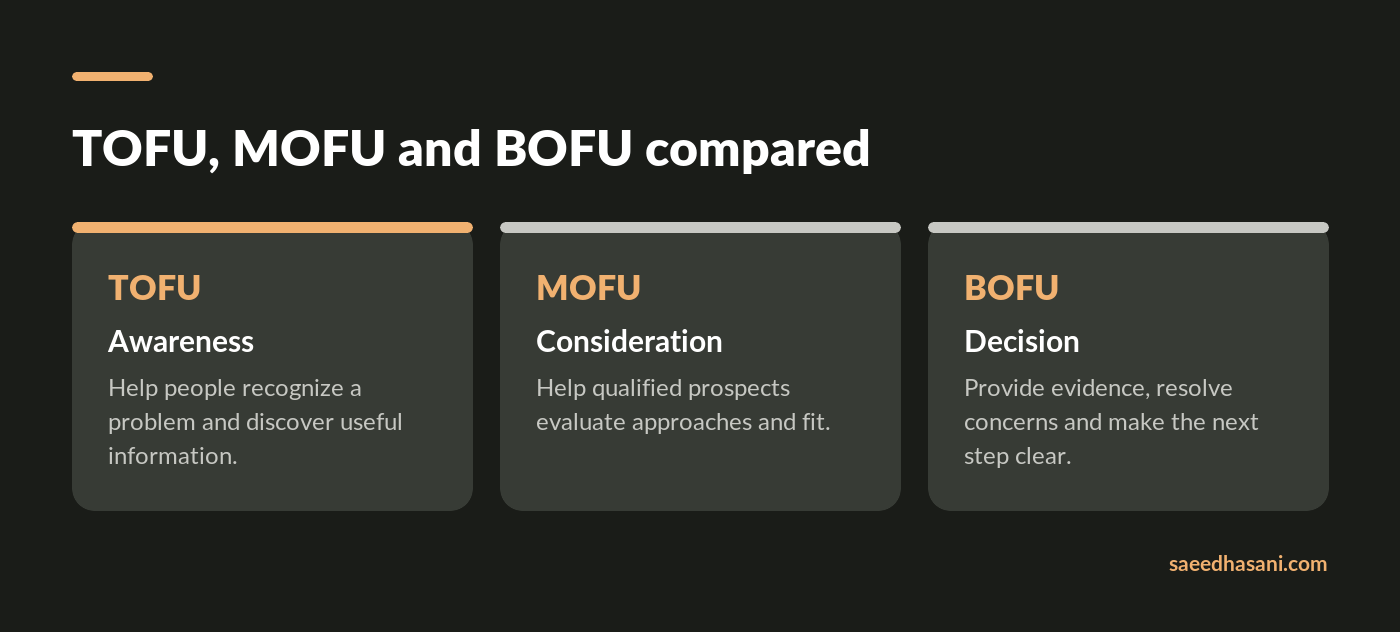
| Stage | Buyer question | Content and tactics | Useful metrics |
|---|---|---|---|
| TOFU: awareness | What is the problem, and what options exist? | Educational articles, social content, introductory videos, broad relevant search content | Relevant reach, impressions, engaged visits, qualified audience growth |
| MOFU: consideration | Which approach fits my requirements? | Guides, webinars, use cases, lead nurturing, solution evaluations | Qualified leads, engagement with evaluation content, stage progression |
| BOFU: decision | Is this particular offer right for me? | Pricing, demonstrations, comparisons, relevant case studies, trials and proposals | Qualified opportunities, purchase conversion rate, win rate, acquisition costs |
Succeeding in TOFU requires relevance and a realistic understanding of the audience. Broad reach can introduce people to a business and support lead creation, but poorly targeted awareness campaigns can consume resources without bringing in people likely to benefit from the offer. Evaluate whether the people reached are appropriate for the business rather than relying on impressions alone.
MOFU focuses on evaluating options. Segment audiences by their needs and known interests, provide useful explanations and personalize communications when appropriate. Track the quality of leads and their progression rather than interpreting every content download as a sales opportunity. A sound lead acquisition marketing strategy connects these efforts to meaningful qualification criteria.
At BOFU, the priority shifts toward reducing the uncertainty and friction associated with a decision. However, buyers at the bottom of the funnel may still read introductory or comparative material. Classify content by the question it answers, not just by the stage label in a marketing calendar.
Making BOFU Convert: 7 Powerful Strategies
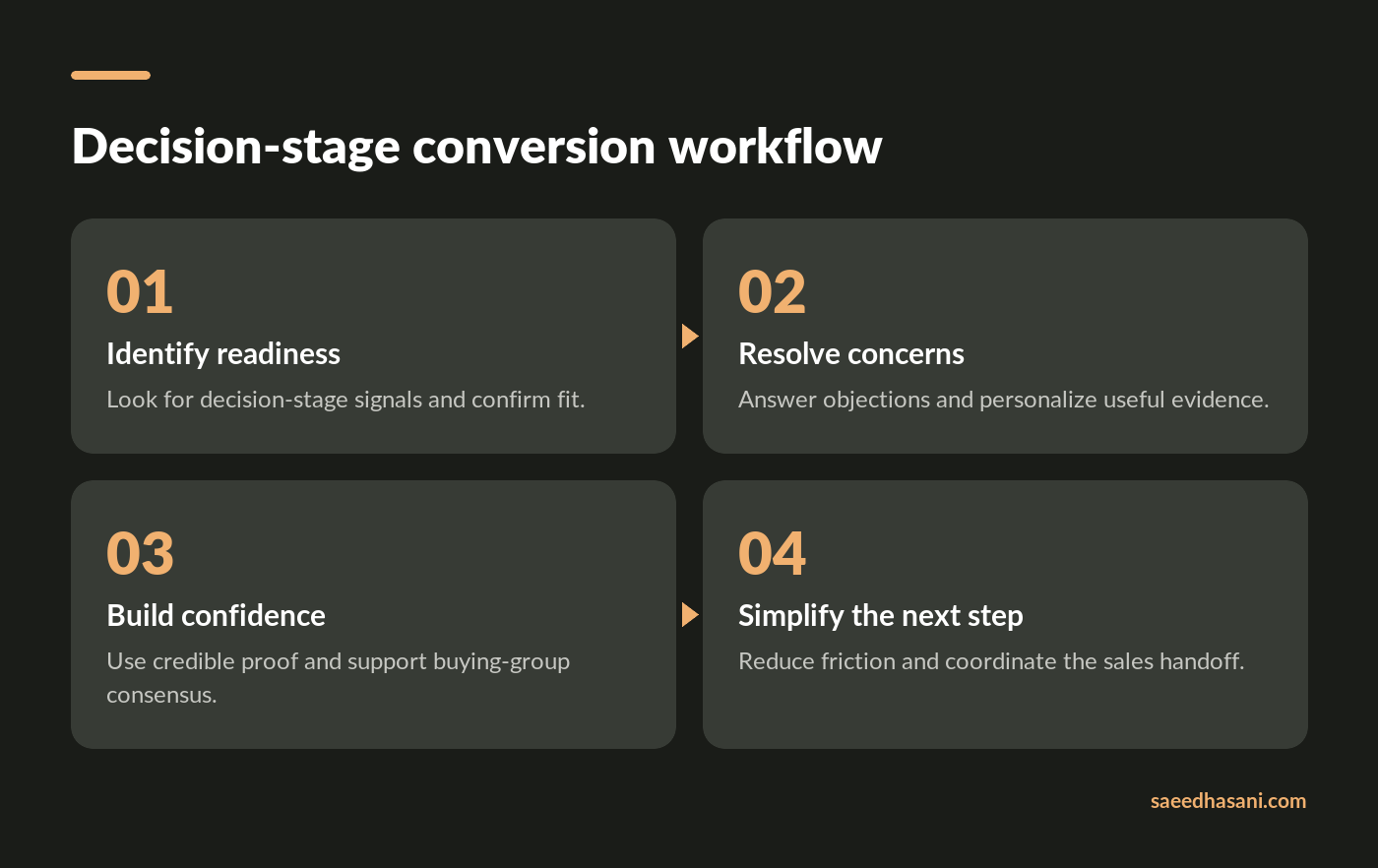
These seven strategies help marketing and sales teams address decision-stage barriers. Start with evidence from customer conversations, sales outcomes and website behavior. A change that helps one business may not help another, so use the strategies as hypotheses to investigate rather than guaranteed conversion improvements.
- Identify decision readiness. Look at signals such as visits to pricing pages, comparison content, requests for quotations and direct questions about implementation. Use agreed qualification criteria to distinguish a genuinely relevant opportunity from general interest. Do not assume that an individual is ready to buy because they clicked one advertisement.
- Address final objections. Review lost deals, customer questions and common support requests. Develop accurate answers to concerns about price, contract length, reliability, compatibility, implementation or service limitations. If a product cannot meet a requirement, state that limitation rather than obscuring it.
- Personalize engagement. Tailor BOFU information to the prospect’s expressed needs, role and use case. For example, send a relevant implementation guide instead of a generic sales email. Respect communication preferences and avoid using sensitive information or inferred characteristics without an appropriate basis.
- Demonstrate credible social proof and truthful urgency. Use genuine customer reviews, permission-cleared case studies and transparent explanations of outcomes. Mention deadlines or limited availability only when they are real and material. Invented countdown timers or fabricated testimonials undermine the trust needed for a decision.
- Enable buying-group consensus. In B2B purchases, different participants may need different information. A finance manager may need total-cost details, a technical reviewer may need integration documentation, and an end user may need a demonstration. Provide shareable resources that help the group discuss the same offer accurately.
- Streamline the purchase process. Check whether pricing, delivery, cancellation terms, booking or checkout steps are clear. Remove unnecessary fields and repair broken buttons. Give visitors a way to ask a question when a self-service purchase is not appropriate. Do not reduce friction by hiding material terms.
- Coordinate marketing and sales. Agree on what constitutes a qualified opportunity, who responds, how requests are routed and how outcomes are recorded. Share the information the buyer has actually provided so the conversation can continue without needless repetition. Use feedback from sales to improve BOFU content.
For a hypothetical software business, these strategies might reveal that prospects understand the product but are unsure about migration. A useful response would be to publish a realistic migration guide, explain which integrations are supported, and offer a demonstration relevant to that workflow. This is more targeted than increasing the advertising budget before investigating the objection.
BOFU Content: What Should Marketing Focus On?
BOFU content helps prospective customers evaluate a specific offer and make an informed choice. Begin by maintaining an accurate source of truth about the product: its features, limitations, pricing terms, supported integrations and actual implementation requirements. Marketing, product and sales teams should agree on this information before publishing decision-stage pages.
| Content type | What it helps buyers evaluate |
|---|---|
| Case studies and testimonials | Relevant customer experiences, with context, permission and clearly described results |
| Product demos and free trials | How the product works and whether it fits the intended workflow |
| Pricing and proposal pages | Included features, total cost, contract terms and available options |
| Comparison and alternatives pages | Differences between credible options, including trade-offs and limitations |
| Best-of guides | Relevant choices evaluated against transparent criteria, without fabricated rankings |
| Integration and implementation pages | Compatibility, requirements, migration and setup responsibilities |
| Decision-stage FAQs and purchase guides | Final objections, support, cancellation, purchasing and next steps |
Product-led content demonstrates how a product solves an actual problem, rather than relying on vague superiority claims. The principles of product-led sales can also help teams use practical product experiences to support evaluation. A demonstration or trial is valuable when it answers a meaningful buyer question and has clearly explained terms.
People may also use AI search systems to compare products or ask for recommendations. BOFU pages should make product information discoverable and understandable, with consistent details, useful comparisons and verifiable evidence. AI-generated answers can vary and contain errors; being mentioned in one answer does not establish that the business will be recommended consistently.
Choose formats according to the obstacle. If customers cannot compare pricing, publishing another case study may not be the best first step. If implementation concerns are causing lost opportunities, integration documentation and a clear onboarding explanation may be more useful than a new discount campaign.
How to Measure BOFU Performance
Measure BOFU by linking decision-stage actions to the outcomes the business actually values. Define a conversion and its denominator before reporting a rate. A completed checkout, a qualified demonstration request and a signed contract are different events; combining them into one number makes it difficult to identify what improved.
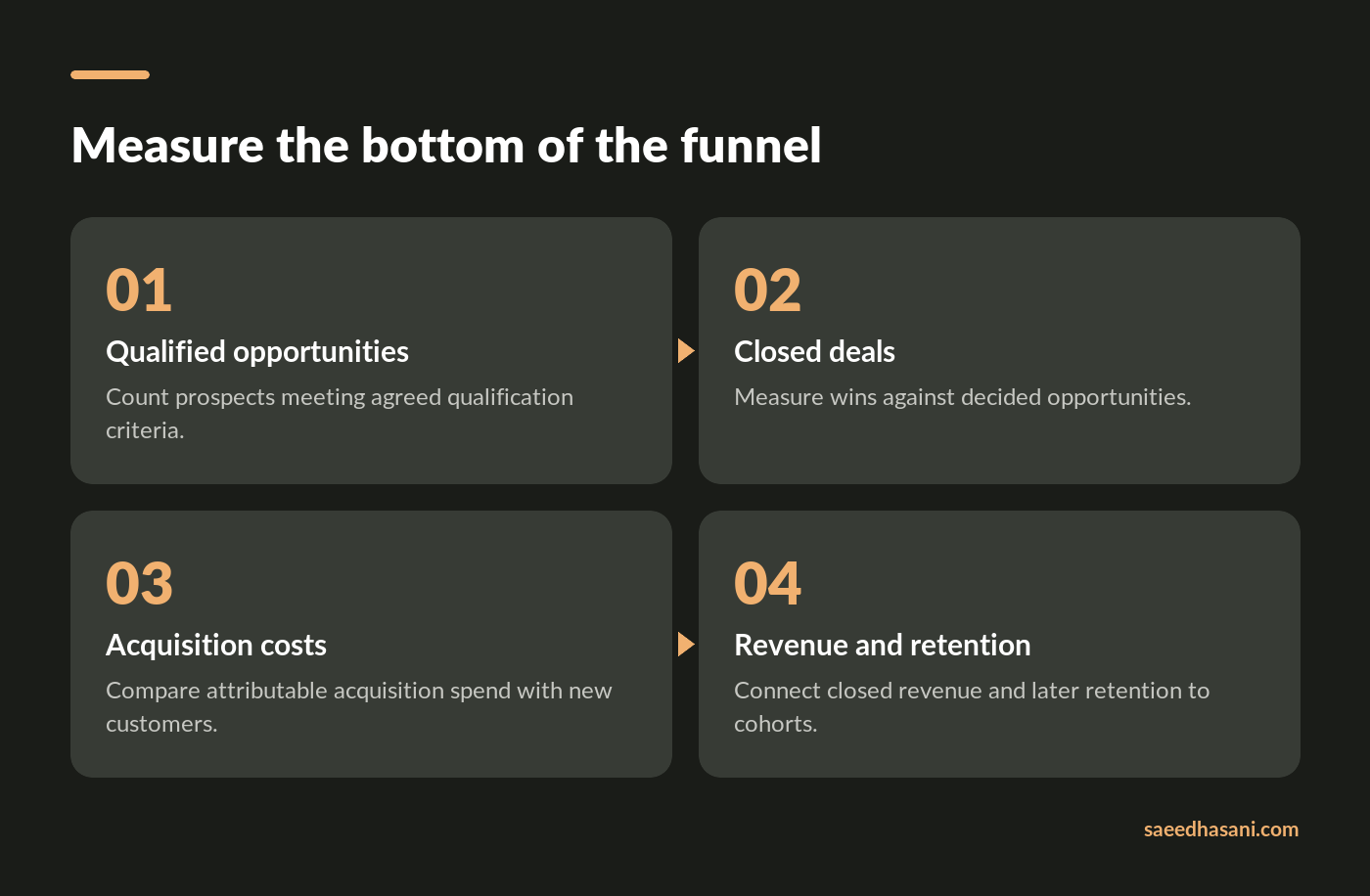
| Metric | Calculation or definition |
|---|---|
| Purchase conversion rate | Purchases divided by eligible sessions or users, using a consistent unit, multiplied by 100 |
| Qualified opportunities | Prospects meeting the agreed qualification criteria |
| Win rate | Closed-won opportunities divided by closed-won plus closed-lost opportunities, multiplied by 100 |
| Cost per acquisition (CPA) | Relevant campaign spend divided by the defined acquisition events |
| Customer acquisition cost (CAC) | Defined sales and marketing acquisition costs divided by new customers for a compatible cohort or period |
| Pipeline and revenue | Value of relevant open opportunities and separately recorded closed sales |
For example, suppose a cohort contains 100 qualified opportunities, with 20 closed-won, 60 closed-lost and 20 still open. The win rate among decided opportunities is 25% (20 divided by 80), not 20%. The open opportunities have not yet reached a decision. If defined acquisition costs for the cohort were $10,000 and it produced 20 new customers, the illustrative CAC would be $500. These numbers are hypothetical, not industry benchmarks.
Use Google Analytics funnel exploration to investigate event sequences and drop-off points when reliable event tracking is available. Connect aggregate analytics to CRM or transaction outcomes where lawful and feasible. Align dates, definitions and identifiers across channels so TOFU, MOFU and BOFU reporting describes compatible populations.
Do not confuse click-through rate and conversion rate. A high click-through rate can reflect curiosity rather than purchase readiness. Similarly, a campaign associated with a final click may not have caused the sale independently of earlier marketing and sales interactions. Compare cohorts, record attribution assumptions and use controlled tests when feasible.
How to Analyze Your Competitors’ Conversion Funnel
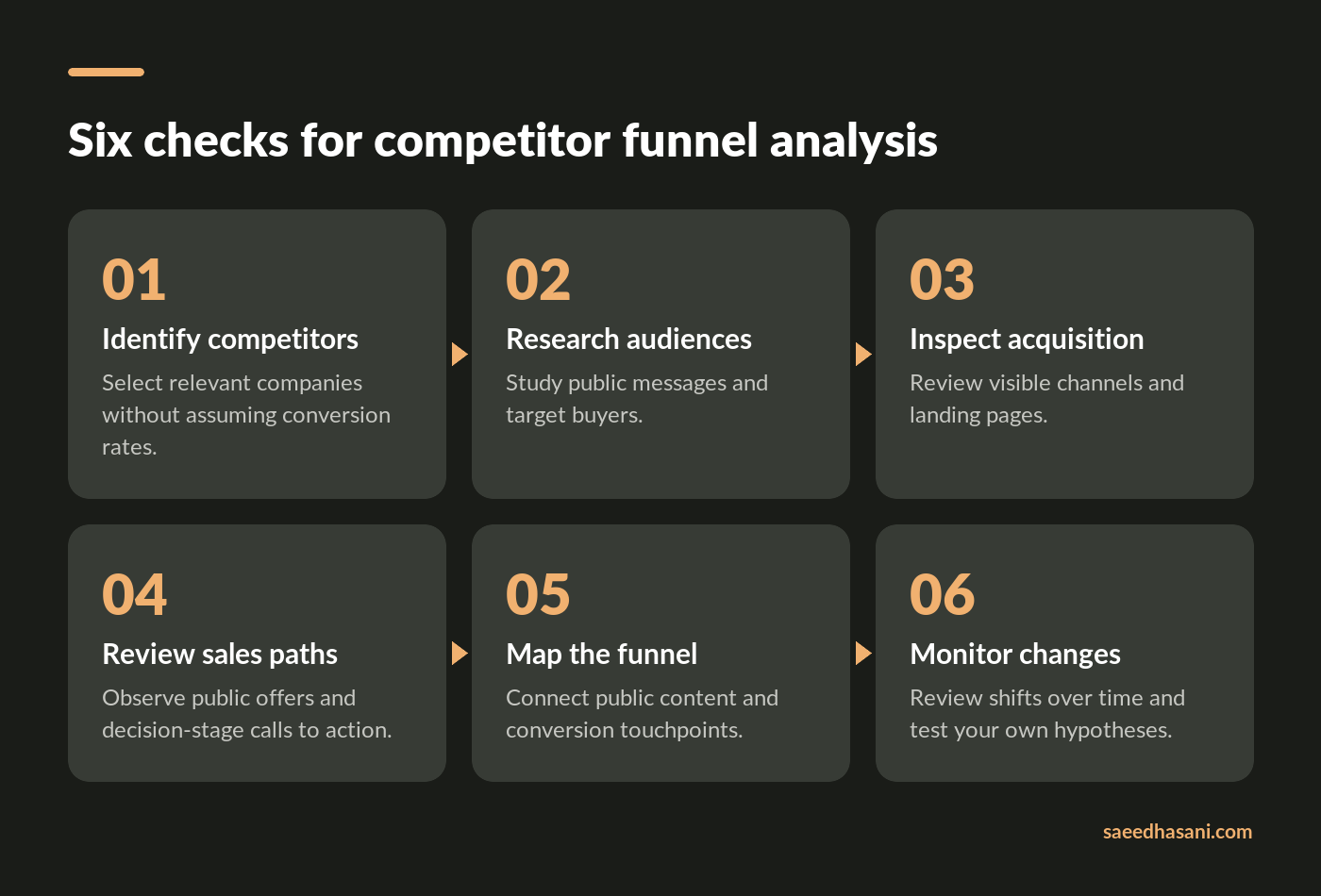
Competitor analysis can reveal how other businesses communicate with potential buyers at different stages. Publicly observable activity is not the same as private performance data. Use the findings to form hypotheses about your own funnel, not to declare which competitor converts best without reliable evidence.
- Identify relevant competitors. Select businesses offering plausible alternatives to your target customers. Consider credible public evidence of results where it exists, but do not label companies top-converting without verified figures.
- Research competitor audiences. Review positioning, customer examples and the questions their pages answer. Identify the buyer roles and use cases they address.
- Find visible acquisition channels. Examine public search results, advertisements, social content and referral opportunities. Traffic estimates are directional rather than exact.
- Discover how competitors close sales. Review public pricing, product trials, consultation pages and checkout pathways. Do not misrepresent yourself to obtain confidential information.
- Map their funnel structure. Connect awareness content, evaluation resources and BOFU touchpoints. Note which questions are answered and which decisions require sales assistance.
- Monitor changes. Revisit public campaigns and offers periodically, document changes and test relevant ideas against your own data.
For instance, a competitor might provide detailed comparisons and integration guides that your own website lacks. This suggests a possible information gap, not proof that copying those pages will increase sales. Confirm whether buyers actually need that information and produce accurate resources that reflect your own offer.
Optimizing Your TOFU, MOFU, and BOFU Strategy
A content marketing audit helps identify where the funnel has useful information and where buyer questions remain unanswered. Review every important resource by its intended audience, purpose, accuracy, next action and observed performance. A page can support more than one stage, so avoid assigning a rigid label when its role is broader.
For TOFU, assess content relevance, engagement metrics and persona alignment. Ask whether the material reaches people whose needs match the business. For MOFU, review lead quality, evaluation content, conversion to appropriate next steps and personalization. For BOFU, examine conversion efficiency, objection handling, the clarity of offers and the quality of customers acquired.
Assign owners to fix the identified gaps. Begin with the highest-impact problem that the evidence supports. If relevant prospects repeatedly abandon a quotation request because the form is confusing, test a clearer process before investing in more acquisition. If there are too few qualified prospects reaching the decision stage, revisit awareness and qualification instead.
Record a baseline and a clear success measure before testing. An illustrative ROI assessment might compare an incremental $2,000 in contribution profit with $1,000 in incremental marketing costs, producing a hypothetical 100% return on that incremental investment. The estimate depends on the actual costs, margins, attribution and time period; it is not a prediction or a guarantee. Review post-sale engagement as well to avoid optimizing for short-term conversions at the expense of customer fit.
Going Beyond BOFU
The purchase is not the end of the customer journey. A new customer may need onboarding, implementation support, training or help understanding the next steps. Clear expectations established at BOFU should carry through to delivery rather than disappearing after a contract is signed.
Coordinate handoffs between sales and customer-facing teams, communicate what was promised and make appropriate support resources available. Where relevant, track activation, repeat purchases, renewals, retention, customer satisfaction and voluntary referrals separately from new-customer acquisition. These measures help reveal whether the business is attracting customers it can serve sustainably.
Customer feedback can also identify gaps in decision-stage marketing. If new customers frequently misunderstand a feature, clarify that feature in the relevant comparison or product page. If onboarding questions repeatedly appear after purchase, explain the process earlier. A well-managed funnel supports the entire relationship rather than treating every buyer as a one-time conversion.
Frequently Asked Questions
What Is the Difference Between Lead Generation and Demand Generation?
Demand generation aims to build interest and awareness among relevant audiences. Lead generation captures identifiable interest through an appropriate action, such as an inquiry or signup. Neither guarantees a sale; qualification and decision-stage support remain necessary.
What Kind of Content Works at the Top of the Funnel?
Useful introductory articles, educational videos, research summaries and explanations of common problems can help people understand their needs. The format should match the audience’s questions rather than simply maximize reach.
How Long Does It Take for Leads to Move Through the Funnel?
There is no fixed duration. A straightforward purchase may take minutes, while a complex B2B decision may involve lengthy evaluation and multiple people. Measure actual time between defined stages for comparable customer groups.
What Is the Best Way to Move a Potential Customer From MOFU to BOFU?
Provide relevant information that helps the buyer evaluate fit, such as a use case, product demonstration or transparent pricing. Make the next step available without pressuring someone who is not ready or whose needs do not match the offer.
What Happens After the Bottom of the Funnel?
After a purchase, the focus moves to onboarding, delivery, customer success and retention. A prospect who decides not to buy may remain eligible for appropriate future communications if they have agreed to receive them. Use the outcome to improve the marketing and sales process.






Responses