
Digital Marketing Audit: 7 Proven Checks to Avoid Costly Gaps


A digital marketing audit is a structured review of how your website, search visibility, content, social channels, advertising and measurement systems support business goals. It reveals where performance is falling short, where evidence is missing and which opportunities deserve attention first.
For a small business, the most useful audit does more than list problems. It connects customer journeys to meaningful outcomes, such as qualified inquiries, appointments or sales. This guide explains how to set a reliable baseline, conduct four practical audit steps, evaluate seven key areas and turn your findings into a prioritized action plan without confusing assumptions with proven results.
Content Overview:
What’s a Digital Marketing Audit?
A digital marketing audit examines the strategy, execution and results of your online marketing activities. Unlike a routine performance report, which tells you what happened, an audit asks why your approach may be working or failing, whether the measurement is trustworthy and what should change.
Consider six interconnected pillars: strategy, goals and measurement, audiences, channels, customer experience and optimization. A weakness in one can affect the others. For example, a campaign may attract the right people but send them to an unclear landing page, or a reporting error may make a productive campaign appear ineffective.
The audit should establish what you know, what you suspect and what you still need to investigate. Its scope may encompass the entire marketing operation or a selected set of channels that contribute to a specific business objective. The important distinction is that a digital marketing audit examines how the pieces work together, rather than judging each metric in isolation.
When Is a Digital Marketing Audit Necessary, and Why Does It Matter?
An audit is valuable when business goals change, inquiries decline, advertising costs rise, tracking becomes inconsistent or a team introduces a new channel. It also helps when results look healthy but the business cannot explain which activities contribute to them.
Ask whether your marketing attracts the intended customers, whether those visitors take meaningful actions and whether the resulting opportunities justify the investment. A rise in traffic alone does not prove improvement if qualified leads are declining.
For example, a company may notice that its advertising report shows more conversions while the sales team receives fewer genuine inquiries. A digital marketing audit can identify whether the discrepancy comes from duplicate tracking, changing lead quality, reporting definitions or another issue. Investigate those explanations before changing the budget.
Regular assessment helps teams avoid spending resources on the wrong problems. It does not guarantee higher rankings, lower costs or increased sales; those outcomes depend on implementation and market conditions.
How to Conduct a Digital Marketing Audit: 4 Steps
Harvard Business School Online describes a useful four-step approach. Adapt it to your business by agreeing on the purpose of the review with the people responsible for marketing, sales and website operations.
- Define clear objectives. Identify the business outcome, the questions you need answered and the channels within scope.
- Evaluate current performance. Collect comparable data, examine the website and channels, and confirm that your tracking measures what it claims to measure.
- Identify opportunity gaps. Compare performance with objectives. Record the evidence, possible causes and missing information for each gap.
- Implement improvements. Assign owners and deadlines, establish a success measure, and review the results after the changes have had sufficient opportunity to take effect.
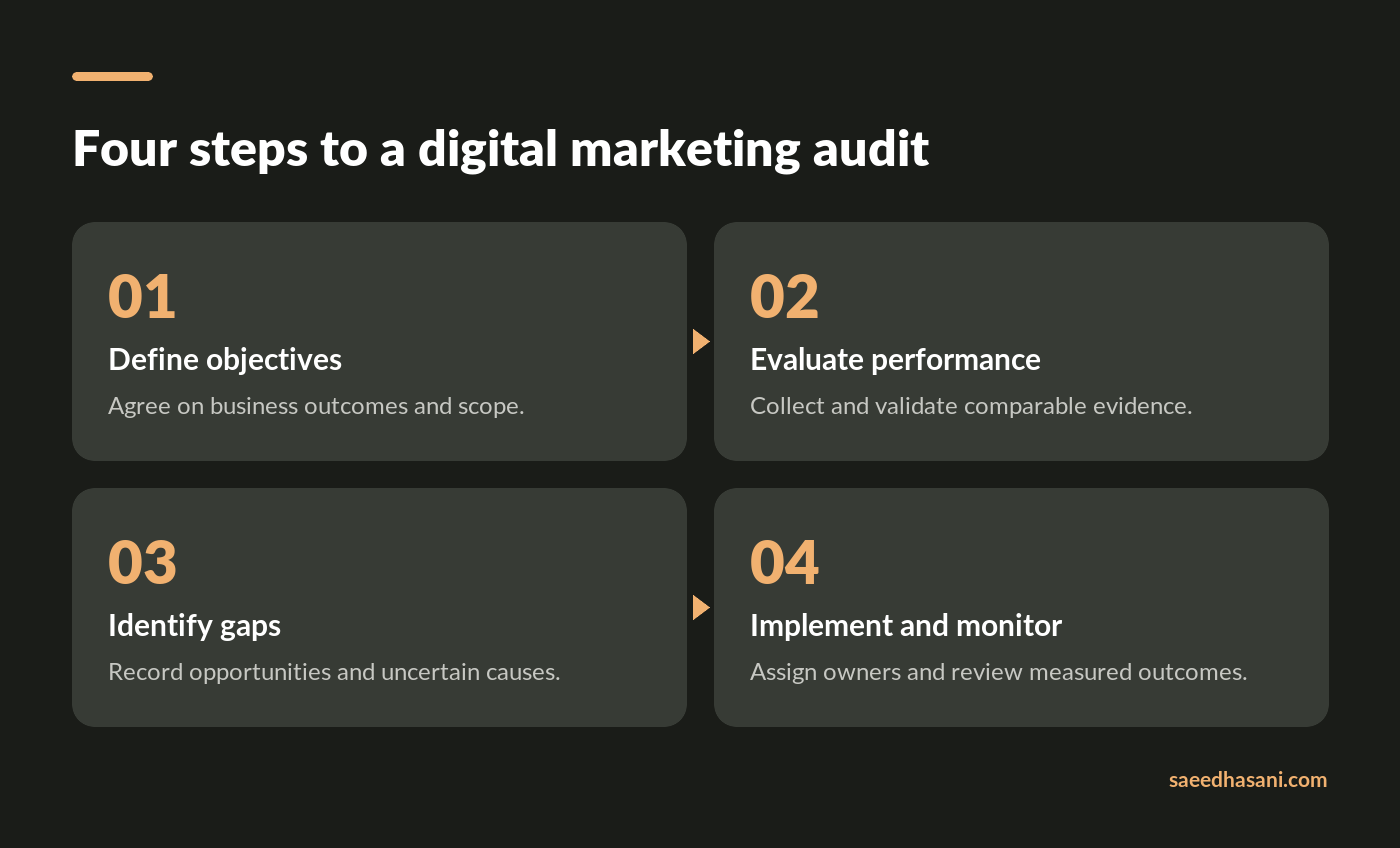
Start your digital marketing audit by agreeing on the objective, rather than purchasing a tool or immediately changing campaign settings. Prepare a shared list of the accounts, reports and website properties you need to inspect. Confirm that team members have the necessary access without requesting or sharing passwords. Record any data you cannot obtain so the final recommendations reflect the actual evidence available.
How Do You Set Goals, Baselines and Audit Scope?
Choose a reporting period appropriate to your sales cycle. For instance, compare the most recent 90 days with a similar earlier period, considering seasonal differences. Record the date range, account, channel owner, metric definitions and data sources so that the baseline can be reproduced.
| Goal | Example KPI | Evidence to check |
|---|---|---|
| Increase discovery | Relevant organic impressions and clicks | Search Console query and page reports |
| Improve engagement | Meaningful content interactions | Analytics events and audience context |
| Generate inquiries | Qualified leads and cost per qualified lead | CRM records and campaign costs |
| Improve sales outcomes | Closed sales and attributable revenue | Sales records, attribution rules and reporting windows |
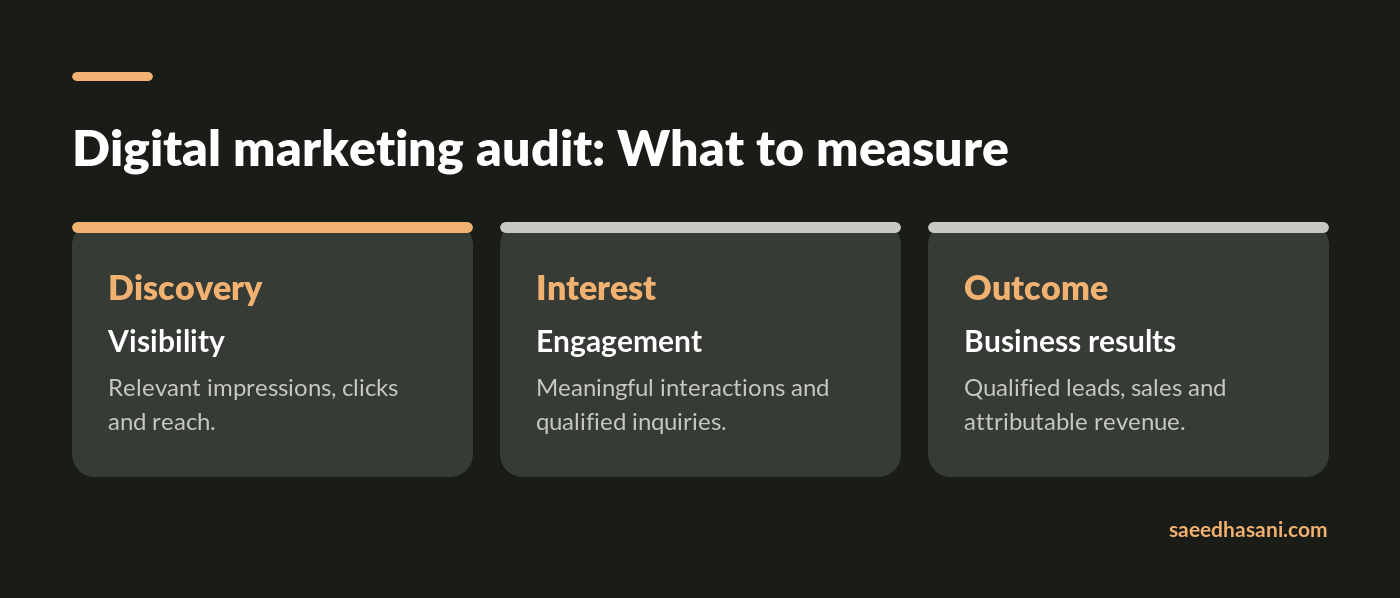
Traffic, engagement, leads and revenue represent different stages. Define a qualified lead with sales before measuring lead quality. Validate event tracking, exclude test submissions where practical and document the limitations of cookies, consent settings and cross-device attribution. Do not expect advertising platforms and analytics tools to report identical totals.
During a digital marketing audit, compare like with like. A local service company should not evaluate a seasonal campaign against a period with a different service mix without documenting that difference. If reporting systems use different time zones, attribution windows or conversion definitions, reconcile them where possible and disclose remaining limitations.
What Are the Seven Parts of a Digital Marketing Audit?
Use this digital marketing audit checklist to organize your evidence and avoid overlooking important channels. Give each check a status such as verified, needs investigation or needs correction, rather than assigning a numerical score that suggests unsupported precision.
- Website and user experience: test mobile usability, page performance, navigation and forms.
- SEO and search visibility: assess indexing, relevance and organic search performance.
- Content: identify useful assets, stale information and missing topics.
- Social media: evaluate audience relevance, organic reach and engagement.
- Paid advertising: review targeting, spend, creative and landing pages.
- Conversion paths and analytics: validate tracking and examine steps from discovery to inquiry or purchase.
- Competitors and channel reach: compare observable market positioning and audience opportunities.
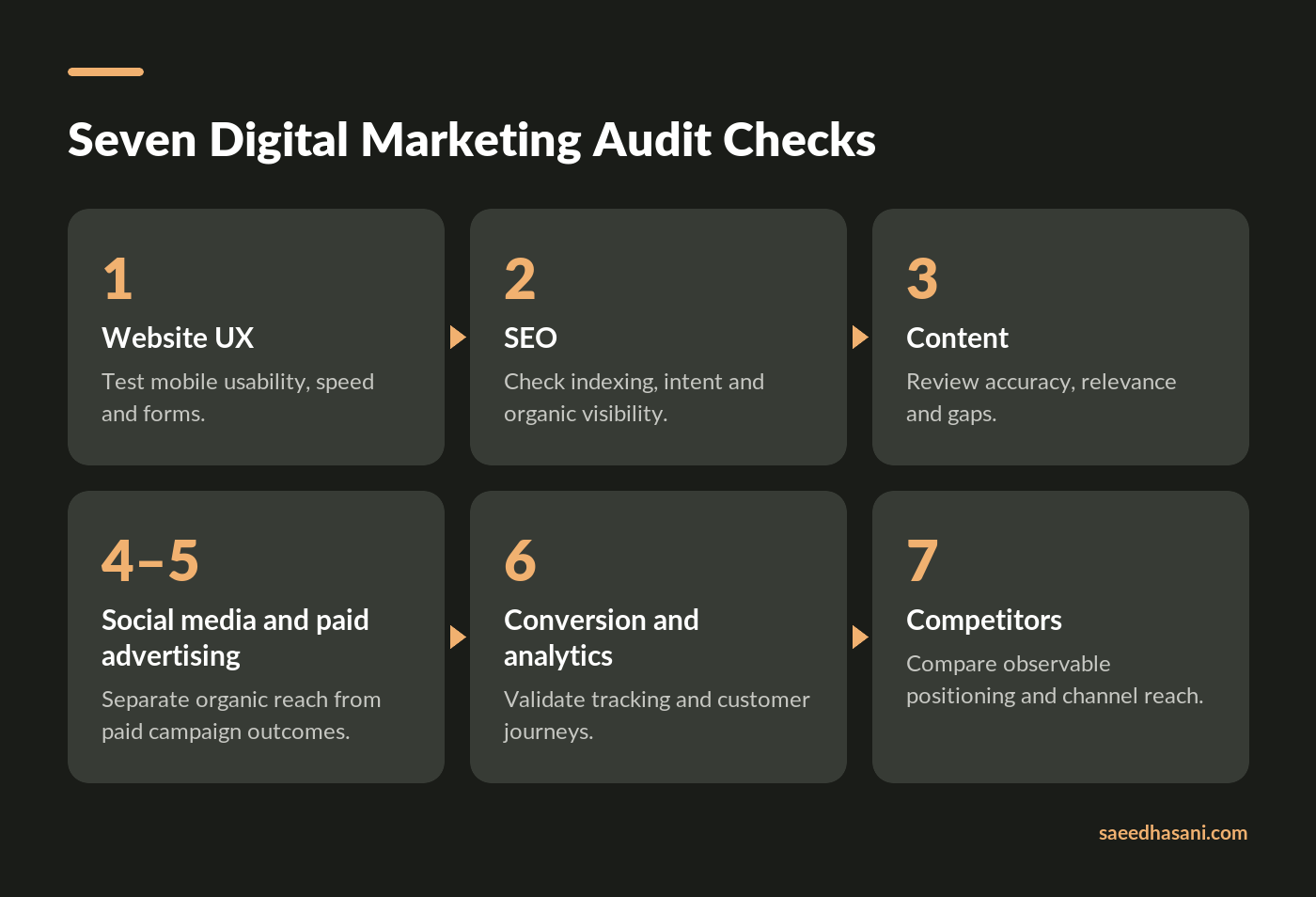
The following sections explain how to investigate these checks in practice, including the increasingly relevant question of AI-assisted search visibility. Some checks will reveal issues that affect multiple channels. Document those shared dependencies once and connect them to the relevant findings instead of assigning several teams to solve the same underlying problem independently.
Auditing the Website: Usability, Performance and Conversion Paths
Start with a real customer task on both desktop and mobile: find a service, understand the offer and submit a test inquiry. Check navigation, readability, accessibility basics, broken links, unexpected redirects, layout shifts, page loading and form validation. Examine whether users receive a useful confirmation and whether the inquiry reaches the correct person.
Technical performance needs ongoing attention because deployments, plugins and third-party scripts can introduce new problems. Unresolved crawl errors and other technical flaws can also contribute to reduced search visibility. Diagnose them rather than assuming every slow page or ranking decline has the same cause.
For conversion paths, compare entry pages, intermediate steps and completed actions. Validate each important event against actual submissions or orders. If visitors abandon a form, inspect the experience and test potential causes before concluding that a particular field is responsible. Related ideas for improving conversion rates can help you explore follow-up and process improvements.
Record device, browser, page URL, reproduction steps and expected behavior when the digital marketing audit identifies a technical defect. This gives the development team enough information to investigate and creates a repeatable test for confirming the fix.
Auditing SEO and Changing Search Behavior
Review crawlability, indexability, XML sitemaps, canonical URLs, redirects and internal links. Check title tags, headings, useful content and alignment between a page and the search intent it targets. Distinguish technical SEO and content SEO when diagnosing problems: a technically accessible page may still be a poor answer to a searcher’s question.
Use the Google Search Console documentation to understand how to investigate organic impressions, clicks, indexing and performance. Compare relevant queries and pages over consistent periods and investigate changes in impressions, click-through rate and average position together. Average position is not a fixed rank for every searcher.
Search behavior is also influenced by results such as maps, videos, shopping panels and AI-assisted answers. Review the actual result types for representative queries and consider how they change the discovery journey. Keep paid search performance separate from organic search. A drop in clicks with steady impressions warrants investigation, not an automatic conclusion that your content is outdated.
An SEO audit within a digital marketing audit should also consider branded and non-branded queries separately. Growth in searches for your company name may indicate stronger brand demand, while changes in non-branded discovery can help identify whether your content is reaching people unfamiliar with your business.
How Do You Audit AI Search Visibility?
AI search visibility describes whether and how a business or its content appears in AI-assisted answers. It is not a single universally standardized metric. Results can vary by platform, prompt, location, date and account settings.
For the AI visibility component of a digital marketing audit, build a small set of representative customer questions, test them consistently and record the platform, date, prompt, brand mention, cited URLs and accuracy of the response. Repeat the tests periodically. Distinguish a brand mention from a citation, a website visit and a genuine business conversion.
Investigate incorrect information and make important business facts clear and consistent on your own website. Compare findings with available first-party analytics, but recognize that not every AI interaction generates a measurable referral. Neither a digital marketing audit nor any content change guarantees that an AI system will mention your business.
Auditing Content and Content Marketing
Create an inventory of important articles, service pages, guides and other assets. Record their target audience, purpose, search intent, last substantive update, performance and intended next action. Read the content itself instead of relying exclusively on traffic numbers.
Look for missing questions, unsupported claims, outdated advice and pages that overlap substantially. Assess whether each asset helps users at an appropriate stage of their journey. A low-traffic page can still be useful if it answers a specific question for prospective customers.
Assign an action to each asset: retain, update, consolidate or investigate a missing topic. Before consolidating or removing pages, consider existing traffic, links and the effect on users. Measure the outcome of substantial updates rather than simply counting published articles. Use the digital marketing audit to identify which content investments support existing priorities rather than building an editorial calendar around search volume alone.
Auditing Social Media Performance and Reach
Review the audience each social channel attracts, publishing consistency, content formats, brand messaging and the quality of engagement. Separate organic reach from boosted posts and advertising. Assess meaningful comments, relevant profile visits, referral traffic and qualified inquiries rather than treating likes as sales.
Compare equivalent reporting periods and account for differences in posting frequency or campaign activity. Examine a sample of high- and low-performing posts to identify patterns in subject matter, format and audience relevance.
If a channel generates engagement but few qualified visits, test more relevant messages or clearer next steps. Use consistent campaign tracking parameters for links where appropriate and avoid giving a channel sole credit for conversions that involved multiple touchpoints. A digital marketing audit should consider the role of social media in brand discovery as well as directly measured conversions.
Advertising Audit: Spend, Targeting and Performance
Review campaign objectives, budgets, targeting, search terms where available, placements, creative and landing-page alignment. Confirm that the conversion actions used to optimize campaigns represent meaningful business outcomes. Check for duplicate events and discrepancies between advertising platforms and sales records.
Use measures that match the campaign objective. For a lead-generation campaign, calculate cost per qualified lead by dividing campaign spend by the number of qualified leads attributed under a documented measurement rule. For example, $600 in spend divided by 12 qualified leads equals $50 per qualified lead. This is an illustrative calculation, not a recommended benchmark.
Investigate high-cost segments and potential wasted spend with sufficient evidence. Test changes in a controlled way, accounting for conversion delays and limited sample sizes. Avoid pausing a campaign solely because an isolated short-term metric looks unfavorable.
Include the cost of servicing leads when the necessary information is available. If one campaign produces inexpensive inquiries that rarely become customers, another campaign with more expensive but better-qualified inquiries may be more valuable. Evaluate the full customer journey during your digital marketing audit instead of optimizing only the first conversion.
How Do You Compare Against Competitors?
Choose competitors that serve a comparable audience or compete for the same relevant searches. They do not have to be the largest companies in your industry. Review their public positioning, service explanations, topic coverage, search result presence and social messaging.
Use competitive analysis to find unanswered customer questions and opportunities to differentiate your business. Record public observations with dates and compare them with your own baseline. If third-party tools estimate traffic or rankings, treat those estimates as directional rather than exact.
Do not assume competitors’ actual marketing budgets, conversion rates, profitability or private customer data from their public activity. Copying a successful-looking campaign without understanding its objectives or economics can lead to the wrong decisions. The digital marketing audit should identify opportunities to serve your customers better, not simply imitate other businesses.
How Do You Turn Audit Findings into Priorities?
A useful digital marketing audit ends with decisions. For each finding, document the evidence, business impact, urgency, confidence in the diagnosis, estimated effort, responsible owner and measurement plan. Prioritize broken measurement or conversion functionality before experiments that depend on those systems.
| Illustrative finding | Next action | Success measure |
|---|---|---|
| Inquiry events fire twice | Analytics owner tests and corrects event implementation | One recorded event per valid test submission |
| Mobile inquiry form fails | Website owner reproduces and fixes the error | Successful test submissions on supported devices |
| Relevant content receives impressions but few clicks | SEO owner investigates query intent and tests title improvements | Comparable organic performance after sufficient observation |
| Paid campaigns attract unqualified leads | Marketing and sales review targeting and qualification together | Cost per qualified lead under consistent rules |
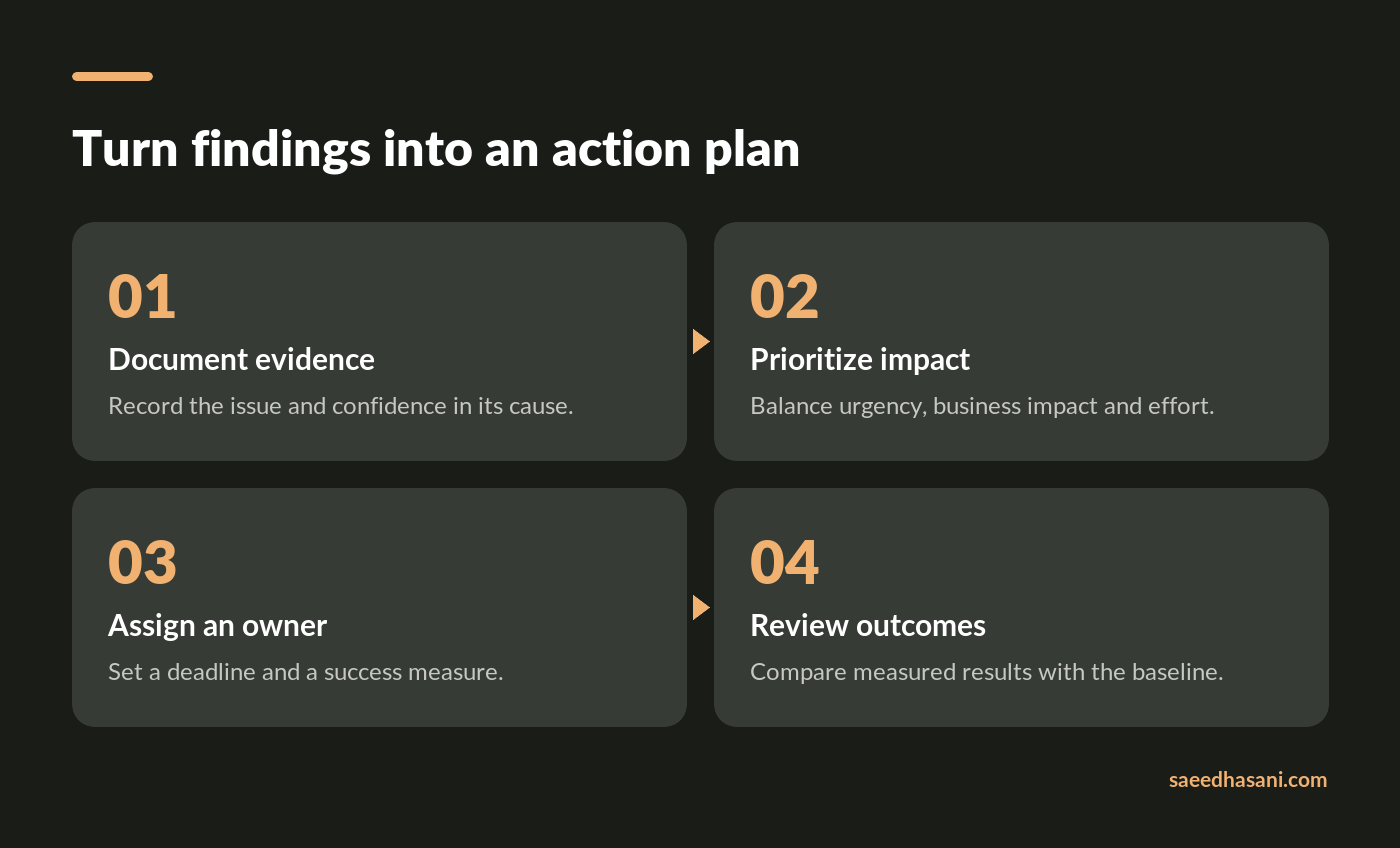
Distinguish quick corrections from larger experiments. Set a review date and record the baseline before implementation so the team can evaluate the change. A shared digital marketing audit action plan should contain the evidence, priority, owner and outcome measure, not just a list of recommendations. When presenting an SEO audit, connect the technical findings to these business decisions.
For a small team, select a manageable first group of actions. A broken contact form may need immediate attention, whereas a new content cluster may require planning and sustained implementation. Mark low-confidence observations as hypotheses, specify how to test them and avoid treating estimated financial impact as a measured result.
How Often Should a Brand Run a Digital Marketing Audit?
The appropriate cadence depends on spending, traffic, the rate of website changes, available resources and business risk. A small business might use monthly checks for tracking and channel performance and a broader quarterly review, adjusting that schedule to its needs rather than treating it as a universal requirement.
Consider an additional digital marketing audit after a website migration, a major campaign launch, a tracking change or a noticeable drop in business performance. Between comprehensive audits, monitor agreed KPIs and unresolved actions, and investigate unexpected changes promptly. Keep a record of the previous audit and completed actions so the next review can distinguish persistent problems from new ones.
Frequently Asked Questions
What Is the Most Overlooked Part of an Audit?
Measurement validation is easy to overlook. Before drawing conclusions from a dashboard, test key events and compare reported conversions with actual inquiries or sales. Unreliable data can distort decisions across otherwise well-managed channels.
What Tools Does a Basic In-House Audit Need?
Start with Search Console, website analytics, advertising and social platform reports, a CRM or sales record, a browser and a spreadsheet. Add a website crawler and performance testing tools where appropriate. The best tool set for a digital marketing audit depends on your channels, budget and audit questions.
How Long Does a Digital Marketing Audit Take?
There is no universal duration. A narrow review may take a few hours, whereas a detailed cross-channel audit can take days or weeks, depending on account access, website size, data quality and how much validation is required. Define the scope before estimating the work.
What Should a Digital Marketing Audit Produce?
It should produce a reliable baseline, documented findings, prioritized opportunities and a practical implementation plan with owners, deadlines and success measures. It should also identify uncertain findings that require further investigation. The value of the audit comes from turning that evidence into measurable decisions.







Responses