
Social Media Marketing: 9 Powerful Steps to Avoid Costly Mistakes


Social media marketing is the practice of using social networks to reach relevant audiences, share useful content, develop customer relationships and support business goals. It includes organic publishing, community management, paid advertising and measurement. The goal is not necessarily to collect more followers. It is to help the right people discover, understand and interact with your business.
A successful social media marketing strategy connects audience research, platform selection, content and commercial outcomes. A company that publishes every day but receives few qualified enquiries may need to improve its offer, targeting or customer journey rather than increase its posting frequency.
This guide explains how social media marketing works, how to select platforms, how to build a nine-step strategy, and how to measure performance while avoiding unnecessary spending and reputational mistakes.
Content Overview:
What Is Social Media Marketing (SMM)?
Social media marketing (SMM) is a discipline within digital marketing that uses social platforms and online communities to communicate with customers and prospective customers. A business can use it to introduce a brand, explain a service, demonstrate products, respond to questions, generate enquiries or support existing customers. Social media management describes the operational work of planning, publishing, monitoring and responding across accounts; marketing connects that work to a defined business objective.
Early social networks were primarily spaces for personal communication and online communities. Over time, businesses developed publishing programs, dedicated advertising capabilities, creator partnerships and customer service channels. Mobile devices, video formats, social shopping and recommendation systems further expanded how people discover information and interact with brands. The underlying opportunity in social media marketing remains a two-way relationship: customers can contribute to the conversation instead of simply receiving a message.
Three categories help explain the different ways a business can reach people through social media marketing.
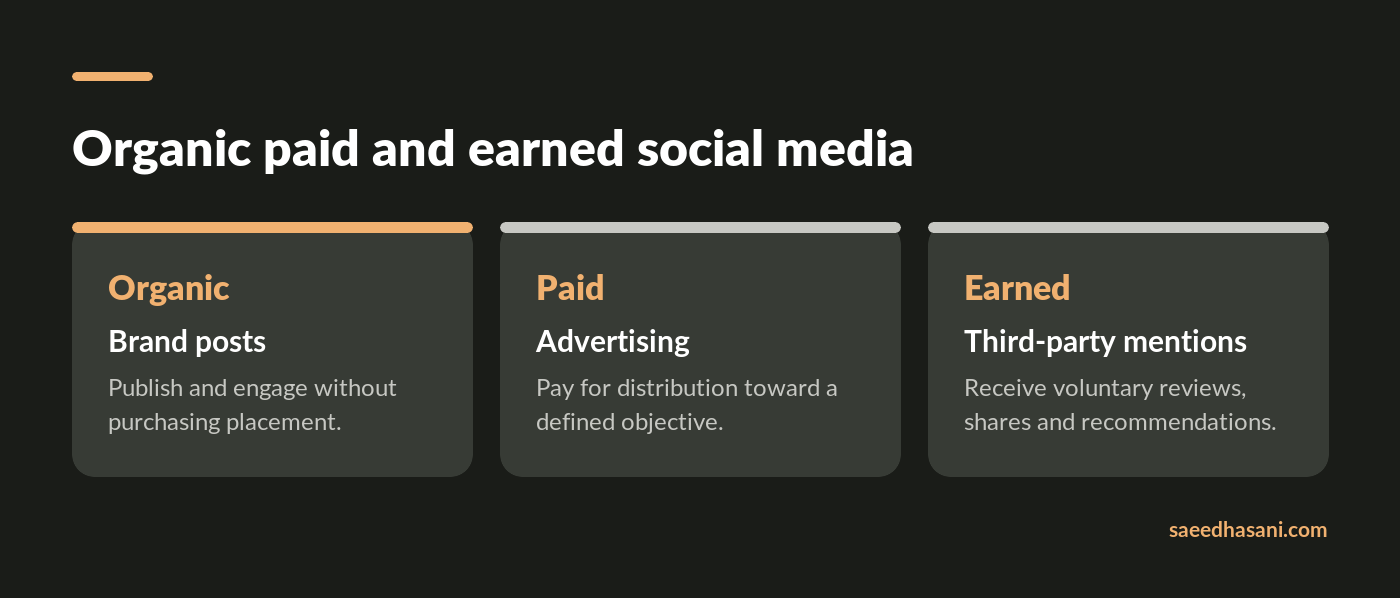
- Organic social media: a brand publishes content and participates in conversations without purchasing the placement of those posts. Creating and managing the content still requires time and resources.
- Paid social media: an advertiser purchases distribution, often selecting an objective, audience, budget and creative through a platform’s advertising tools.
- Earned media: exposure occurs through independent mentions, voluntary reviews, recommendations and shares. A paid creator endorsement is not purely earned exposure, even if the creator uses a personal account.
These activities can complement one another. A useful organic tutorial may be shared by customers, while a paid campaign can introduce it to an eligible new audience. Social media marketing is one part of a broader digital marketing strategy, which can also include search, email, websites and other channels. A business should maintain ways to reach customers outside platforms it does not control.
How Social Media Marketing (SMM) Works
Social media marketing combines research, communication and customer relationships. A passive approach involves monitoring publicly available conversations and relevant feedback to understand customer needs. An active approach involves publishing, replying, advertising and participating in communities where the organization has something useful to contribute. Both approaches help identify opportunities and risks.
For example, a neighborhood furniture retailer may observe recurring questions about the size of sofas in small apartments. It can publish a measurement guide, demonstrate a compact product in a realistic setting, answer questions and direct interested people to a relevant product page. The company learns from feedback while helping prospective buyers make a more informed decision.
Customer segmentation in social media marketing helps businesses tailor content and campaigns to distinct needs. An existing customer may need support or product instructions, while a prospective customer may need a comparison or price explanation. Segment according to relevant behavior, customer needs or other appropriate information. Avoid assuming that demographic labels alone explain someone’s interests, intentions or purchasing power.
Social networks also facilitate electronic word of mouth (eWOM). A person may share a useful demonstration with a friend, post an independent recommendation or describe an experience. This is different from one-way advertising because the message can be discussed, interpreted and redistributed by others. It is not necessarily positive, and businesses cannot control every conversation about their brand.
Customer relationship management (CRM) connects relevant enquiries, follow-up tasks and sales outcomes with a business’s other customer interactions. Where appropriate, social media marketing teams can route messages into an established support or sales process rather than leaving requests scattered across separate accounts. Only necessary information should be recorded, with suitable access controls and permissions.
For local businesses, community participation, accurate opening information, events and location-relevant content can help people discover a nearby service. Social media may also reduce reliance on some traditional advertising placements. A printed advertisement can direct readers to a useful website or community page, for example. Do not eliminate an effective offline channel simply because digital activity is easier to measure.
Advantages and Disadvantages of Social Media Marketing (SMM)
Why is social media marketing important for businesses? It creates opportunities for communication, relevant distribution and feedback in the same environment. A focused program can help a small organization demonstrate expertise, respond to customer questions and build familiarity with people who may later need its products or services.
| Potential advantage | Associated limitation |
|---|---|
| Brand awareness and access to relevant audiences | Organic distribution is unpredictable and platform-dependent |
| Direct customer conversations and feedback | Public complaints require time and appropriate responses |
| Flexible paid distribution and audience selection | Media costs, audience restrictions and competition vary |
| Website traffic, qualified enquiries and sales opportunities | Not every click becomes a customer; attribution may be incomplete |
| Customer insights and content testing | Data quality, privacy restrictions and biased samples affect interpretation |
| Community, customer loyalty and voluntary advocacy | Consistent service and engagement require sustained resources |
Social media marketing may be a comparatively accessible starting point for a small business, but it is not free. The costs include research, content production, approvals, moderation, reporting, advertising and tools. A business should also account for the time customers wait for answers. An account that invites enquiries but rarely responds may create frustration instead of loyalty.
Platform policies and ranking systems change, and a large audience does not guarantee that a business will reach the same people in the future. Customers may also prefer other communication channels or lack convenient access to a particular platform. Maintain a usable website, appropriate customer contact options and a realistic plan for managing changes in distribution.
Assess the benefits of social media marketing relative to the objective. A company seeking customer support improvements may value resolution times and satisfaction more than follower growth. An online retailer may prioritize qualified traffic, completed purchases and contribution margin. A B2B business with a long sales cycle may need to evaluate opportunity quality and the role of social activity alongside other touchpoints.
Which Social Media Platforms Are Best for Marketing?
Social media marketing platform selection should follow audience research, content requirements and business objectives. A network with a large user base may not be the best social media marketing channel if your prospective customers rarely use it to research the type of product you offer. Consider the quality of interactions, the resources required and how users can take the next meaningful action.
| Platform | Typical formats and use | Potential business application |
|---|---|---|
| Pages, groups, text, images, video and events | Local information, community discussion, customer communication and advertising | |
| Visual posts, carousels, Stories and Reels | Product demonstrations, visual storytelling, creator collaborations | |
| YouTube | Searchable tutorials, long-form video and Shorts | Education, demonstrations, detailed comparisons and discovery |
| TikTok | Short-form video and discovery-oriented content | Creative product demonstrations, educational clips and cultural participation |
| Visual discovery, saved ideas and themed boards | Design inspiration, product research and planning-related content | |
| X (formerly Twitter) | Short updates and public conversation | Timely communication, industry discussion and support |
| Professional posts, articles, video and company pages | B2B marketing, professional education and industry relationships | |
| Threads | Text-led conversation and multimedia posts | Brand discussion, feedback and community participation |
| Bluesky and Mastodon | Conversation and interest-based communities | Participation in relevant niche communities where appropriate |
| Snapchat | Visual, temporary and augmented-reality formats | Relevant mobile-first creative and audience-specific campaigns |
| Tumblr | Blog-style posts, creative media and reblogging | Interest-driven and creative communities |
| Yelp | Local business profiles, reviews and discovery | Local reputation and accurate service information |
Blogs and social bookmarking communities can support discovery and the circulation of useful resources. Participate according to community rules, disclose relevant affiliations and avoid repeatedly submitting promotional links that provide little value. A brand’s own blog also gives it a destination for deeper explanations that may not fit within a short social post.
Where supported, built-in shopping tools can allow users to discover or purchase products with fewer steps. Check availability, fulfillment obligations, product eligibility and measurement before relying on these features. Social commerce can complement a website rather than replace all direct customer relationships.
A restaurant might choose Instagram for menu demonstrations and Facebook for local updates and events. A B2B consultancy might focus on LinkedIn and YouTube to explain industry questions. A healthcare business should prioritize accurate information, appropriate professional standards and patient confidentiality rather than simply pursuing popular formats. A home decor retailer may find Pinterest useful if customers use it to plan purchases. These are starting hypotheses, not universal recommendations.
Begin your social media marketing efforts with one or two platforms where you can consistently deliver quality content and respond to relevant interactions. Use your own audience and performance data to decide whether expanding to a newer or niche platform is worthwhile. Evaluate posting times and format performance in the context of your own account instead of applying a global average as a rule.
Social Media Marketing Strategy: 9 Powerful Steps
The following nine steps build a social media marketing strategy from customer research through execution and evaluation. They can be applied to a new account or used to improve an existing program.
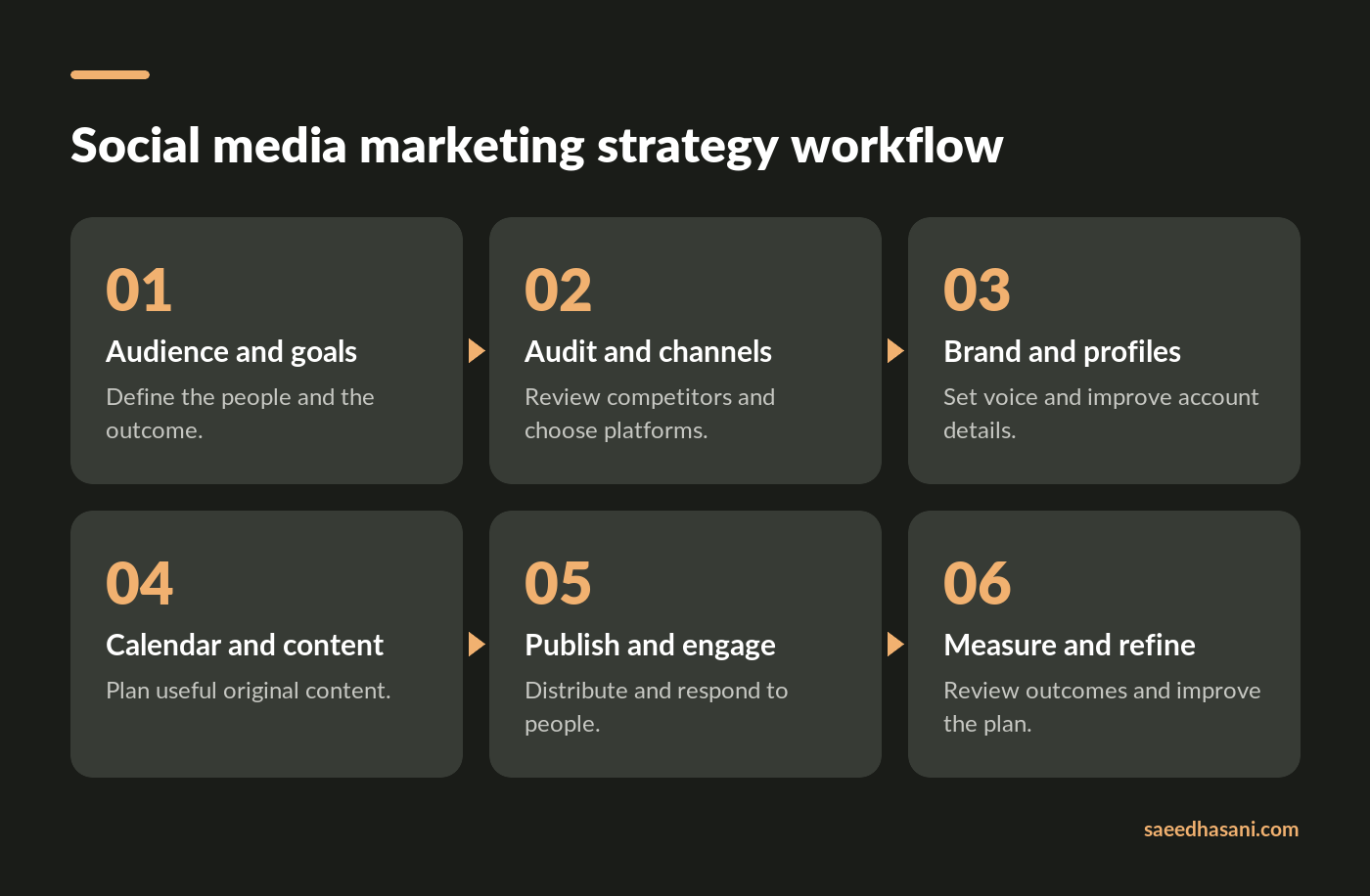
- Identify your target audience and their preferences. Understand who has a reason to care about the offer, how they research decisions, what questions they ask and which platforms they actually use. Review customer interviews, sales and support conversations, permitted account insights and relevant community discussions. Create practical audience profiles based on needs and behaviors rather than relying on stereotypes. Distinguish customers, prospective buyers and people who participate for other reasons.
- Set clear and measurable goals. Connect the activity to a business objective and define a baseline, timeframe and measurement method. A SMART goal is specific, measurable, achievable, relevant and time-bound. For example, a local service could aim to increase qualified appointment enquiries attributed to social referrals from its existing baseline over the next quarter, within a defined budget and capacity limit. Treat the target as a planning goal rather than a promised result.
- Research competitors and audit your current presence. Review relevant public accounts, messaging, content themes, audience questions, engagement quality and apparent gaps. Audit your own profiles, posts, broken links, response practices, access permissions and tracking. Determine which activities are aligned with the objective and which need improvement. Do not assume a competitor’s highly visible post generated revenue or copy its content without permission.
- Choose the right social media marketing channels. Rank potential platforms by audience fit, format suitability, available resources, advertising options and measurement. Consider where your customers seek information as well as where they are entertained. A small team can begin with a focused platform mix and expand only when it has a clear reason and the ability to manage the additional workload.
- Define your brand voice. Decide how the organization should communicate across content and conversations. Document its tone, visual guidelines, factual standards and boundaries for humor or trend participation. The same message may need different formats on different platforms while retaining consistent meaning. Provide examples of language that the team should use and avoid, especially for complaints and sensitive subjects.
- Optimize your social media profiles. Use recognizable account names and images, accurate descriptions and up-to-date contact or location information where relevant. Explain the value of the account and provide a clear next step. Check links, accessibility, profile details and account ownership. Use the destination page that matches the intended action instead of directing every visitor to a generic homepage.
- Create a content calendar. Plan content pillars, formats, publishing dates, responsibilities, approval status and destination links. Balance the team’s capacity with the needs of the audience. Include time for customer questions and current developments. Review past performance to choose a starting schedule, but leave flexibility for new evidence and avoid treating a calendar as an obligation to publish low-value material.
- Develop original, high-quality content. Turn customer needs into useful explanations, demonstrations, stories and relevant offers. Make content accurate, recognizable and appropriate for the platform. Use clear captions, readable visuals and accessible alternatives where needed. Check image rights, factual claims and disclosures before publishing. Adapt rather than blindly duplicate creative across platforms, and choose trends only when they fit your audience and message.
- Start posting, measure and refine. Publish according to the plan, respond to relevant interactions and use appropriate account analytics and website or CRM data. Review performance against the objective, identify useful learning and document changes. Test different messages or formats when feasible. Decide which content deserves repetition, which needs revision and which activity is no longer justified. Revisit the broader strategy as audience needs or business priorities change.
For a hypothetical local retailer, the initial goal might be to increase qualified visits to its product pages rather than maximize video views. The team researches common purchase questions, chooses a visual platform and a community channel, produces product explanations and measures eligible referrals and downstream purchases. This connects social media marketing activity to a customer need and an observable outcome.
Build Your Social Media Content Plan
A content plan translates social media marketing strategy into a set of useful publishing activities. Content pillars are recurring themes tied to audience needs and business objectives, such as product education, customer questions, industry insights or practical examples. Formats are the ways these ideas are presented: videos, images, carousels, polls, articles or text posts. Start with themes the business can discuss credibly, then choose formats that make each idea easier to understand.
| Content type | Example | Purpose |
|---|---|---|
| Educational | How-to guide or frequently asked question | Help people understand a problem or solution |
| Promotional | Accurate product demonstration or offer | Communicate availability and support a decision |
| Behind the scenes | Explanation of a team’s process | Make the business more understandable and credible |
| Customer-focused | Authorized customer story or independent feedback | Provide context and evidence |
| Interactive | Question, poll or live Q&A | Gather feedback and encourage conversation |
| Thought leadership | Original analysis of a relevant industry question | Demonstrate expertise and help decision makers |
Sticky content is material that captures and sustains relevant attention. Shareable content offers enough usefulness, interest or relevance that people choose to pass it along. Viral marketing attempts to encourage rapid redistribution beyond the original audience. Viral reach can generate exposure, but it is unpredictable and does not necessarily reach prospective customers. Plan for repeatable relevance rather than requiring every post to go viral.
Earned media can include independent reviews, mentions and user-generated content. Obtain appropriate permission before reusing a customer’s photograph or video, and distinguish genuine feedback from compensated promotion. Influencer marketing can introduce a brand through a creator’s audience, but relevance and truthful disclosure matter more than a large following alone. A business can also adapt material from its blog into shorter, platform-appropriate explanations.
The 50/30/20 content mix is sometimes used as a planning heuristic. One possible interpretation allocates 50% to educational or useful content, 30% to community or relationship-building content and 20% to promotion. Other interpretations exist; there is no official universal ratio. Adjust the mix to the audience, the stage of the customer journey and the results you observe.
A simple weekly calendar could include a practical customer question on Monday, a demonstration on Wednesday and a customer-approved example or relevant offer on Friday, with community responses managed throughout the week. Record each item’s goal, format, owner, approval deadline, publishing date and next step. Adjust timing and frequency according to actual account data and the team’s ability to maintain quality.
Use links strategically in social media marketing. A post answering a preliminary question might direct readers to an educational resource, whereas a product demonstration could link to an appropriate product page. Keep the promise of the post consistent with the destination and avoid inserting unrelated promotional links. Some posts can deliver complete value without requiring a click.
Social Media Listening and Engagement
Social media listening involves identifying recurring conversations, relevant mentions, customer questions and emerging concerns. Monitoring focuses more directly on tracking specific interactions, such as comments, messages and tagged posts. Together they help social media marketing teams understand what audiences need and whether existing content and service processes address those needs.
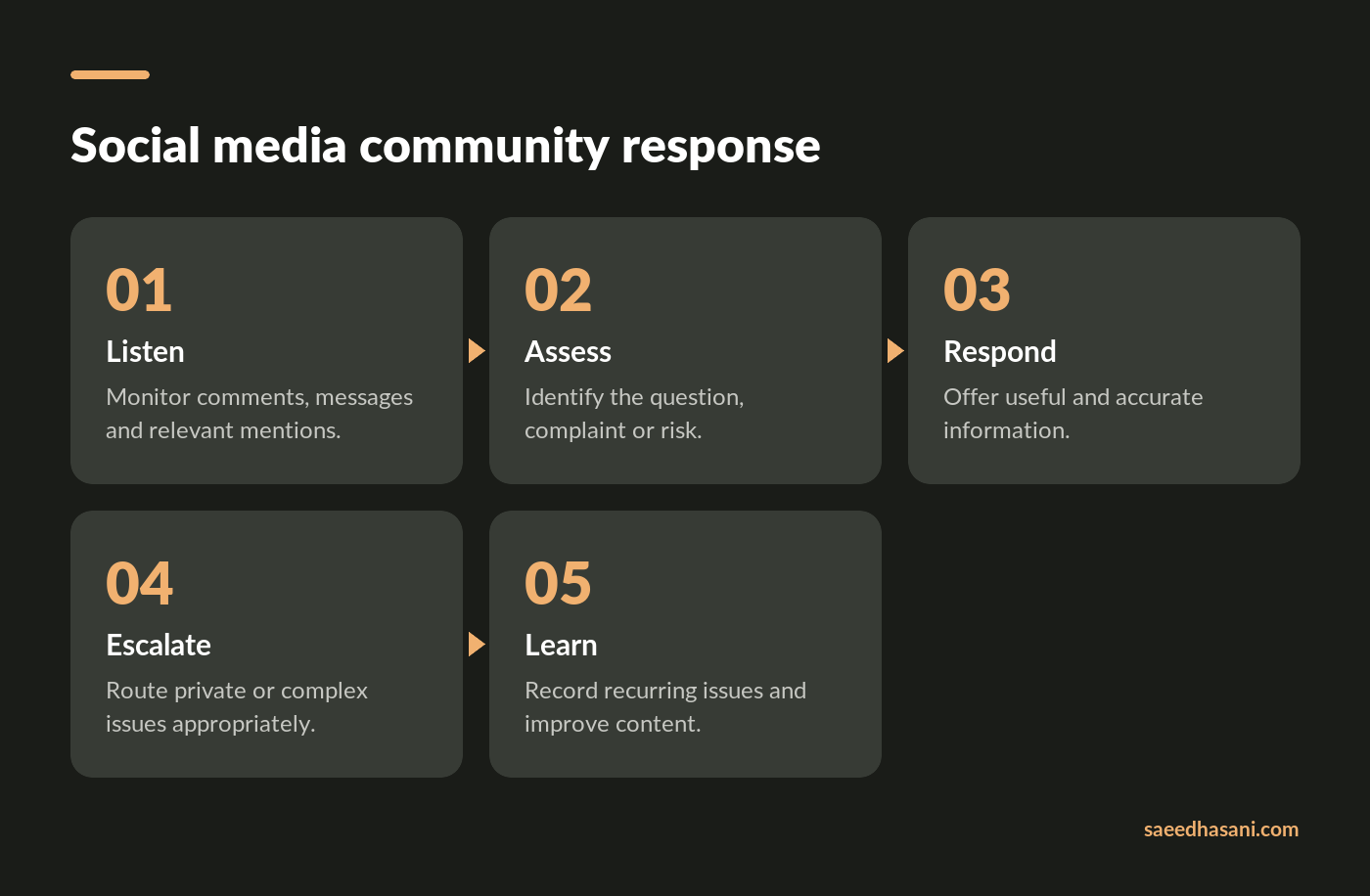
Use a shared inbox or clearly assigned responsibilities to identify messages that need attention. Separate routine questions, purchase enquiries, service complaints and potentially sensitive issues. Respond with accurate information in a tone suited to the brand. Route private details or complex support requests to an appropriate secure channel rather than asking customers to publish personal information in comments.
When someone raises a legitimate complaint, acknowledge the relevant problem, explain the available next step and coordinate with the people responsible for resolving it. Do not promise an outcome that the organization cannot provide. Establish moderation rules for harassment, spam and abuse, while preserving legitimate criticism. If the brand publishes inaccurate information, correct it transparently and review the process that allowed the mistake.
Engage with communities rather than treating them as advertising inventories. A useful response to a customer’s question can also reveal a topic for future content. Invite relevant discussion, listen to feedback and recognize contributions without fabricating engagement. Get the team involved: sales staff may understand frequent objections, support teams know common problems, and subject specialists can help verify claims.
Listening also provides context for trends. Before participating, consider the origin of the trend, whether it aligns with the brand and whether the audience will find the contribution relevant. Avoid imitating jokes or references to serious events merely because they are receiving attention. Record recurring questions and issues, then use the findings to improve content, customer experience and service procedures.
Social Media Advertising
Social media advertising purchases distribution on a platform. It differs from organic social media publishing because a campaign has a media budget and configurable delivery settings, although an existing organic post may sometimes be promoted. Platforms may offer objectives such as awareness, traffic, engagement, leads or sales; select the objective that matches the actual business goal and available measurement.
Begin with a relevant offer, suitable creative and a clear destination or in-platform action. Define permitted targeting, geography where applicable, placements, budget and success criteria. Test creative variations with an understandable hypothesis, and monitor both traffic quality and the downstream actions it generates. Avoid interpreting a low cost per click as proof that a campaign is commercially successful.
Retargeting can reach eligible people who previously interacted with a business, subject to platform rules and applicable privacy requirements. It may help people resume research, but repeated exposure does not establish that advertising caused a purchase. Monitor frequency, incremental value where feasible and whether the message remains appropriate for the audience.
Influencer partnerships and affiliate marketing may also form part of a paid distribution strategy. Evaluate audience fit, creative quality, contractual terms, appropriate permissions and genuine outcomes. For U.S. campaigns, material relationships such as payment or free products should be disclosed when required in a clear and conspicuous manner. The FTC guidance on influencer disclosures explains these responsibilities. Do not imply that a platform’s branded-content label automatically satisfies every obligation.
Social commerce features and lead forms may reduce the number of steps needed to act. Before adopting them, verify what customer information can be accessed, how enquiries will be handled, whether tracking is reliable and how the transaction fits existing fulfillment or support processes. Use a clear offer, transparent terms and appropriate data handling.
Budget planning for social media marketing should include production, management and reporting costs in addition to media spend. Establish an amount the business can reasonably test, define a review point and decide in advance which outcomes justify continuing or adjusting the campaign. Social media marketing does not require paid advertising for every objective, and buying distribution is not a substitute for solving problems in the customer journey.
Tracking Metrics
Measurement connects social media marketing activities to their intended purpose. Select key performance indicators (KPIs) according to the objective, not simply the metrics easiest to collect. Platform definitions may differ, so document the reporting period, data source and calculation method before comparing results.
| Metric | What it measures | Interpretation |
|---|---|---|
| Reach | Estimated unique accounts or people exposed | Audience exposure within the source’s definition |
| Impressions | Recorded displays | Distribution volume, including repeat exposure |
| Follower growth | Change in followers over a defined period | Audience development, not proof of demand |
| Engagement rate | Defined interactions divided by a stated denominator × 100 | Response to content under consistent definitions |
| Shares and saves | Recorded sharing or saving actions | Possible usefulness or relevance |
| Share of voice | Brand mentions divided by comparable mentions in a defined market or topic × 100 | Relative visibility within the measured sample |
| Click-through rate (CTR) | Relevant clicks divided by impressions × 100 | Response to an actionable placement |
| Referrals | Visits recorded from social sources | Traffic reaching the website |
| Conversion rate | Eligible converting users or visits divided by matching population × 100 | Completion of a defined action |
| Response rate and time | Share of relevant messages answered and time taken | Responsiveness of the community or support process |
| Cost per click (CPC) | Ad spend divided by relevant clicks | Media cost of traffic |
| Cost per acquisition (CPA) | Defined acquisition spend divided by acquisitions | Efficiency of a defined conversion objective |
| Return on ad spend (ROAS) | Attributed advertising revenue divided by ad spend | Reported revenue relative to media investment |
Consider an illustrative campaign with 50,000 impressions, 1,000 link clicks and $500 in media spend. CTR is 2%, and CPC is $0.50. Suppose 800 eligible sessions produce 40 qualified enquiries. The session-based conversion rate is 5%, and advertising cost per qualified enquiry is $12.50. If eight enquiries become customers, advertising cost per acquired customer is $62.50 before accounting for production, management and sales costs.
If $2,000 in revenue is attributed to those customers, reported ROAS is 4:1. That does not establish a 4:1 return on total investment. ROI should account for the relevant investment, costs and net gain, and attributed revenue may include sales that would have occurred anyway. A business should investigate attribution uncertainty and evaluate margin, lead quality and retention before scaling spend.
Engagement rates may use followers, reach or impressions as a denominator. A rate of 4% calculated using followers cannot be directly compared with a rate of 4% calculated using reach. Use consistent definitions and distinguish impressions from unique exposure. Segment organic and paid performance when possible to avoid attributing purchased distribution to organic content quality.
Website analytics and campaign tagging can help identify eligible social referrals; CRM records may connect enquiries to opportunities and customers. Understand the limitations of attribution windows, privacy settings and cross-device behavior. If relevant people click through but do not complete an intended action, investigate landing-page usability and offer relevance. A structured approach to conversion optimization can help improve this part of the journey.
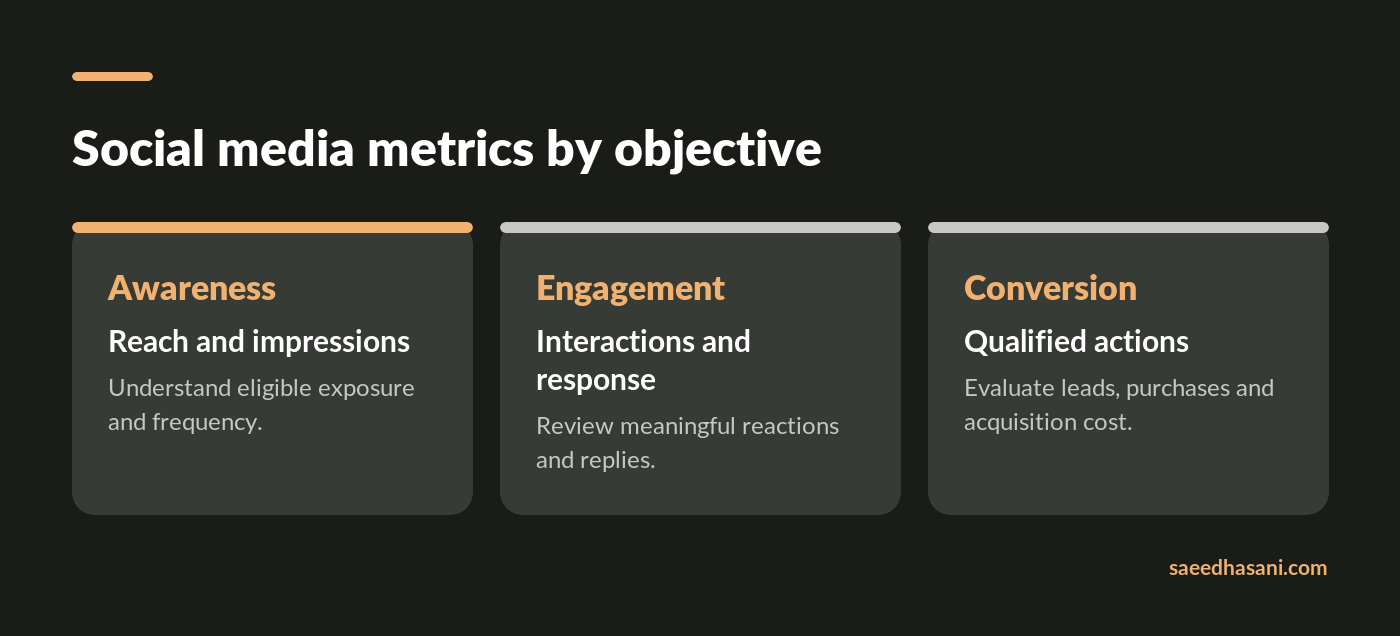
Review metrics by objective. For awareness, evaluate relevant reach and frequency; for engagement, review meaningful comments, shares, saves and responsiveness; for conversion, evaluate qualified actions, cost and commercial outcomes. Set a recurring review schedule that reflects the amount of data available. Do not overreact to one unusually strong or weak post.
Social Media Marketing: Best Practices
Reliable social media marketing combines audience knowledge, consistent quality and responsible participation. The following practices can be adapted to the size and resources of the organization.
- Know your audience: use actual customer research to select topics and formats.
- Focus on platforms that make sense: expand only when there is evidence of audience fit and enough capacity to manage the channel.
- Maintain optimized profiles: periodically check business information, account access and destination links.
- Engage with communities: respond to relevant questions and participate where the brand can add value.
- Be authentic and relatable: use accurate information and language that reflects the organization instead of forcing popular trends.
- Create value: prioritize explanations, useful demonstrations and customer needs over repeated promotional messages.
- Get your team involved: coordinate subject experts, sales, support and marketing to produce useful and accurate content.
- Be strategic with links: connect content to a relevant destination only when it helps the audience take a meaningful next step.
Social media marketing management tools can assist with scheduling, account monitoring, moderation and reporting. Choose tools according to the channels, team workflow, access controls and data requirements. A small business may initially use built-in platform insights and a simple calendar. More complex programs may benefit from shared inboxes, approval systems, campaign tracking and CRM integration.
Use AI to speed up workflow, not replace your brand voice. It can help organize topic ideas, summarize permitted feedback or produce drafts for review. A human should verify factual claims, tone, image rights and the suitability of responses. Do not enter private customer information into tools without appropriate authorization. Automation should help teams manage repetitive tasks while preserving accountability and a route to human support.
Plan for accessibility and account security in social media marketing. Use readable text, captions, helpful descriptions where available and clear links. Assign appropriate permissions, use strong account protection and document ownership and recovery procedures. Review scheduled posts when circumstances change. Use performance data to improve creative choices rather than claiming that a particular posting time, hashtag count or format guarantees engagement.
Common Social Media Marketing Mistakes to Avoid
Many costly mistakes occur when businesses confuse activity with strategy or prioritize immediate exposure over the quality of the customer relationship.
- Posting without a strategy or sharing little value: a large volume of unrelated content makes it difficult for audiences to understand why they should pay attention. Define the audience, purpose and next action for each social media marketing content pillar.
- Not engaging with comments: publishing while ignoring relevant customer questions weakens the two-way nature of the channel. Assign responsibility and response expectations.
- Advertising too often: repeated promotions can overwhelm useful content. Monitor audience response, frequency and downstream value.
- Chasing every trend: a popular format may be irrelevant to the brand or inappropriate for the circumstances. Check context and potential interpretation.
- Buying engagement or publishing misleading claims: artificial followers, fake reviews and unsupported promises distort performance and may damage trust. Evaluate real customer outcomes.
- Ignoring privacy and content rights: unauthorized use of personal information, customer photos or copyrighted media can create avoidable risks. Establish permissions and review procedures.
- Depending on one platform: policy changes or account restrictions can disrupt access to an audience. Maintain appropriate owned channels and account recovery processes.
Social media mishaps can escalate quickly when a message is inaccurate, insensitive or misleading. Establish a review process for consequential content and a response plan for incidents. If an error occurs, investigate it, stop the problematic activity if appropriate, correct misinformation and communicate proportionately. Avoid deleting legitimate concerns solely to make the account appear positive. Social media marketing ethics should guide both ordinary content decisions and difficult responses.
What Does a Social Media Marketer Do?
A social media marketing specialist researches audiences, plans campaigns, develops or coordinates content, manages community interactions and evaluates performance. The role may involve selecting platforms, building calendars, writing copy, briefing designers or videographers, monitoring comments, setting up appropriate campaigns and reporting outcomes to business stakeholders.
Social media management focuses on daily operations and consistency. A strategist connects these tasks to audience needs and business goals, while a paid media specialist may manage advertising budgets and experiments. Content creators develop original material, and community managers often handle conversations and escalation. In a small company, one person may perform several roles, but responsibilities should still be clear.
Effective professionals collaborate with sales, service and product teams. They understand how to measure qualified outcomes, distinguish a correlation from a causal finding and communicate limitations. Creative judgment, writing, analysis, project management and ethical decision-making are useful across the discipline. The right specialist depends on the business’s actual needs rather than a job title alone.
How to Learn Social Media Marketing
Start learning social media marketing by understanding marketing fundamentals, audience research, content planning, community management, advertising and analytics. Official platform learning resources can help explain account features and reporting definitions, while reputable courses and guides can provide structure. Select learning materials that explain the reasoning behind decisions instead of relying on formulas for guaranteed reach or sales.
Practice social media marketing with a manageable project. Choose a legitimate business or personal project, define one audience and a measurable objective, create a small content calendar and publish useful material. Monitor relevant results and document what you learn. A portfolio can show examples of content, research, a measurement plan and the decisions made after reviewing results. Use only data and materials you have permission to share.
Develop practical skills in writing, visual communication, scheduling, basic analytics and customer response. Learn to assess information quality and understand the boundaries of advertising, privacy and platform policies. A course or certification may support learning, but it does not guarantee employment or business outcomes.
The key takeaway is that social media marketing works best as a disciplined process of research, useful communication and measurement. Start with a focused plan, build reliable customer relationships and adjust based on evidence rather than chasing every trend.
Frequently Asked Questions
How Does Social Media Marketing Work?
It combines audience research, organic publishing, community engagement, paid distribution where appropriate and performance measurement. The business uses each activity to support a defined goal, such as relevant awareness, qualified enquiries or customer retention, and adjusts the plan using evidence.
How Much Does Social Media Marketing Cost?
There is no universal price for social media marketing. Costs depend on content production, the number of channels, management, advertising spend, software and reporting requirements. Evaluate the total resources required and define a manageable test budget based on business objectives rather than assuming organic publishing is costless.
What Is the 50/30/20 Rule for Social Media?
It is a flexible content-planning approach. One version divides content into 50% useful education, 30% relationship-building and 20% promotion. Interpretations vary, and the ideal mix should be evaluated for the business and audience.
What Is the Difference Between a Social Media Ad and a Social Media Post?
An organic post is published through an account without buying its placement, while an advertisement purchases distribution through a paid campaign. A post can sometimes be promoted as an ad. Their costs, delivery controls and reporting methods differ.
What Is Sticky Content in Social Media Marketing?
Sticky content attracts and sustains relevant attention because it is useful, interesting or meaningful to an audience. It may encourage saving, sharing or another action, but it does not necessarily lead to a sale.
What Is Viral Marketing in Social Media Marketing?
Viral marketing aims to encourage people to redistribute a message rapidly beyond the original audience. The outcome is uncertain, and large exposure does not necessarily indicate that the right people were reached or that the campaign was profitable.
What Is Earned Media in Social Media Marketing?
Earned media is independent exposure through voluntary reviews, mentions, recommendations and shares. Compensated endorsements should be identified as such and should not be presented as purely independent customer recommendations.
What Are Some Examples of Social Media Marketing Strategies?
A local business may publish useful location-specific information and respond to community questions; an ecommerce retailer may combine product videos with relevant ads; a B2B business may share original educational material and route qualified enquiries to its sales process. The strategy depends on the audience, objective and available resources.






Responses