
Affiliate Marketing Definition: 7 Essential Steps to Avoid Costly Mistakes


The simplest affiliate marketing definition is a performance-based partnership in which a business rewards an independent publisher for generating an agreed result, such as a qualifying sale or lead. The publisher promotes the business’s products or services through a tracked link or referral code and earns a commission when the program’s conditions are met.
Affiliate marketing can extend a company’s reach without requiring it to create every piece of promotional content itself. For publishers, it can provide a way to earn revenue from useful content. Neither side is guaranteed a profit: the results depend on audience fit, the offer, tracking accuracy, commission terms and the cost of operating the channel.
This guide explains the affiliate marketing definition, compensation models, practical examples, seven steps to get started, and the safeguards businesses need when establishing a partner program.
Content Overview:
Affiliate Marketing Definition: What Is It?
In business terms, the affiliate marketing definition describes a commercial arrangement in which an advertiser compensates a third party for an eligible action attributed to that partner. Unlike a fixed advertising placement, many affiliate arrangements tie payment to measurable performance. The exact payment event depends on the agreement.
Understanding the affiliate marketing definition starts with four participants:
- Merchant or advertiser: the business that supplies the product or service, defines program conditions and is responsible for fulfilling purchases.
- Affiliate or publisher: a person or organization that introduces potential customers to the merchant through permitted marketing activities.
- Customer: the person who follows the referral and may complete a qualifying action.
- Affiliate network or tracking provider: an optional intermediary that helps administer links, attribution, reporting and payment.
A key element of the affiliate marketing definition is the affiliate link, which contains a reference that helps identify the publisher under the program’s tracking rules. An affiliate program is the set of contractual, technical and commercial arrangements governing participation. A network can operate multiple programs, but a merchant can also run one directly.
For example, a gardening blogger publishes a helpful comparison of tools and discloses that purchases through certain links may generate a commission. A reader follows a link, buys a qualifying tool from the merchant, and the affiliate earns the agreed reward after validation. The publisher is not ordinarily responsible for inventory, shipping or refunds; the merchant handles the transaction according to its terms.
This affiliate marketing definition places the model within broader channel partner marketing. It is different from dropshipping, where the retailer generally sells directly to the customer and arranges fulfillment. It is also different from a recruitment-driven scheme in which earnings depend primarily on enrolling new participants rather than generating legitimate customer value.
History of Affiliate Marketing
The history behind the affiliate marketing definition begins with commission-based referrals that existed before the internet. Online commerce made them easier to administer by allowing merchants to connect a visit or purchase with a particular publisher. Early web programs relied heavily on banners, links and website referrals; tracking systems gradually helped connect these referrals with more meaningful outcomes.
Amazon Associates was an influential early example of a large online affiliate program. As blogs, comparison websites, social networks and video platforms developed during the Web 2.0 era, the range of publishers expanded beyond traditional websites. Creators could now explain or demonstrate products to audiences through many different formats.
The underlying affiliate marketing definition has remained consistent despite these changes: an identifiable partner promotes an offer and receives agreed compensation for an eligible result. The technologies used to attribute that result have evolved, and businesses must now account for changing privacy requirements, browser behavior and platform policies.
How Affiliate Marketing Works
The affiliate marketing definition becomes clearer through the four steps of a typical sale-based arrangement. Other programs may reward a verified lead, registration or another approved event instead of a purchase.
- Share the product. The affiliate creates relevant content and includes a program-approved link or code, accompanied by an appropriate disclosure.
- The customer follows the referral. The customer visits the merchant’s website or another permitted destination.
- The program tracks and validates the conversion. If the customer completes an eligible action, the system applies the attribution window, eligibility rules and any fraud, cancellation or refund checks.
- The affiliate gets paid. Approved commissions become payable under the program’s schedule and minimum payment conditions.
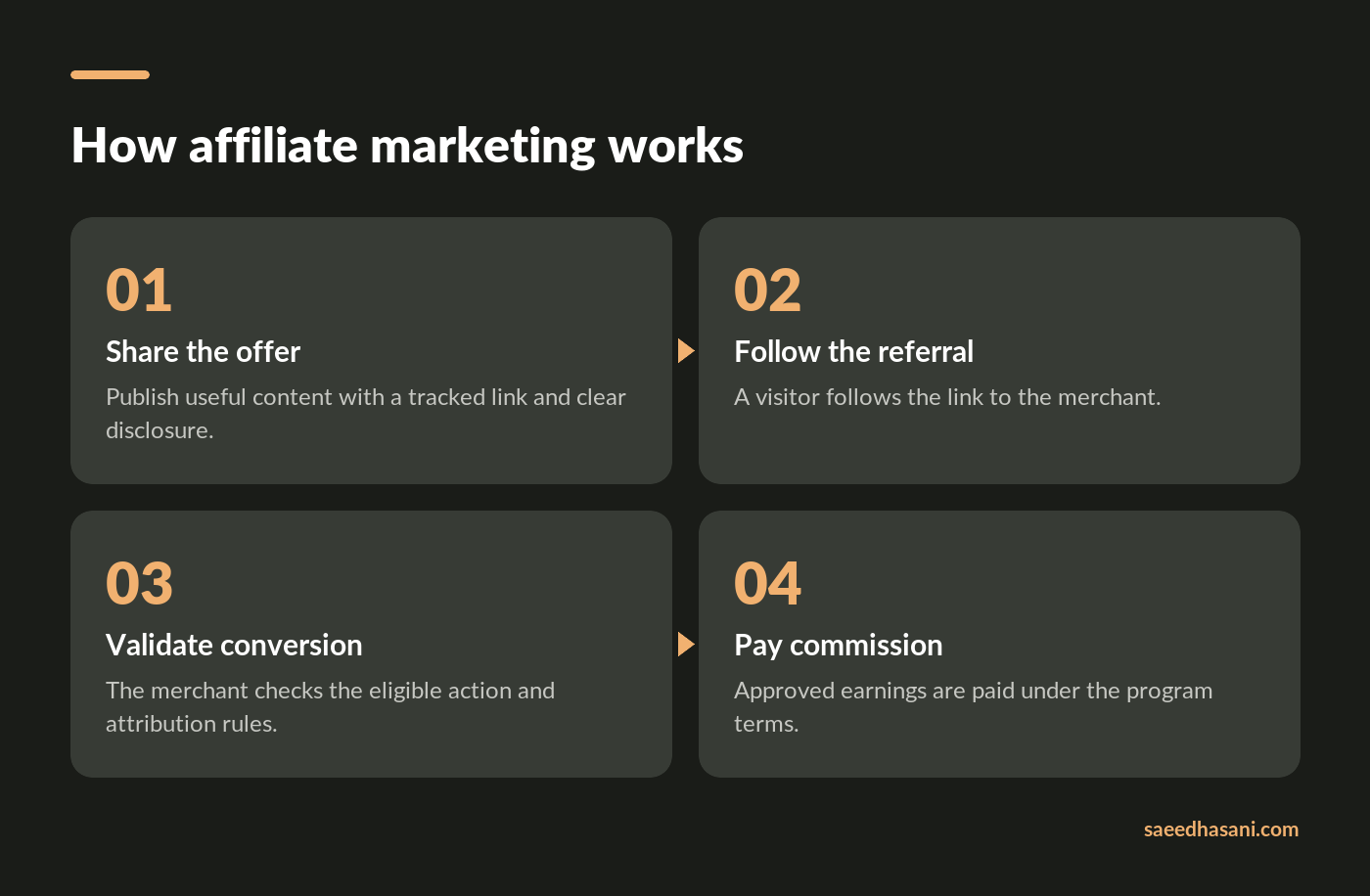
An affiliate marketing definition is incomplete without attribution. For instance, a program may credit a qualifying purchase to the last eligible affiliate referral within its specified attribution window. Another program may use a discount code or different allocation rule. There is no universal cookie duration or commission entitlement simply because someone clicked a link.
Cookies, server-side events and referral codes are possible tracking methods. Browser restrictions, consent choices, cross-device behavior and competing marketing touchpoints can affect what is recorded. Tracking should respect applicable privacy requirements. Publishers should review their reports and contact the program when a discrepancy cannot be explained by its published terms.
In the affiliate marketing definition, an optional intermediary is the network. Affiliate networks may provide access to multiple merchants, tracking tools, application processes and consolidated payments. A direct program may give a business greater control of its relationship with publishers. Assess the fees, ownership of reporting data, integration options and responsibilities before choosing either approach.
How Do Affiliate Marketers Earn Money?
The compensation element of the affiliate marketing definition is the agreed payment for an eligible outcome. The amount can be a percentage of qualifying revenue, a fixed payment per conversion or a recurring reward for an eligible subscription. Some programs use different rates for different product categories or partner agreements.
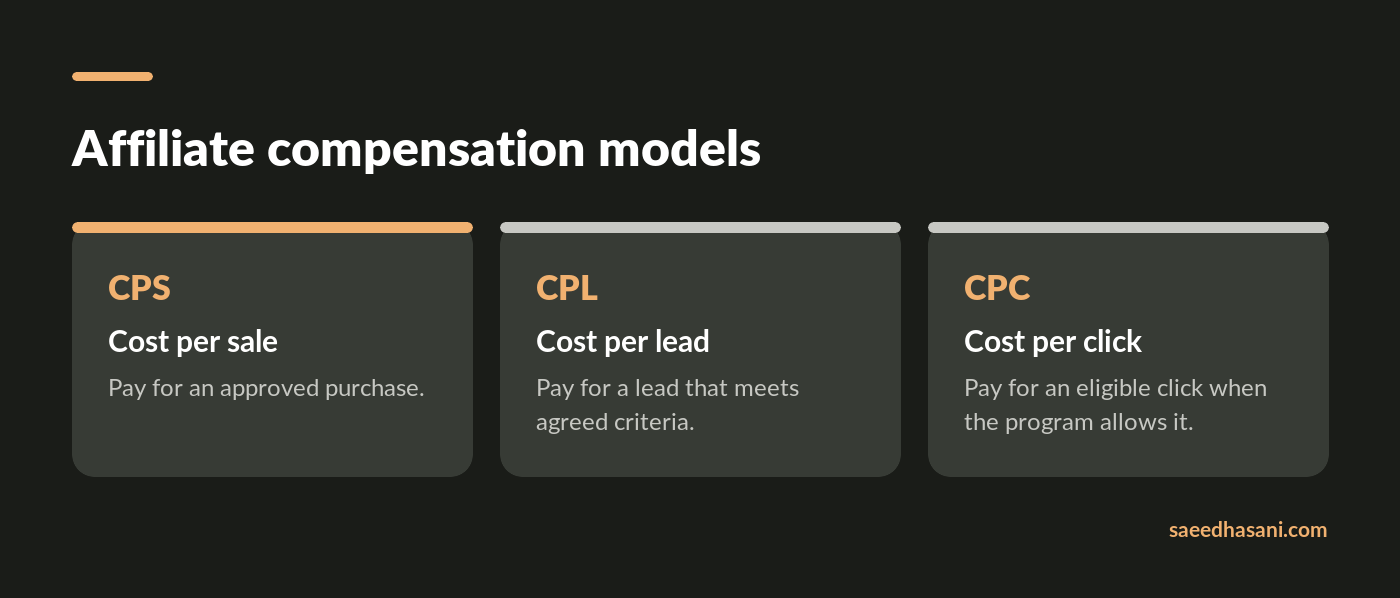
| Compensation model | What triggers payment? | Important consideration |
|---|---|---|
| Pay per sale (CPS) | Approved purchase | Refunds, exclusions and commissionable order value |
| Pay per lead (CPL) | Lead meeting agreed criteria | Lead quality and duplicate submissions |
| Pay per acquisition (CPA) | Defined eligible acquisition event | Whether the event represents meaningful customer value |
| Pay per click (CPC) | Eligible click | Traffic quality and invalid activity |
| Recurring commission | Eligible renewal or subscription payment | Retention and the duration of the reward |
Under the performance-based affiliate marketing definition, sale-based and qualified-lead models connect payments more closely to business outcomes. Click-based and impression-based arrangements have also existed, but they require careful validation and may be less representative of the affiliate channel’s final value. A qualified-lead arrangement should align with a company’s broader lead acquisition marketing strategy.
A related variation of the affiliate marketing definition is the multi-tier model. Some multi-tier programs compensate a publisher for qualifying sales generated by referred affiliates. Examine whether the economics depend on genuine retail activity. A program that emphasizes recruitment fees or promises income regardless of customer demand should be approached with particular caution.
Consider a hypothetical publisher who generates 1,000 tracked visits, 40 approved sales and a commission of $8 per sale. Gross affiliate earnings would be $320. If the publisher spent $120 on content and other directly attributable costs, the illustrative remainder would be $200 before other expenses and taxes. These figures demonstrate arithmetic, not a typical earnings benchmark.
The affiliate marketing definition refers to commissions, not a guaranteed salary. Some publishers earn little or nothing, while established publishers may generate substantial revenue. Income depends on audience size, relevance, conversion, commission terms, cancellations and costs. Even existing content may require maintenance as offers, links, prices and search visibility change.
What Are the Different Types of Affiliate Marketing?
The three familiar variations of the affiliate marketing definition differ according to the publisher’s relationship to the product. This distinction explains how a recommendation is made rather than which technical payment model is used.
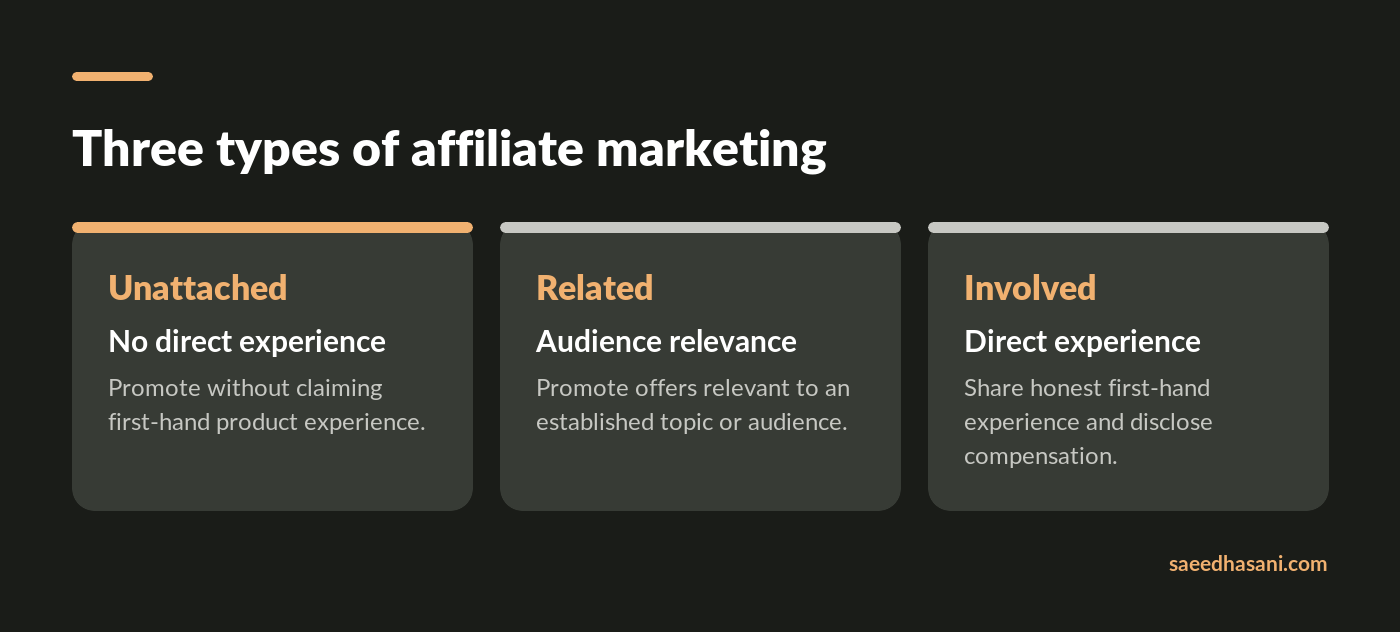
Unattached affiliate marketing: the publisher promotes an offer without claiming expertise or personal experience with it. An advertisement pointing to a merchant’s website could fit this category. Lack of direct experience is not permission to make misleading claims.
Related affiliate marketing: the offer fits the publisher’s established subject or audience, but the publisher does not necessarily use the product. A photography website, for example, might compare equipment based on accurately documented specifications while explaining which products it has actually tested.
Involved affiliate marketing: the publisher has first-hand experience and shares an honest account of using the product. Direct experience can support helpful demonstrations and credible comparisons, but financial incentives still need disclosure and experiences must not be exaggerated.
The affiliate marketing definition also applies across different publishing formats:
| Affiliate format | Typical approach |
|---|---|
| Review sites | Evaluate products and explain strengths, limitations and suitability. |
| Price comparison sites | Help shoppers compare available offers on a consistent basis. |
| Coupon sites | Share authorized discounts and explain eligibility. |
| Email publishers | Recommend relevant offers to appropriately subscribed readers. |
| Loyalty programs | Provide permitted rewards or benefits to members for purchases. |
| Influencers | Demonstrate or discuss products in social and video content. |
| Content affiliates | Publish tutorials, buying guides and other useful resources. |
Regardless of the format covered by the affiliate marketing definition, choose a channel based on what the audience needs, what the publisher can substantiate, and what the program permits. A high commission is not a sufficient reason to promote an unsuitable offer.
Affiliate Marketing Examples
Recognizable examples help make the affiliate marketing definition concrete. Amazon Associates illustrates how a retailer can compensate eligible publishers for qualifying activity. Etsy’s affiliate arrangements and eBay Partner Network illustrate marketplace-based models, while shopping content from publishers such as BuzzFeed demonstrates how editorial resources can include commercial links.
Other published examples illustrate different niches and approaches. WhistleOut has been discussed as a comparison-focused example, Money Crashers as a finance content example, Roo’s Home in the health and fitness context, and Travel Tom Tom and NOMADasaurus in travel content. These examples illustrate publishing formats rather than providing independently verified current earnings, conversion rates or endorsements of their products.
A software company could establish its own program for consultants who publish relevant implementation guides. A local service business might compensate approved partners for qualified inquiries if the arrangement is lawful and commercially appropriate. A retailer may instead recruit publishers that create genuine buying guides. The eligible action, attribution method and economics should match the actual business model.
Programs frequently change their eligibility conditions, rates and permitted channels. Always check current official terms rather than relying on an old article or an earnings screenshot.
The Benefits of Affiliate Marketing
From the merchant’s perspective, the affiliate marketing definition explains the appeal of the ability to reach relevant audiences through independent publishers. A well-matched program can introduce products to new customers, increase brand awareness, help promote new offerings and draw on publishers’ specialized marketing skills. It can be useful for startups when margins, fulfillment capacity and program management resources support it.
From the publisher’s perspective, the affiliate marketing definition describes a way to monetize content without necessarily producing or stocking the products being promoted. Publishers can select programs that fit their audiences, combine compatible revenue sources and develop expertise in audience research, content creation and performance analysis.
The affiliate marketing definition does not imply that the merchant pays only for profitable incremental sales. The merchant may incur network fees, program management expenses, creative costs and commissions for purchases that would have occurred anyway. Affiliates may also incur content, advertising and tool expenses before receiving any approved commissions.
| Participant | Potential advantages | Potential disadvantages |
|---|---|---|
| Merchant | New audiences, partner expertise, performance-linked compensation | Less direct control over promotion, attribution conflicts, fraud and administration |
| Affiliate | Flexible publishing model, access to existing products, revenue diversification | Uncertain earnings, program dependency, maintenance costs and reputation risk |
Judge the channel by qualified outcomes and sustainable contribution rather than raw attributed revenue. The right decision may be to expand the program, restrict it to certain partners or avoid it entirely if the economics or compliance requirements do not fit the business.
What Are the Most Popular Niches for Affiliate Marketing?
Technology, personal finance, health and fitness, and travel are common examples of affiliate content categories. These are illustrations of market opportunities, not a ranking of current market size or earnings.
Technology publishers may explain software features or compare devices. Finance publishers may educate readers about financial products, but must take care with licensing, eligibility, risk and promotional rules. Health and fitness publishers should avoid unsupported medical claims or recommendations beyond their expertise. Travel publishers may compare practical services and destinations, while acknowledging changing availability and prices.
Beyond learning the affiliate marketing definition, four signs that a niche may suit a publisher are a well-defined audience, credible knowledge of the subject, access to relevant legitimate programs, and enough resources to produce and maintain genuinely useful content. Check competition, search demand, commission terms, likely costs and consumer needs before committing to a niche.
A narrowly focused audience with a clear purchasing question can sometimes be more valuable than a broad audience with little interest in the offer. That is why the practical affiliate marketing definition should be understood in relation to audience fit, not commission rates alone.
7 Essential Steps to Get Started With Affiliate Marketing
For someone moving from the affiliate marketing definition to implementation, the following seven steps provide a practical starting sequence.
- Pick your niche. Define the audience and specific problems you can credibly help solve. Research existing resources and identify a genuine information gap.
- Choose your marketing channels. Decide whether a website, video channel, newsletter or permitted social platform fits your audience, skills and resources. Review each platform’s advertising and linking rules.
- Choose an affiliate program. Compare relevant direct programs and networks. Review eligibility, commissionable events, payout timing, permitted traffic sources, geographic restrictions and cancellation policies.
- Create valuable content. Produce tutorials, comparisons, demonstrations or explanations that are helpful even if the reader does not purchase. Distinguish tested products from researched products and clearly disclose commercial relationships.
- Build an audience and expand your network. Publish consistently, earn trust, develop relevant professional relationships and seek feedback. Avoid spam or purchased engagement. Focus on reaching appropriate readers instead of merely accumulating followers.
- Optimize link placements and build your skills. Place links where they genuinely support the reader’s decision. Check mobile usability, link accuracy and disclosure visibility. Improve copywriting, analytics and audience research rather than using intrusive promotional tactics.
- Monitor your progress. Maintain a record of clicks, approved conversions, earnings, refunds, costs and program changes. Test improvements and stop promoting offers that no longer serve your audience or generate sustainable value.
Once the affiliate marketing definition is clear, begin with a manageable scope. Free publishing tools and programs can reduce upfront spending, but the work still takes time, skills and ongoing attention. Set a budget you can afford and evaluate actual approved earnings before committing more resources.
How to Get Started Setting Up Affiliate Marketing Channels
From the advertiser’s perspective, the affiliate marketing definition becomes a program design question: which partners should be rewarded, for which outcomes, and under what conditions? Establish the commercial logic and measurement rules before recruiting publishers.
- Research your audience. Identify the buyers you want to reach and the content or communities that influence their decisions.
- Find suitable third parties. Recruit publishers with relevant audiences, credible practices and compatible promotional formats. Review their existing content and traffic sources.
- Set a compensation package. Define qualifying products and actions, attribution rules, commission rates, exclusions, payout schedules and reversals. Model contribution margin and the expected cost of acquiring an incremental customer.
- Build digital infrastructure. Choose direct management, an affiliate network or a specialist provider. Test links, referral codes, conversion reporting, consent handling and payout reconciliation. Provide accurate approved creatives and clear program policies.
- Monitor and track activity. Review partner performance, quality, compliance and attribution. Assign responsibility for onboarding, support, dispute handling, auditing and program improvements.
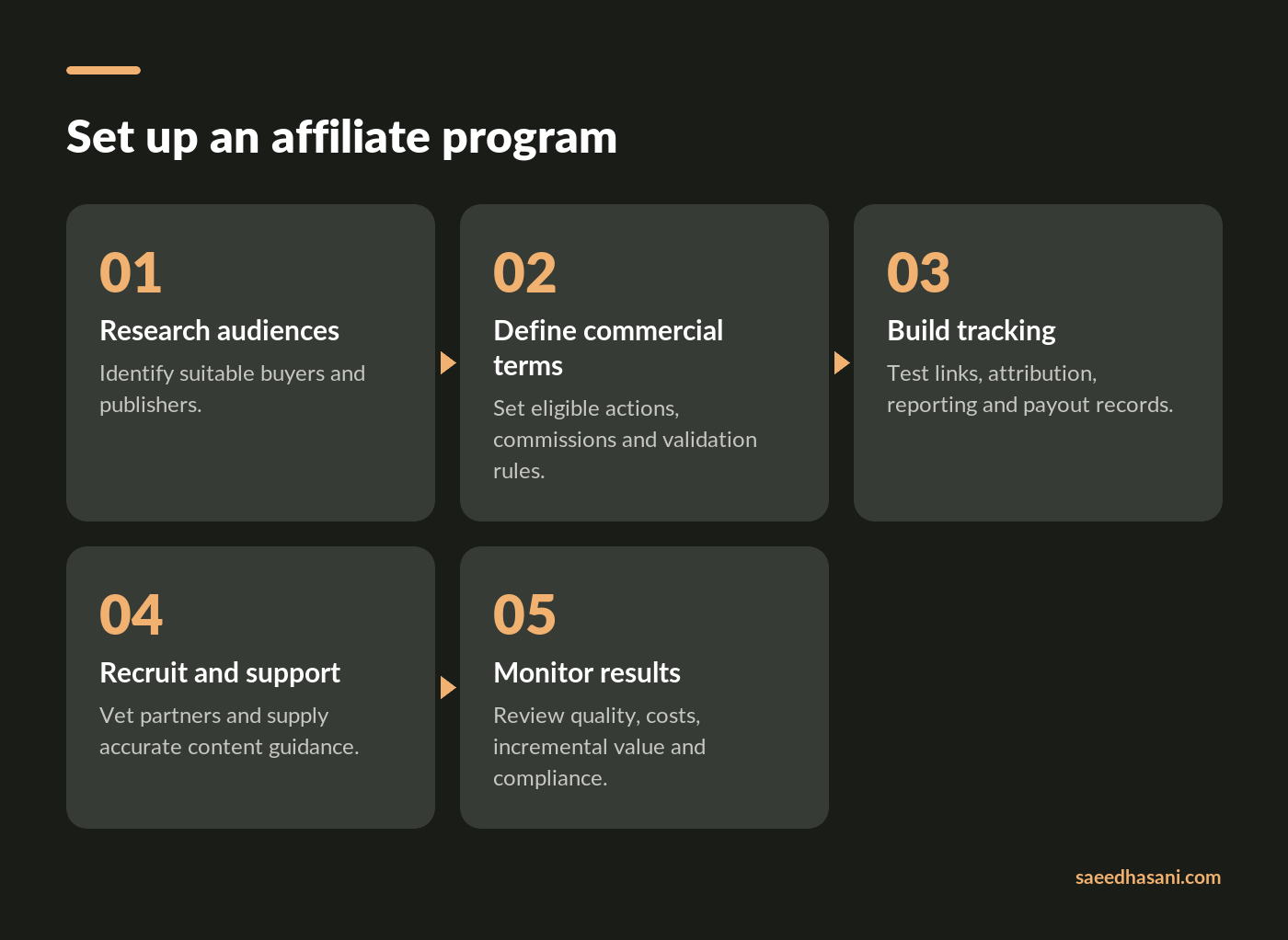
The affiliate marketing definition does not prescribe a management structure. In-house management can offer control and direct relationships, while outsourcing may provide technical or operational resources. Compare platform fees, reporting transparency, responsibilities, data access and the ability to enforce policies. Do not assume that outsourcing removes the advertiser’s responsibility for partner oversight.
Seasonal events such as Black Friday may increase interest in discount codes, comparisons and gift guides. Before launching promotions, confirm inventory, valid discounts, commission terms and publication deadlines. Evaluate whether coupon referrals are bringing genuinely additional customers rather than merely claiming credit at checkout.
Tips for Successful Affiliate Marketing
Move from the affiliate marketing definition to measurable practice: study strategies that fit the audience and the merchant’s economics, rather than assuming that another publisher’s success will transfer directly. Consider the rewards available in each program in relation to content costs, likely conversions, approval rates and the time required to keep recommendations current.
To measure the qualifying outcomes described in the affiliate marketing definition, build an affiliate dashboard that connects visits, qualifying actions, approved commissions, reversals and expenses. Merchants should compare those figures with transaction records, margins and other marketing channels. A digital marketing audit can help identify gaps in tracking and align the program with wider business goals.
| Metric | How to interpret it |
|---|---|
| Approved conversion rate | Approved conversions divided by relevant tracked clicks, multiplied by 100. |
| Earnings per click | Approved affiliate earnings divided by tracked clicks over a consistent period. |
| Reversal rate | Reversed transactions divided by initially recorded transactions, using a consistent cohort. |
| Publisher net return | Approved earnings less relevant costs, before other applicable expenses and taxes. |
| Merchant contribution | Revenue less product, fulfillment, payment, commission and other relevant variable costs. |
For example, a merchant may record 50 approved orders at $100 each, generating $5,000 in attributed revenue. If the associated product and fulfillment costs total $3,000 and commissions and program costs total $800, the illustrative contribution is $1,200 before other expenses. This does not prove that the entire $1,200 was incremental; some customers may have purchased without an affiliate.
Cultivate strong relationships with publishers through timely communication, reliable payouts, product information and transparent policy changes. Affiliates should similarly maintain relationships with merchants, ask about unclear terms and remove outdated or unsuitable recommendations. These practices make the affiliate marketing definition a sustainable partnership rather than a short-term link promotion exercise.
Past and Current Issues: Risks and Disclosure
The performance-based structure in the affiliate marketing definition can create incentives to manipulate attribution or mislead customers. Historical and ongoing issues include email spam, low-value search engine spam, misleading advertisements, malicious browser extensions, adware, cookie stuffing and unauthorized trademark bidding. Some coupon sites have also used click-to-reveal interactions that obscure how referral credit is assigned. The appropriate response is clear policies, monitoring and transparent user experiences.
Merchants should prohibit fake leads, unauthorized brand impersonation, forced attribution and deceptive claims. Review unusual traffic patterns and reconcile attributed transactions with legitimate customer activity. Define whether branded search advertising or coupon distribution is permitted. Use documented enforcement procedures and give legitimate partners a clear way to dispute incorrect decisions.
Another essential part of the affiliate marketing definition is compensation disclosure. Under US consumer protection principles, a financial relationship that could affect how people evaluate an endorsement should be disclosed clearly and conspicuously. The FTC endorsement guidance explains how these principles apply to affiliate relationships and different media formats.
For example, a publisher might state near a recommendation that they may earn a commission if a reader purchases through the link. The explanation should be understandable, visible and appropriate for the medium. A vague label or a disclosure hidden at the bottom of a long page may not adequately inform the reader. In videos, the disclosure may need to be communicated within the content itself as well as near links in the description. Disclosures do not make false claims acceptable.
There is no single universal industry standard or certification that guarantees responsible affiliate conduct. Businesses can establish training, codes of conduct and compliance checks, but must also consider applicable laws and platform rules. Sales tax and other tax obligations may depend on jurisdiction, the nature of affiliate arrangements and the business’s circumstances. Consult a qualified adviser for case-specific tax or legal questions, and review privacy requirements before deploying tracking technology.
Frequently Asked Questions
Do I Need a Website or Blog to Do Affiliate Marketing?
No single publishing channel is required by the affiliate marketing definition. Some programs permit social channels, videos or newsletters, while others require an eligible website. Choose a channel allowed by the program and appropriate for your audience, and follow its disclosure and promotion rules.
Can Beginners Do Affiliate Marketing With No Money?
Beginners can start with free publishing tools and programs without necessarily buying inventory. However, creating useful content, building an audience and maintaining accurate information require time and effort. Free tools do not guarantee that the activity will be profitable.
Can I Join Multiple Affiliate Programs?
Yes, if the individual agreements allow it. Compare program restrictions, product relevance and reporting requirements. Do not promote competing offers indiscriminately merely to increase the number of commission opportunities.
What Commission Rates Should I Offer?
The affiliate marketing definition does not set a universal commission rate. Start with contribution margin, acquisition objectives, partner costs and the value of the qualifying event. Consider refund and cancellation patterns and review results before changing rates. The payout should be sustainable for both the program and its legitimate partners.
How Can I Track Referrals and Attribute Sales?
To connect a qualifying action to a publisher as described in the affiliate marketing definition, use program-approved unique identifiers, links or codes and reliable conversion reporting. Define the attribution window, conflict rules and validation conditions in advance. Reconcile recorded events with eligible transactions and respect privacy and consent obligations. Attributed sales should not automatically be treated as incremental sales.







Responses