
Conversion Optimization: 9 Powerful Strategies to Avoid Costly Mistakes


Conversion optimization is the systematic improvement of a website, app or customer journey to help more eligible visitors complete meaningful actions. These actions might include making a purchase, submitting a qualified enquiry, booking an appointment or starting a subscription. Rather than simply attracting more traffic, conversion optimization focuses on making existing traffic more valuable through a better customer experience.
However, a higher conversion rate does not automatically mean a healthier business. Discounts that eliminate profit, forms that generate unqualified leads and misleading urgency can increase a metric while damaging commercial performance. A strong CRO strategy connects user research, reliable measurement and controlled experimentation to outcomes that matter.
This guide explains how to calculate conversion rates, establish a research-led process, choose nine practical strategies and evaluate whether your changes actually improve business results.
Content Overview:
What Is Conversion Rate Optimization?
Conversion rate optimization (CRO), often called conversion optimization, is an iterative discipline for understanding barriers to a desired action and improving the experience that surrounds it. It combines quantitative analysis, qualitative research, design, copywriting and experimentation. It is not simply a redesign, a collection of popular website tactics or a one-time technical fix.
A conversion represents a defined action that contributes to a business objective. A retailer might focus on completed purchases, a B2B company on qualified enquiries and a subscription business on paid activation. Smaller actions, such as viewing a product, beginning a form or adding an item to a cart, can be useful micro-conversions. They help diagnose the journey, but they are not automatically equivalent to sales or qualified leads.
The purpose of conversion optimization is to improve the relationship between acquisition, the user experience and valuable business outcomes. A conversion optimization strategy sets goals, identifies friction, proposes evidence-based improvements and determines how success will be measured before changes are implemented.
Why Is Conversion Rate Optimization Important?
Acquiring qualified traffic takes resources. If visitors cannot understand an offer, trust a website or complete the desired action, some acquisition investment is wasted. Conversion optimization can help a business obtain more value from the traffic it already attracts, provided the improvements do not undermine other important metrics.
For example, if advertising spend and visitor numbers remain constant while qualified leads increase, the cost per lead may decrease. If the proportion of leads that become customers and their value remain stable, customer acquisition cost may also decrease. These relationships depend on the quality of leads and the costs included in the calculation. They are not guaranteed outcomes of redesigning a page.
Better measurement and systematic testing can improve revenue planning by revealing how changes affect the funnel. A conversion optimization program can also uncover unclear product positioning, technical defects and customer objections that are relevant beyond the website itself. Businesses should connect these discoveries to their wider lead acquisition marketing approach rather than treating CRO as an isolated activity.
Increasing the conversion rate should not be the only goal of conversion optimization. A company could sell products at an unsustainable discount and record a large increase in transactions. It might nevertheless earn less contribution margin. Evaluate conversion quality, customer value, profitability, accessibility and retention alongside the percentage of users who convert.
What Is a Conversion Rate?
A conversion rate is the proportion of an eligible population that completes a defined action during a specified period. For conversion optimization, the numerator and denominator must describe the same population and measurement method. A session-based purchase rate and a user-based purchase rate are different metrics, so they should not be compared as if they were interchangeable.
| Business type | Primary conversion | Diagnostic micro-conversion |
|---|---|---|
| Ecommerce | Completed order | Add to cart or checkout start |
| B2B | Qualified lead or opportunity | Form start or demo page visit |
| Travel | Confirmed booking | Availability search |
| Media | Subscription activation | Subscription page visit |
| Software | Paid activation | Trial or onboarding completion |
What is a good conversion rate? There is no universal answer. Traffic source, customer intent, price, device, product complexity, audience familiarity, geography and the action being measured all affect the result. A newsletter signup and an enterprise software sale have different levels of commitment. Even industry benchmarks may use incompatible definitions or sample populations.
Begin conversion optimization with your own baseline, broken down into relevant segments. Set a realistic improvement goal based on business value, available traffic and research findings. Use stable definitions and comparable reporting periods. In Google Analytics 4, important behavioral events are called key events; conversions used for advertising are a related but distinct concept. Google’s guidance on key events and conversions explains the distinction. Correct tracking is the foundation of conversion optimization.
CRO Formulas
Use the following conversion optimization calculations to connect website behavior with commercial planning. Always define the reporting period, eligible visitors, customer cohort and acquisition costs before interpreting the results.
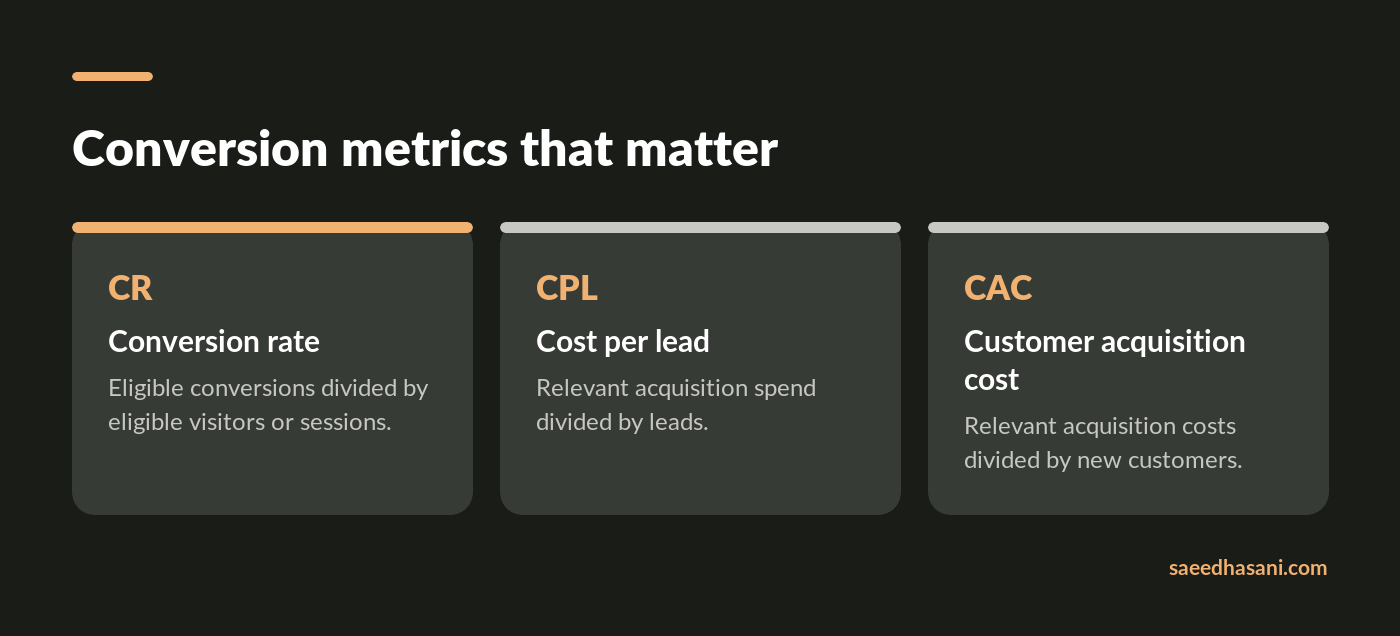
1. Conversion rate percentage: (eligible converting users ÷ eligible users) × 100. If 200 of 10,000 eligible users convert, the user conversion rate is 2%. For a session-based metric, count eligible sessions containing the action and divide by eligible sessions instead.
2. Number of net new customers required: target new-customer revenue ÷ expected revenue per new customer. For example, a $30,000 new-customer revenue target at $1,000 per customer requires 30 new customers. If the business is measuring net customer growth rather than newly acquired customers, it must also account for customers lost during the period.
3. Lead goal: required new customers ÷ expected lead-to-customer conversion rate expressed as a decimal. At a 20% close rate, 30 customers require an estimated 150 qualified leads. If 3% of eligible visitors become qualified leads, this implies roughly 5,000 eligible visitors. These are planning assumptions, not forecasts.
Consider a hypothetical campaign with 10,000 eligible visits and $5,000 of advertising spend. Its lead conversion rate improves from 2% to 3%, while the lead-to-customer rate remains 20%.
| Metric | Before | After |
|---|---|---|
| Eligible visits | 10,000 | 10,000 |
| Lead conversion rate | 2% | 3% |
| Leads | 200 | 300 |
| Customers at 20% close rate | 40 | 60 |
| Advertising cost per lead | $25 | $16.67 |
| Advertising cost per customer | $125 | $83.33 |
The difference is one percentage point or a 50% relative uplift. Full customer acquisition cost would also include relevant sales and marketing costs beyond advertising. If lead quality deteriorates, the close rate may fall and change the result. Conversion optimization should therefore connect web analytics to downstream customer and revenue data rather than extrapolate from a form submission alone.
What Impacts Conversion?
Users make decisions in context. They need to understand what is offered, whether it fits their needs, whether the business is credible and what will happen after taking action. Conversion optimization begins by investigating these questions rather than assuming visitors need more persuasion.
Common barriers include unclear headlines, inconsistent landing-page messaging, hidden fees, unnecessary form fields, inaccessible controls, slow loading, confusing navigation, technical errors and insufficient information at important decision points. On mobile, tap targets, readable text, keyboard behavior and intrusive overlays can be especially important.
Persuasion principles offer useful hypotheses when applied responsibly. Reciprocity means offering genuine value before asking for commitment. Commitment can mean helping users progress through appropriate small steps. Social proof and authority rely on authentic reviews, relevant evidence or verified expertise. Liking and unity relate to rapport and shared needs, while scarcity concerns real limitations on availability. These principles should support informed choices, not conceal material terms or create false urgency.
No color, headline formula or layout works for every audience. A simplified page may help one segment while removing essential information for another. Treat conversion optimization best practices as hypotheses to investigate in your own context.
Conversion Rate Optimization Process
A repeatable process is more useful than a list of disconnected tactics. Start with the business problem and build a continuous conversion optimization program with an accountable owner, access to reliable data and enough design and development capacity to act on findings.
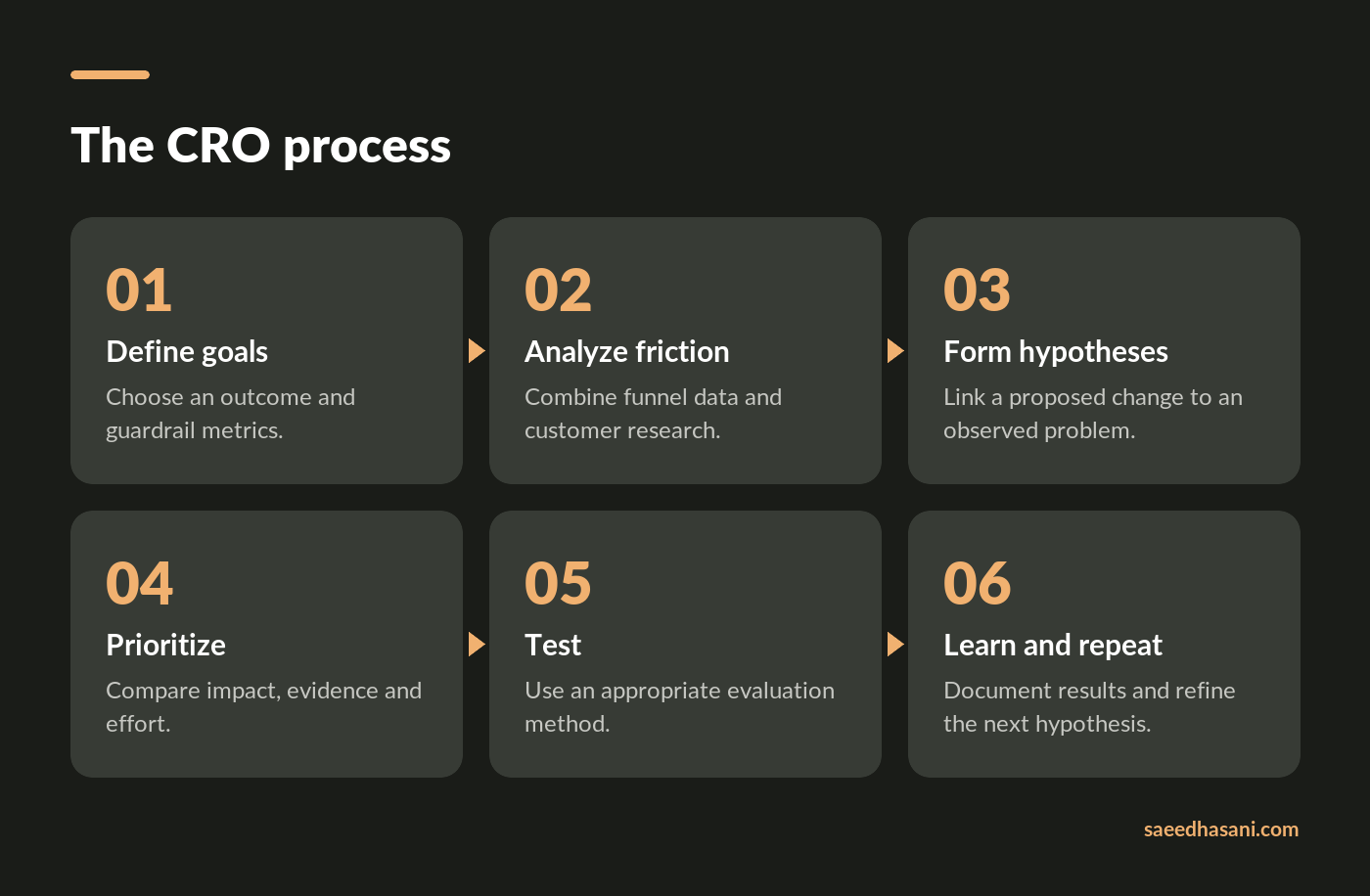
- Start with the why. Specify the valuable outcome, baseline and guardrails. Decide whether the focus is qualified leads, revenue per visitor, paid activation or another meaningful result.
- Analyze and hypothesize. Examine funnel reports, customer interviews, support enquiries, usability sessions and technical defects. Form a hypothesis that links observed friction to a proposed change and expected effect.
- Prioritize. Compare expected reach, business impact, strength of evidence and implementation effort. Give attention to high-traffic or underperforming pages where meaningful improvements are possible.
- Test and experiment. Choose an evaluation method suitable for the question and traffic available. Set success criteria and guardrail metrics before collecting results.
- Learn, test and repeat. Record the outcome, uncertainty and implementation decision. Fix verified defects, retain useful learning from unsuccessful tests and feed the findings into the next round of research.
A digital marketing audit can help establish the initial measurement and website baseline. A funnel report may show that many users leave the pricing page, for example, while interviews reveal uncertainty about onboarding costs. A better hypothesis is to clarify the relevant costs and process rather than simply change a button color.
Use an impact-confidence-effort scoring framework for conversion optimization as a discussion aid rather than a precise prediction. Document why an idea matters and what evidence supports it. A known broken checkout or inaccessible form should generally be repaired directly, not left defective simply to run an experiment. Establish the resources and business case for continuing the program after the first round of changes.
9 Powerful Strategies to Optimize Conversion Rates
These nine conversion optimization strategies address common obstacles from the first impression to the experience after conversion. Choose them according to research findings, rather than applying all nine at once.
- Clarify the value proposition above the fold. Explain who the offer is for, what problem it addresses and why it is relevant. Match the promise of the advertisement or search result that brought the visitor to the page. Give mobile users enough context before asking them to act.
- Write compelling, specific headlines. Replace vague slogans with language that communicates a meaningful outcome or useful distinction. Use customer language gathered through interviews, sales discussions and search queries. Check that the supporting copy substantiates the headline rather than making unsupported promises.
- Use emotional and contextual visuals. Show the product, service or experience in a context that helps users understand its relevance. Demonstrations, useful screenshots and authentic photographs can reduce uncertainty. Ensure the imagery does not slow the page unnecessarily or exclude users who need accessible alternatives.
- Strengthen social proof at decision points. Place genuine testimonials, relevant case studies, verified ratings or meaningful evidence close to the decisions they support. Do not fabricate reviews or imply that exceptional results are typical. Explain material conditions where a claim depends on them.
- Use genuine urgency and scarcity. Explain a real booking deadline, limited inventory or an actual offer expiry when relevant. Avoid countdown timers that reset, invented stock warnings and misleading discount claims. Trust is a business asset, not something to trade away for a short-term increase in clicks.
- Optimize CTA language for commitment. Make the next action and its consequence clear. A button such as Request a Demo describes a different commitment from Buy Now. Place the primary action where it fits the information sequence and avoid competing calls to action that obscure the intended journey.
- Simplify forms and checkout. Remove fields that are unnecessary for the decision, use appropriate input types and make errors specific and recoverable. Preserve fields genuinely required for qualification or fulfillment. Explain delivery fees and other material terms early. Test completion on mobile and with keyboard navigation.
- Improve page speed, usability and accessibility. Investigate slow interactions, oversized assets, layout shifts, difficult navigation and poorly functioning controls. Prioritize actual user problems and validate changes on representative devices. A technically fast page still needs clear information, and an attractive page still needs working controls.
- Use relevant recommendations and reinforce retention. Offer complementary products or helpful next steps when they fit the customer’s needs. Monitor average order value and contribution margin instead of simply maximizing add-ons. After conversion, provide clear confirmation, onboarding or support so that customers can achieve the outcome they expected.
Each conversion optimization strategy should address an observable problem, a measurable goal and a decision rule. Combining several changes into one experiment can test an overall experience, but it makes it harder to identify which component caused the difference.
Where to Implement a CRO Strategy
Conversion optimization should follow the customer journey. The best starting point is not automatically the homepage. Review traffic, potential value, drop-offs and the specific purpose of each page before prioritizing.
| Website area | Potential improvement | Relevant outcome |
|---|---|---|
| Homepage | Clear proposition and navigation | Relevant next-page engagement |
| Pricing page | Transparent plans and limitations | Qualified demo or purchase |
| Blog | Contextual next steps aligned with intent | Engaged visits and qualified enquiries |
| Landing page | Campaign message match and a focused CTA | Eligible completion rate |
| Product page | Useful details, images and delivery information | Purchase and return rate |
| Forms and checkout | Fewer unnecessary steps and clear validation | Completion and quality |
| Site search | Relevant results and useful no-result recovery | Product discovery and purchases |
Site search deserves particular attention in ecommerce conversion optimization. Visitors who search often have a specific need. Analyze frequent queries, zero-result searches and product discovery problems. Improve synonyms, filtering and relevance where necessary. Personalized recommendations may help users find suitable products, but evaluate whether they improve the experience and respect privacy requirements.
A pricing page or booking page can be particularly important for a bottom-of-funnel strategy, while informational content should help visitors progress naturally without forcing a premature sales action. Measure micro-conversions to diagnose intermediate steps, but retain a clear connection to the main outcome.
What Tools Are Used for Conversion Optimization?
Conversion optimization tools should answer research questions rather than dictate the strategy. A conversion optimization toolkit typically includes analytics, usability research, testing and reporting capabilities. The appropriate combination depends on available traffic, technical resources and the complexity of the journey.
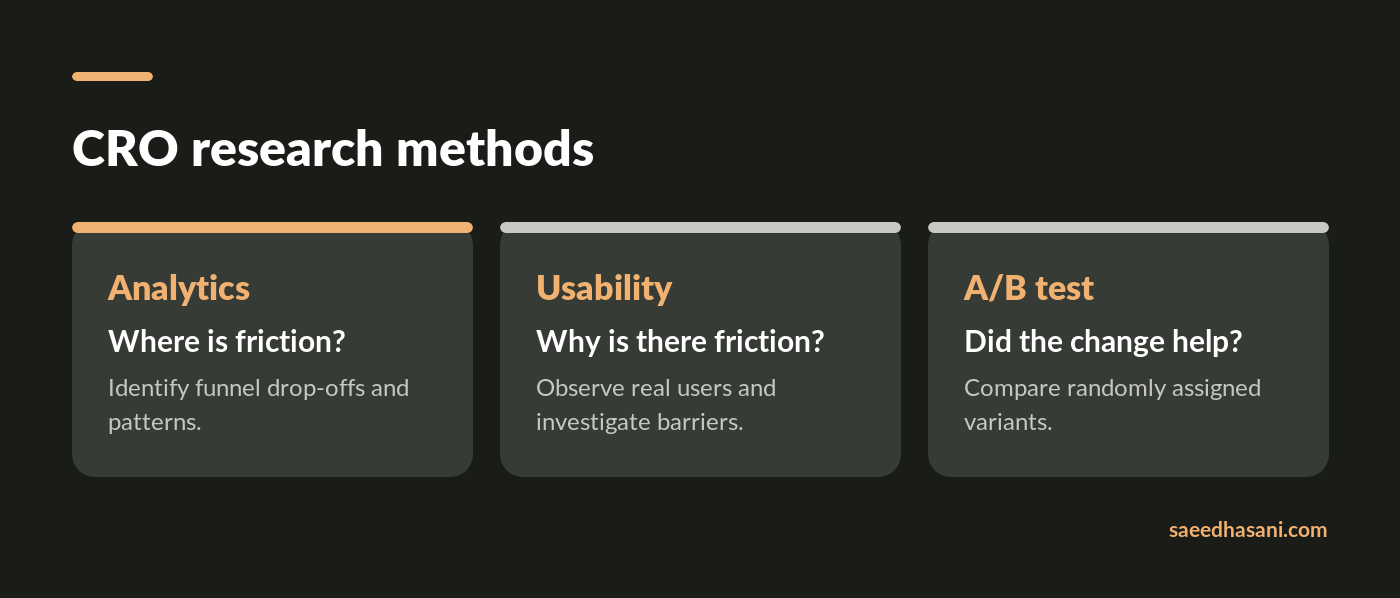
Web analytics tools help identify where visitors enter, navigate and abandon a journey. Funnel analysis, segmentation and event tracking can reveal patterns, although observational data alone cannot establish the cause of a problem. CRM and sales data help connect leads to downstream qualification, opportunities and actual customers.
Behavior analysis tools can show interaction patterns through heatmaps and session recordings where appropriate. Surveys, interviews and usability testing can reveal why users hesitate or fail to complete a task. Do not infer every visitor’s intention from a heatmap. Collect only necessary information, protect sensitive fields and implement applicable privacy and consent requirements.
A/B testing platforms help assign traffic to variants and evaluate predefined metrics. Multivariate testing investigates combinations of changes, but typically requires enough traffic to distinguish their effects. Landing-page builders and conversion calculators can help implement ideas and model potential outcomes. Performance testing and accessibility checks identify technical barriers that should not depend on a marketing experiment to be addressed.
A CRO strategist establishes objectives and prioritization; a CRO analyst investigates measurement and evaluates results; designers develop clearer experiences; developers implement reliable, accessible changes. Small teams may combine these responsibilities, but conversion optimization still needs both research and implementation expertise.
A/B Testing: Data-Driven Decisions That Deliver
An A/B test compares a control experience with one or more alternatives using an appropriate assignment method. Random assignment helps balance other influences between groups, making differences more interpretable than a simple comparison between two time periods.
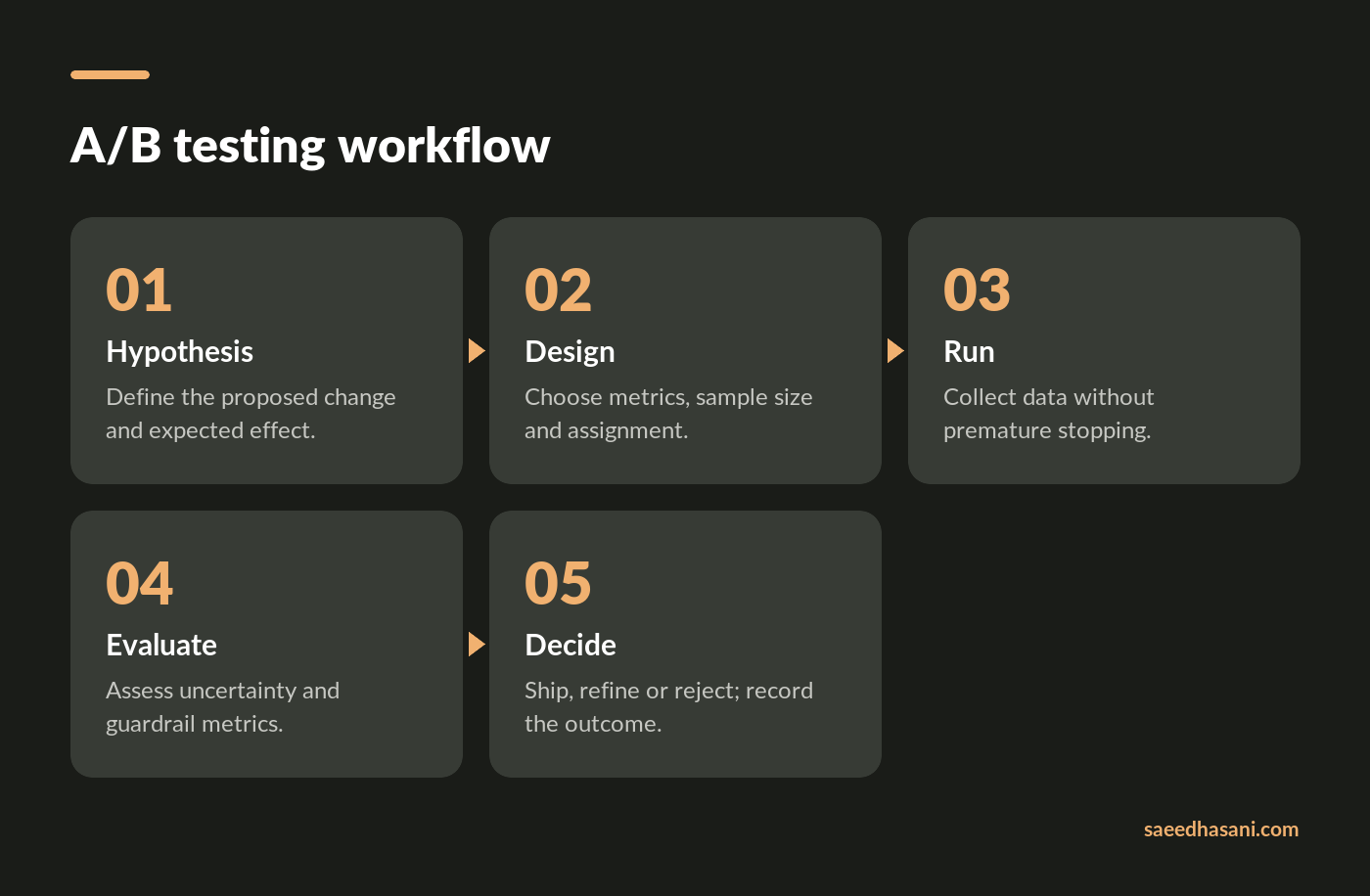
Before starting a conversion optimization experiment, specify the primary outcome, eligibility rules, minimum effect worth detecting, required sample size, test duration and statistical method. Define guardrails such as returns, qualified lead rate, page performance or support requests. Check instrumentation and assignment before relying on the data.
For a standard fixed-horizon experiment, avoid stopping simply because an early result looks favorable. Use the planned analysis or a valid sequential method designed for ongoing evaluation. Include relevant business cycles and consider whether repeated exposure, seasonal changes or interaction with other experiments could affect the interpretation.
In a conversion optimization experiment, test a single well-defined variable when the goal is to isolate its effect. A larger redesign can be a valid experiment when the question concerns the entire experience. Be careful with multiple outcomes and post-hoc segment comparisons, which can produce apparently interesting results by chance.
Not every idea will improve the conversion rate. An uncertain or negative result is useful when the experiment was well designed. Record what was learned, distinguish absence of evidence from evidence of no meaningful effect and avoid presenting an inconclusive test as a confirmed win. Low-traffic businesses can prioritize usability research, verified bug fixes and cautious monitoring instead of forcing underpowered experiments.
Conversion Rate Optimization Examples
Experiment ideas illustrate how context changes the answer. One published example compares a real book cover with an abstract visual; another explores predicting a visitor’s next useful action. These illustrate possible test questions, not universal design rules. A realistic product image may improve comprehension in one situation and be less effective in another.
Imagine a B2B landing page where sales feedback and user interviews reveal uncertainty about the demo process. A conversion optimization hypothesis is to explain what happens after submitting the form, how long the meeting lasts and what information is required. Measure qualified demo requests per eligible visitor, and check show-up and opportunity rates to avoid optimizing for low-quality submissions.
In ecommerce, shoppers may abandon a checkout because delivery charges appear late. Test showing accurate shipping information earlier, or repair the information gap directly if it is a clear usability defect. Evaluate completed purchases, order value, refunds and margin. If a change raises checkout completion but lowers total contribution, it may not be the right commercial decision.
For each example, distinguish a proposed hypothesis from a measured result. Before-and-after data may be influenced by acquisition mix, seasonality or pricing changes. Controlled experiments or other carefully designed evaluation methods provide stronger evidence when feasible.
How CRO and SEO Work Together
Search engine optimization focuses on attracting relevant organic traffic, while conversion optimization focuses on improving the experience and outcomes of eligible visitors. Their objectives differ, but they often reinforce each other when content addresses genuine customer needs.
For example, an informational search about choosing software may be best served by a useful comparison guide with a relevant next step. A transactional query may warrant a product or service page with transparent information and a clear purchase or enquiry option. Matching the page to intent can support both discovery and conversion, although neither improved rankings nor increased conversion is guaranteed.
Align search landing pages with their purpose, keep important content accessible to users and search engines, improve technical usability and use contextual CTAs. Evaluate organic traffic quality, engaged visits, qualified leads and pipeline value rather than judging every SEO page by immediate sales.
Retargeting can bring interested visitors back to a relevant offer, but it does not resolve unclear messaging or broken forms. Assess incremental impact, frequency, acquisition cost and audience eligibility, and respect applicable privacy requirements. Retargeting is a complementary acquisition tactic, not a substitute for conversion optimization.
CRO Best Practices
Build a continuous conversion optimization program with clear ownership, consistent measurement, customer research and an evidence-based testing backlog. Review results with the people responsible for product, marketing, sales and development. Prioritize changes that solve meaningful customer problems and align with long-term commercial value.
Track lead quality, customer acquisition cost, revenue per eligible visitor, margin, cancellations, repeat purchases and satisfaction where relevant. A single conversion optimization metric cannot describe the complete customer journey. Maintain a record of research findings, hypotheses, tests, decisions and subsequent monitoring so the program learns rather than repeats the same ideas.
Ultimately, conversion optimization should make it easier for suitable customers to make informed decisions and receive the value they expect. Use best practices as starting points, test when feasible and protect the experience of people who choose not to convert as well as those who do.
Frequently Asked Questions
What Are the Core CRO Techniques?
Core conversion optimization techniques include funnel analysis, customer research, usability testing, landing-page optimization, clearer messaging, form improvements and controlled experimentation. Choose techniques based on the problem and measure meaningful outcomes rather than implementing a universal checklist.
How Do You Define the Right Conversion Goals for CRO?
Start with a business outcome such as qualified leads or completed purchases, define the eligible population and measurement method, and select diagnostic micro-conversions and guardrails. Align the goals with the page’s role in the customer journey.
How Important Is Retargeting in Conversion Rate Optimization?
Retargeting may support conversion optimization by bringing interested people back to relevant content. Its value depends on audience fit, incremental outcomes, costs and privacy requirements. It should complement improvements to the original experience.
How Long Should a CRO Test Run?
There is no fixed universal duration for a conversion optimization test. Plan an experiment around the baseline, traffic, minimum meaningful effect, statistical method and business cycles. Do not stop a conventional fixed-horizon test early just because the observed result appears favorable.
Can Conversion Optimization Work With Low Website Traffic?
Yes. Start with usability sessions, customer interviews, technical repairs and high-confidence improvements. A controlled experiment may take too long to produce useful evidence when traffic is limited. Monitor outcomes carefully and avoid overstating causal conclusions.







Responses