
Digital Marketing: 7 Essential Steps to Avoid Costly Mistakes


Digital marketing is the use of digital channels, technologies and data to reach an audience, communicate value and support measurable business objectives. Search engines, websites, social networks, email, online advertising and mobile applications are familiar examples. The challenge is not simply to be present on these channels. It is to choose the right combination for your customers and connect the work to meaningful outcomes.
A company can spend heavily on ads, publish frequently and attract thousands of visitors without creating a profitable customer relationship. A useful digital marketing strategy starts with the offer, audience and business goal, then establishes how to reach, engage, convert and retain customers.
This guide explains the main channels, the customer journey, essential tools and metrics, and seven practical steps for building a plan. It also examines common mistakes, career paths and emerging developments so that beginners can understand how the pieces fit together.
Content Overview:
What Is Digital Marketing?
Digital marketing includes marketing activities delivered through digital devices, platforms and technologies. Online marketing is a major part of it, but some digital activity, such as SMS messaging or digital signage, can reach people without an active web browsing session. The terms are often used interchangeably when discussing websites, advertising and online communication.
The core purpose is to connect a relevant audience with an offer, using appropriate messages and interactions throughout the customer lifecycle. That might mean introducing a new brand, educating potential buyers, generating qualified enquiries, making sales or helping existing customers get more value from a product. The right objective depends on the business and the needs of the audience.
Three useful categories describe how digital marketing reaches people. Owned media includes a company’s website, email list and other assets it controls. Paid media includes advertising placements, sponsored content and other purchased distribution. Earned media includes voluntary coverage, customer reviews, recommendations and mentions. A social media account is an owned presence in a practical sense, but the platform controls access, distribution and its policies. An email list or website provides a more direct relationship, subject to the applicable permissions and technical infrastructure.
Digital marketing developed as the internet became accessible to consumers and businesses. Early websites and email enabled direct communication, search engines helped people discover information, and online advertising introduced more granular targeting and measurement. Social platforms and smartphones expanded the contexts in which customers could discover, discuss and buy products. Today, automated systems and AI-assisted tools support many tasks, but clear positioning, customer understanding and reliable measurement remain essential.
Businesses of different sizes can use digital marketing. A local service provider may prioritize search visibility and booking enquiries; an online retailer may focus on product discovery and purchases; a B2B company may use educational content and email to support a longer sales cycle. Nonprofit organizations can use similar channels to inform supporters and encourage participation. Not every organization needs every platform, and channel selection should reflect how its audience actually makes decisions.
Digital Marketing vs. Traditional Marketing
Traditional marketing commonly includes printed materials, direct mail, outdoor advertising, radio and television. Digital marketing uses digital devices and media to distribute information and facilitate interactions. The distinction is not absolute: a broadcast advertisement can be delivered through a digital streaming service, and a printed brochure can direct readers to a website.
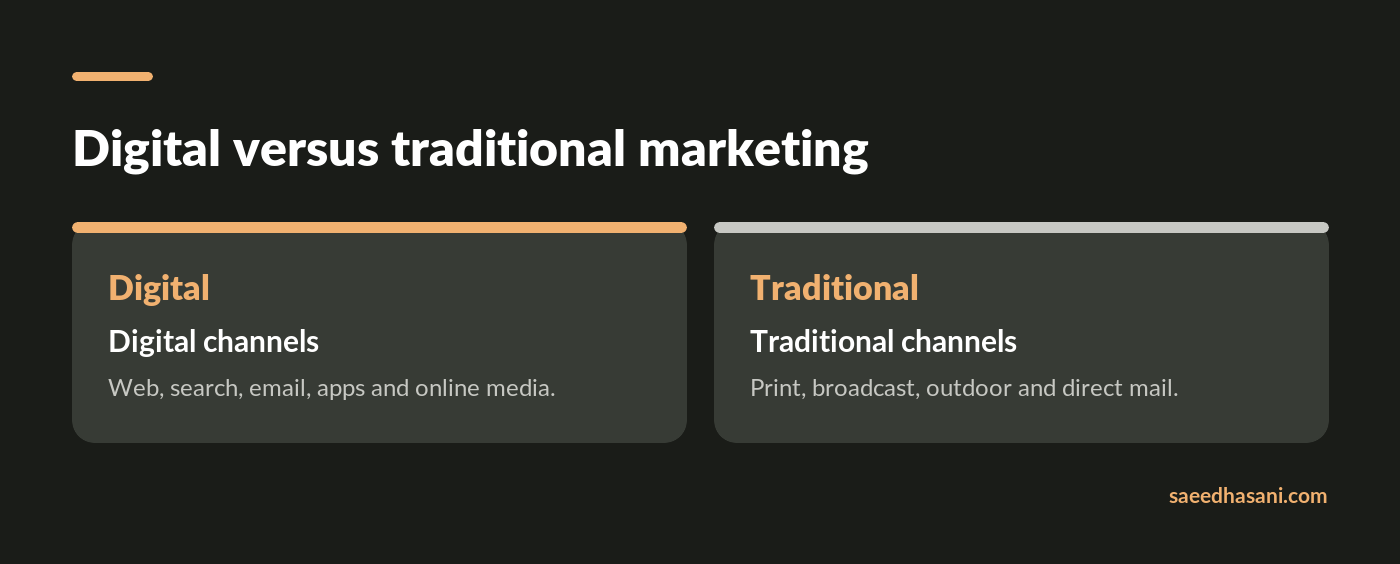
| Factor | Digital marketing | Traditional marketing |
|---|---|---|
| Distribution | Websites, search, email, apps and digital media | Print, broadcast, outdoor and direct mail |
| Targeting | May use search intent, location, context and permitted audience data | Often based on geography, publication readership or audience demographics |
| Interaction | Clicks, comments, forms, purchases and other online actions | Calls, visits, responses to mail or other offline actions |
| Measurement | Event tracking and campaign reports, with attribution limitations | Audience estimates, response codes, surveys and sales analysis |
| Flexibility | Many campaigns can be revised while running | Changes may depend on production schedules and booked placements |
Digital campaigns may offer more flexible budgets and rapid feedback, but they are not automatically cheaper or more effective. Competitive auctions, content production, software and skilled staff all cost money. Traditional media may be useful for broad awareness or reaching audiences that spend less time online. A business could combine a local radio campaign with a dedicated landing page, track calls and enquiries, and compare responses with its baseline. The goal is a coherent customer experience, not a contest between online and offline channels.
Why Is Digital Marketing Important?
Digital marketing matters because many purchasing decisions begin with an information search, a recommendation, a product comparison or another digital interaction. A useful online presence gives people access to accurate information when they need it, including outside business hours. It can also help companies respond to customer questions and present a consistent brand personality.
The major advantages include:
- Relevant reach: communicate with people who have a reason to care about the offer, using appropriate geographic, contextual or intent-based targeting.
- Brand awareness: build familiarity through consistent, distinctive communication rather than relying on a single advertisement.
- Community engagement: listen to feedback, answer questions and develop relationships through channels that support conversation.
- Measurable performance: observe eligible visits, leads, purchases and other events, then evaluate outcomes against a defined objective.
- Efficient resource allocation: direct effort toward activities with a plausible contribution to business goals and adapt when the evidence changes.
- Customer lifecycle support: educate prospective buyers, remove barriers to purchase and provide helpful post-purchase communication.
These benefits can help smaller organizations compete in focused markets. A local firm does not need to outspend a national brand everywhere; it can concentrate on relevant queries, a specific geographic market and a better experience for customers it is able to serve. However, access to a platform does not guarantee equal visibility, affordable acquisition or positive returns. The quality of the offer, competitive conditions and the team’s execution still matter.
As customer behavior and platforms have evolved, digital marketing has become less about maintaining a static website and more about coordinating multiple interactions. The same buyer might discover a business through social content, search for reviews, revisit the website and speak to a sales representative. A useful strategy makes these interactions coherent. Measurement is valuable precisely because the customer journey is not always simple or fully observable.
The Cornerstones of Digital Marketing
Before choosing channels, establish the foundations. A useful product or service, credible brand vision and well-defined customer profiles give digital marketing a direction. Advertising cannot reliably compensate for an offer that does not solve a meaningful problem, inaccurate information or an experience that disappoints customers after purchase.
Start by identifying the audience’s situation, goals, objections and decision criteria. Customer profiles should reflect research rather than invented demographic stereotypes. Interviews, support requests, sales discussions, search behavior and customer feedback can reveal how people describe their needs. Competitive research helps identify alternatives and gaps in the market without copying a competitor’s message or assuming that its campaigns are profitable.
Brand guidelines should establish the visual identity, voice, factual claims and tone that the team can use consistently. Core assets include a well-maintained website, relevant content, a permission-based contact database, verified business profiles, product information, photographs and measurement documentation. Treat these assets as ongoing responsibilities rather than one-off campaign materials.
The 5D framework provides a practical way to understand the environment in which digital marketing operates:
- Digital devices: smartphones, computers, tablets and other connected devices through which people interact.
- Digital platforms: search engines, social networks, marketplaces, websites and applications.
- Digital media: the formats and distribution methods used to communicate, such as content, ads and email.
- Digital data: information about eligible interactions, campaign performance and customer relationships.
- Digital technology: the systems used to create, deliver, manage, automate and evaluate marketing activities.
These elements work together. A campaign may reach a buyer on a smartphone, through a search platform, using an ad that links to a website, while analytics records an eligible event. A CRM system may then help manage an enquiry. The business should understand what it can measure, which systems control the data and where consent or other permissions are required.
The Major Digital Marketing Channels Explained
Digital marketing channels are the routes through which businesses communicate and support customer decisions. Some capture existing demand, others help develop awareness, and others nurture an ongoing customer relationship. They overlap, but their objectives and cost structures differ.
1. Search engine optimization (SEO). SEO aims to improve the discoverability of useful, accessible website content in organic search. It includes technical optimization, crawlability and indexing, keyword research, relevant content creation, internal linking and earning legitimate external references. Local businesses may also need accurate business profiles and location-specific information. SEO is an ongoing discipline, not a guarantee of rankings. Prioritize pages that address genuine search intent and ensure that search visitors can find the next appropriate action.
2. Pay-per-click advertising (PPC) and search engine marketing (SEM). Paid search enables businesses to compete for ad placements on relevant search queries, typically through an auction. PPC describes a payment model based on clicks, whereas SEM is often used to describe paid search and sometimes the wider search marketing field. Define conversion goals, budget limits, relevant landing pages and exclusion criteria. A click has little commercial value if the person cannot find the information promised by the advertisement.
3. Content marketing. Guides, articles, demonstrations, case studies, videos and other useful materials help audiences understand problems and make informed decisions. Content may also support SEO, email and sales conversations. Select topics according to audience needs and the customer journey; update inaccurate information and measure the contribution of content to the relevant objective.
4. Social media marketing (SMM). Organic social media supports communication, community and distribution through posts and conversations. Paid social media ads purchase reach and may support awareness, traffic, enquiries or sales. Each platform has different audience behavior, formats and reporting conventions. Choose platforms based on relevant audience activity and the resources needed for consistent participation, rather than copying every popular trend.
5. Email marketing. Permission-based email can inform subscribers, nurture leads, communicate product updates and support existing customers. Segmentation helps make messages relevant. Use clear subject lines, accessible design and straightforward opt-out mechanisms, following applicable rules. Monitor delivery, clicks, conversions and unsubscribes. An increase in opens does not necessarily mean a campaign created valuable customer outcomes, particularly when privacy features affect reporting.
6. Video marketing. Product demonstrations, tutorials, customer stories and explanations can make complicated information easier to understand. Long-form videos may serve research-oriented audiences; short videos can introduce ideas or demonstrate a specific feature. Captions, clear audio and relevant landing pages improve usefulness. Evaluate viewing behavior together with the action the video is intended to support.
7. Influencer marketing. Collaborating with creators can introduce an offer through a relevant audience and trusted context. Evaluate audience fit, genuine engagement, brand suitability, contractual terms and the quality of resulting traffic. Paid or compensated endorsements should be appropriately disclosed. Follower counts alone do not establish commercial value.
8. Affiliate marketing. Affiliates promote a product or service and may receive compensation when a defined action is attributed to their referral. A program needs clear eligibility, commission terms, tracking, disclosure and fraud controls. Our guide to affiliate marketing explains these relationships in more detail. The channel can complement other digital marketing activities without guaranteeing incremental sales.
9. Display advertising and programmatic buying. Display ads include visual placements across websites, applications and other digital environments. Programmatic buying uses automated systems to manage ad opportunities, bidding and delivery. Reach, frequency, viewability, placement quality and brand safety matter, in addition to clicks. Retargeting can remind eligible previous visitors about a relevant offer, but repeated exposure does not prove that advertising caused a sale.
10. Mobile marketing. Mobile-friendly websites, apps, SMS and appropriate notifications can help people act in contexts where a computer is not convenient. Optimize loading, readability, forms and payment interactions for mobile devices. Avoid disruptive messages and use permission-based communication. A desktop campaign may need different creative or landing-page treatment on mobile.
11. Audio and podcast marketing. Podcasts, streaming audio and sponsorships may reach listeners during activities when visual content is impractical. Educational episodes can establish familiarity with a topic, while carefully matched sponsorships introduce offers. Unique landing pages or campaign codes can provide useful response signals, although they do not capture every effect.
12. Conversational marketing and chatbots. Live chat, automated messaging and other conversational interfaces help answer questions, route requests and assist customers. Use accurate information, protect sensitive data and provide a clear route to human assistance when appropriate. Measure whether the interaction actually resolves a need rather than simply counting messages.
These channels should be considered as a portfolio. For instance, search ads can capture active demand, content can answer questions, email can support follow-up, and social channels can introduce a brand. The best allocation depends on the audience, the offer and the economics of acquisition.
Digital Channels and Platforms
A website is often the foundation of a digital marketing strategy because it can contain accurate information, clear offers, useful content and a measurable path to the desired action. A business does not control search engine rankings or social media algorithms, but it can maintain its own website and improve the experience it provides.
Prioritize website speed, mobile usability and accessibility. Use visual hierarchy to help visitors understand what matters on each page. Focus each page on a meaningful purpose while providing enough information to support a decision. Familiar navigation conventions and straightforward forms are generally more useful than decorative complexity. Experiment consistently when there is evidence that a change could resolve a problem; do not redesign purely because a competitor has changed its layout.
Digital channels and platforms serve different roles. Search engines help people find information; social networks facilitate discovery and conversation; advertising platforms distribute paid messages; email services help manage communications; video platforms support demonstrations and education; and mobile applications enable ongoing interactions. A blog supports research and education, while a campaign-specific landing page can help a visitor understand a particular offer.
Before investing in any platform, consider audience fit, creative requirements, access to customer data, operating costs, measurement options and platform dependency. Document ownership of accounts, access permissions and recovery procedures. If a business relies on an external agency or contractor, it should retain appropriate access to its own website, advertising accounts and reporting data. A platform should support the strategy, not become the strategy.
The Digital Marketing Funnel: How Channels Work Together
The marketing funnel organizes activities according to the customer’s stage of decision-making. It is a planning model rather than a literal description of every person’s journey. Buyers can skip stages, return to earlier questions or move across channels before deciding.
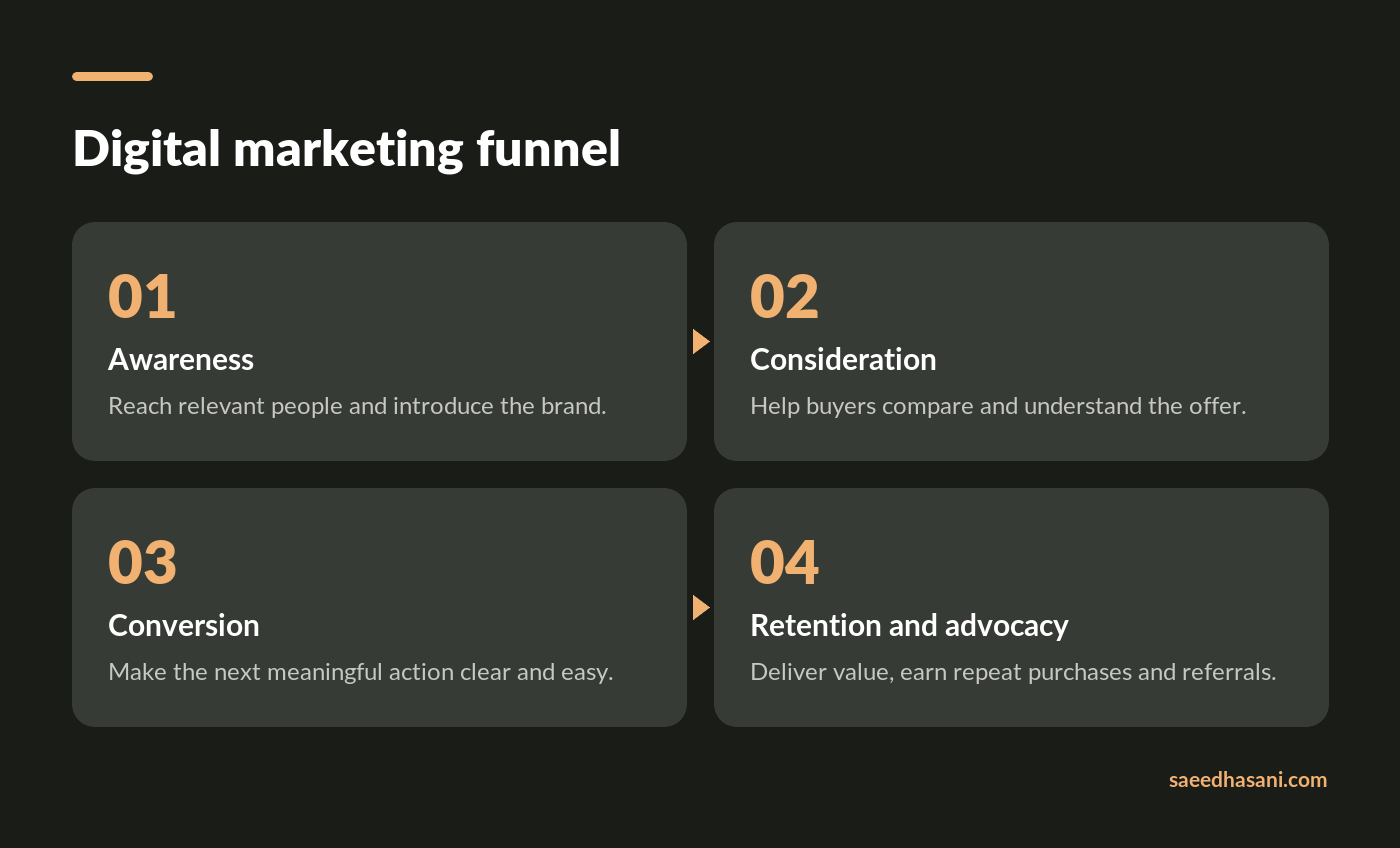
| Stage | Customer need | Example activity | Useful measure |
|---|---|---|---|
| Top of funnel (TOFU) | Recognize a problem or discover an option | Educational video, discovery content or awareness advertising | Relevant reach, engaged visits |
| Middle of funnel (MOFU) | Compare approaches and understand value | Guide, case study, product demonstration, email nurture | Useful engagement, qualified enquiries |
| Bottom of funnel (BOFU) | Evaluate the offer and decide | Pricing page, demo, product page, checkout | Qualified conversions, sales |
| Post-purchase | Receive value and obtain support | Onboarding, helpful updates, customer service | Retention, repeat purchase, satisfaction |
Imagine a small business looking for appointment software. A manager first watches a video about reducing scheduling errors, later searches for comparisons, then reads a product guide and requests a demonstration. After becoming a customer, the manager receives onboarding resources and may eventually recommend the software. Different digital marketing channels can support each stage. No individual interaction necessarily deserves all the credit for the final sale.
Customer relationship management (CRM) helps organize information about leads and customers across the lifecycle. A CRM system can record enquiries, ownership, consent status, follow-up activity and sales outcomes. Marketing automation may help deliver relevant messages when appropriate conditions are met. Coordinate these systems with sales and customer support so that a person does not receive irrelevant messages after purchasing or requesting assistance.
The funnel is incomplete if it ends at acquisition. Retaining customers, resolving concerns and earning voluntary advocacy can contribute to business value. Track relevant outcomes after the initial conversion and evaluate whether the original promise was fulfilled. The objective is not to force every visitor through a predetermined sequence, but to provide helpful options at each point of need.
How to Build a Digital Marketing Strategy: 7 Essential Steps
Use these seven steps to create a digital marketing plan that is grounded in business objectives. The process applies to a new campaign or an existing program that needs improvement. Adapt the level of detail to the size and complexity of the business.
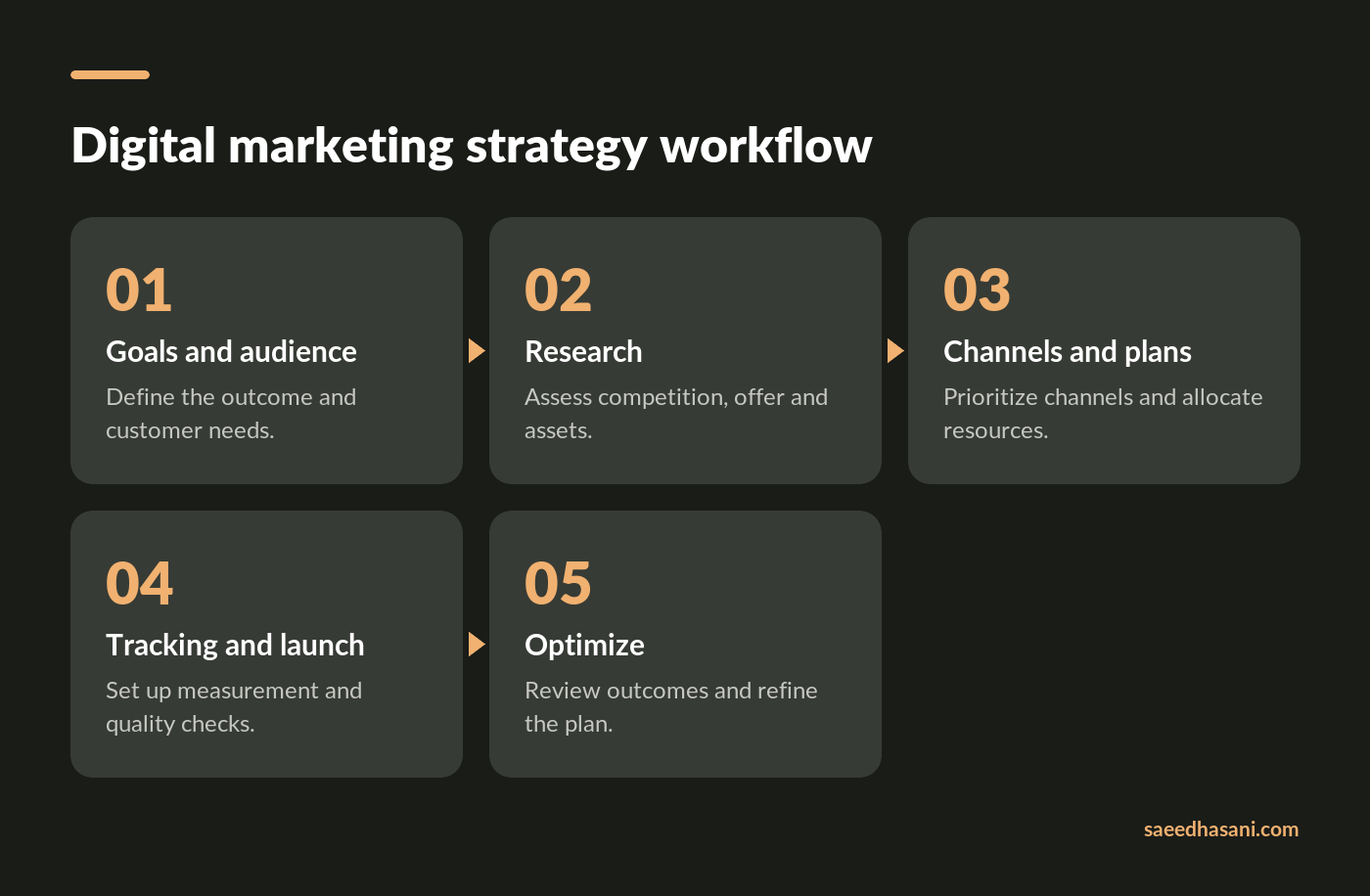
- Define your goals clearly. Identify what business outcome the activity should support. Examples include generating qualified enquiries for a local service, acquiring paying customers for an online product or improving repeat purchases. Establish a baseline, timeframe and budget constraints. Choose measurable objectives that connect to the business rather than setting a traffic or follower target simply because it is easy to report.
- Know your audience deeply. Research who needs the offer, what motivates their search, what alternatives they consider and which objections prevent action. Speak with customers and sales staff, review support questions and examine relevant search and website behavior. Build profiles around real decision criteria. Distinguish people who are likely to buy from those who may only be curious or outside the service area.
- Analyze your competitive landscape and assets. Evaluate competitors’ public offers, messaging, search visibility and customer experience. Identify your own strengths, missing information, technical problems and measurement gaps. A digital marketing audit can help structure this review. Do not assume another company’s visible activity is profitable; its budget, margins and objectives may differ from yours.
- Choose your priority channels. Select a manageable number based on audience behavior, intent, resources and expected economics. For a local service with established demand, search visibility and accurate location information may be a useful starting point. A new visual product may benefit from demonstrations and creator content. A B2B company may require research-oriented content and a reliable enquiry process. You do not have to do it all at once.
- Create content, channel plans and a budget. Map messages and formats to the customer journey. Assign responsibilities, establish editorial standards and determine production, distribution and technology costs. Plan a consistent publishing or communication schedule that the team can sustain. Set an experimental budget and clear criteria for reviewing spend; leave room for learning rather than committing everything to an untested assumption.
- Implement tracking and launch carefully. Configure meaningful events, campaign naming and relevant CRM fields before launching. Check links, mobile pages, forms, checkout, permissions and accessibility. Ensure advertisements and landing pages communicate consistent information. Define how the team will identify errors and respond to customer enquiries. A campaign should not send more visitors into a journey that is known to be broken.
- Measure, analyze and optimize continuously. Review actual outcomes against the baseline and business objectives. Investigate differences by channel, device and audience where the data supports it. Identify what is working, what requires further evidence and what should be changed or stopped. Document experiments and monitor lead quality, profitability and retention as appropriate. Revisit the plan when the offer, market or customer needs change.
Consider a hypothetical local professional service that wants more suitable appointment enquiries. The business first documents its current enquiry volume and capacity. It researches common questions, improves its service information and booking process, prioritizes relevant search queries and establishes a reporting system that distinguishes genuine enquiries from spam or duplicate submissions. It then tests messages or page improvements and compares the results against the agreed objective. This is a practical digital marketing strategy because each activity has a role and a way to evaluate its contribution.
For budgeting, distinguish working media spend from production, tools, staff time and other execution costs. A channel with inexpensive clicks can still be expensive if few visitors are relevant or the sales team spends significant time screening poor-quality leads. Start with assumptions, observe actual data and adjust the allocation. The aim is to create a repeatable process, not a fixed list of activities that must continue regardless of results.
Key Digital Marketing Metrics Every Beginner Should Know
Analytics help a business evaluate digital marketing, but a metric is useful only when its definition and connection to the objective are clear. Key performance indicators (KPIs) are the subset of measures used to judge progress toward a defined goal. Other measures can help diagnose performance without being the primary success criterion.
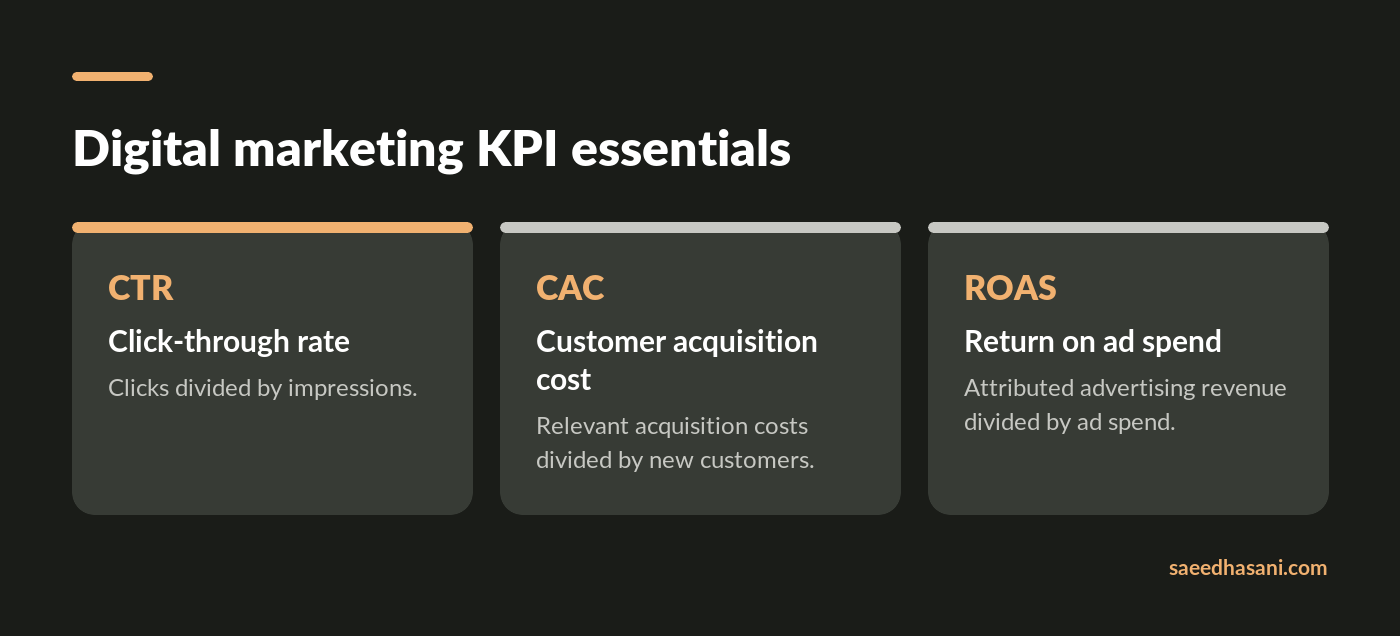
| Metric | Calculation or meaning | Use |
|---|---|---|
| Impressions | Number of recorded ad or content displays | Understand distribution |
| CTR | Clicks divided by impressions × 100 | Evaluate response to a placement or message |
| CPC | Ad spend divided by clicks | Understand traffic acquisition cost |
| CPM | Ad spend divided by impressions × 1,000 | Compare cost per thousand impressions |
| Conversion rate | Eligible converting visits or users divided by matching eligible population × 100 | Evaluate completion of a defined action |
| CPL | Relevant acquisition costs divided by leads | Assess lead acquisition efficiency |
| CAC | Relevant customer acquisition costs divided by new customers | Evaluate customer acquisition economics |
| ROAS | Attributed advertising revenue divided by ad spend | Evaluate reported advertising revenue efficiency |
| ROI | Net gain relative to the defined investment divided by that investment × 100 | Assess economic return under stated assumptions |
| Retention rate | Share of a defined customer cohort retained over a period | Evaluate ongoing customer relationships |
Here is a hypothetical paid campaign. Suppose a business spends $2,000, records 100,000 impressions and receives 2,000 clicks. CTR is 2%, CPC is $1 and CPM is $20. If 1,800 eligible website sessions produce 90 qualified leads, the session-based lead conversion rate is 5%. Advertising cost per qualified lead is approximately $22.22. If 15 of those leads become customers, advertising cost per acquired customer is approximately $133.33; full CAC may be higher when other sales and marketing costs are included.
If $6,000 of revenue is attributed to the campaign, reported ROAS is 3:1. That does not mean the company earned $4,000 of profit. Product costs, fulfillment, staff time, refunds and other relevant expenses affect economic return. Attribution also does not establish how many sales would have occurred without the campaign. These distinctions matter when comparing digital marketing channels or deciding whether to increase spend.
Campaign tagging can improve the consistency of traffic source reporting. Use a defined naming convention for parameters such as source, medium and campaign, avoiding sensitive personal information in URLs. The official Google Analytics campaign tagging guidance explains the use of UTM parameters. Compare reporting across web analytics, advertising systems and CRM records with awareness of their different attribution windows, identity limitations and event definitions.
Conversion rate optimization (CRO) focuses on improving the experience and increasing meaningful actions among eligible visitors. Use customer research, funnel analysis and appropriate experiments to diagnose barriers. The separate guide to conversion optimization explains how to connect this work with qualified outcomes and business value. More traffic is not always the best solution if the existing journey loses relevant users.
Measure channel-specific signals in context: organic visibility and qualified traffic for SEO, delivery and relevant response for email, engagement and audience fit for social activity, and acquisition economics for paid advertising. Avoid treating followers, impressions or rankings as evidence of profit on their own. A concise reporting dashboard should show the objective, baseline, current outcome, limitations and next decision.
Essential Digital Marketing Tools
Tools support research, execution and measurement; they do not replace judgment. Begin with the capabilities necessary for your digital marketing plan, and add software only when it solves a defined problem. Many small teams can work effectively with a simple set of tools before investing in more advanced systems.
| Category | Examples of capabilities |
|---|---|
| Analytics and measurement | Web events, traffic acquisition reports, dashboards and cohort analysis |
| SEO tools | Search Console, crawl diagnostics, keyword research and backlink analysis |
| Paid advertising | Campaign management, targeting, budget controls, conversion reporting |
| Social media management | Scheduling, moderation, community listening and channel reporting |
| Email marketing | Permission management, segmentation, delivery and campaign automation |
| Content creation | Writing, editing, design, video production and editorial planning |
| CRM and marketing automation | Lead records, follow-up workflows, sales handoffs and lifecycle reporting |
Google Analytics and Search Console can support website and search measurement; advertising platform interfaces can manage paid campaigns; CRM tools can help record enquiries and sales outcomes. An organization should compare capabilities, costs, data access and integration requirements rather than assume that a popular product is the best option. Ensure the team understands how the selected systems define a lead, conversion or attributed sale.
Assign ownership and document account access, security, retention and permissions. Validate tracking before trusting reports, and periodically check that integrations still work. Automated actions should have safeguards against duplicate messages, incorrect segmentation or accidental disclosure. Good tools can reduce repetitive work and improve consistency, but decisions should still reflect evidence and customer needs.
Challenges in Digital Marketing
Digital marketing presents challenges that are not solved by simply publishing more content or spending more on ads. Competition, platform changes, limited budgets, incomplete measurement and the need for skilled execution can all affect outcomes. Build a plan that can adapt to these conditions rather than assuming stable costs or guaranteed reach.
Ad fraud and low-quality traffic can distort campaign performance. Monitor unusual activity, irrelevant placements, repeated suspicious interactions and inconsistencies between clicks and genuine website behavior. Use appropriate platform controls and investigate anomalies before concluding that traffic is fraudulent. Lead validation and downstream CRM reporting can help distinguish genuine customer interest from spam or accidental submissions.
Privacy and data protection require particular attention. Collect only information necessary for a legitimate purpose, respect applicable permissions and consent requirements, manage access, protect records and avoid placing sensitive information in tracking URLs. Requirements differ by jurisdiction, channel and data use. Businesses should obtain appropriate advice about their obligations rather than assume that a software default resolves them.
Measurement gaps are unavoidable when people move across devices, interact offline or restrict tracking. Avoid presenting estimated attribution as precise causation. Consider customer feedback, operational records, controlled experiments where feasible and multiple reporting perspectives. Diversify relevant channels so that a single platform policy change does not unnecessarily threaten the entire customer acquisition process.
Common Digital Marketing Mistakes Beginners Make
The following mistakes can reduce the value of digital marketing even when individual activities appear successful.
- Trying to be everywhere at once: spreading a small team across too many channels can undermine consistency and quality. Start with a focused plan.
- Focusing on tactics without strategy: choosing a format or platform before defining the audience and objective creates activity without direction.
- Not measuring anything: launching before establishing a baseline and meaningful events prevents informed evaluation.
- Prioritizing vanity metrics: large reach or follower numbers may be useful diagnostic information, but they do not establish qualified demand or profitability.
- Ignoring SEO: neglecting relevant content and technical accessibility may reduce organic discoverability and leave valuable customer questions unanswered.
- Inconsistency: changing messages or abandoning activities without reviewing evidence makes it difficult to learn what contributes to results.
- Neglecting existing customers: focusing only on new acquisition overlooks onboarding, service, retention and referrals.
To diagnose what works and what does not, compare results with the purpose of the activity. An awareness campaign may need a different evaluation from a high-intent search campaign. Review data quality, customer feedback, acquisition costs and downstream outcomes before making decisions. A disappointing result may signal an unsuitable channel, a weak offer, unclear messaging, poor execution or an unrealistic expectation. Investigate the cause before repeating or abandoning the tactic.
Careers in Digital Marketing
The scope of digital marketing includes research, strategy, content, distribution, analytics, customer relationships and technology. Professionals often collaborate with sales, product, design and development teams. A small company may hire a generalist, while a larger organization may divide these responsibilities among specialists.
Common roles include digital marketing manager, SEO specialist, content strategist, paid media specialist, social media manager, email or CRM specialist, marketing analyst and CRO specialist. Responsibilities differ according to the organization. A strategist may coordinate channel selection and budgets, while an analyst examines performance and a specialist implements work within a particular channel. Communication and the ability to interpret evidence are useful across these roles.
Students and beginners can develop transferable skills through practical projects. Learn the principles of customer research, copywriting, web analytics, SEO, advertising and experimentation; then build a small project with a clearly defined objective. Document the decisions, measurement setup, work completed and lessons learned. A portfolio that explains the reasoning behind an outcome is more informative than screenshots of unverified numbers.
To improve employability, choose a role that fits your interests, study reputable learning resources, practice using relevant tools and develop the ability to explain results to non-specialists. Courses and certifications may help provide structure, but they do not guarantee a high-paying job. Compensation varies by location, experience, role, industry and responsibilities. Research current local salary data when comparing opportunities rather than treating figures from another country as universal expectations.
The Future of Digital Marketing
Digital marketing continues to change as technology and audience behavior evolve. Rather than treating every development as an urgent requirement, examine whether it addresses a real customer need or makes work more reliable.
Artificial intelligence can assist with research organization, drafting, analysis, segmentation and workflow automation. Human review remains important for factual accuracy, brand voice, privacy and strategic decisions. AI-generated content can be inaccurate or generic; automated recommendations may reflect incomplete data. Use appropriate oversight and evaluate outcomes rather than assume that automation improves performance.
First-party data collected through direct customer relationships can help businesses understand audiences with appropriate permissions. Relevant personalization may improve communication, but excessive or inaccurate personalization can feel intrusive. Start with meaningful differences in customer needs and avoid collecting data merely because a technology enables it.
Short-form video and the creator economy provide formats for discovery and education. Search is evolving beyond traditional lists of links, with richer result formats and AI-assisted answers; voice search can make conversational questions relevant in some contexts. Maintain accurate, accessible, useful information rather than chasing a single presentation format. Augmented reality may help customers visualize products when it adds genuine value, but development cost and usability should be considered.
Sustainability is another consideration for brands whose customers value environmental responsibility. Communicate specific, verifiable practices rather than unsupported claims. Efficient websites, responsible resource use and transparent communication can support a more coherent customer experience. The technologies and formats will change, but the underlying principle remains: build a strategy around customer needs, measurable business objectives and responsible execution.
Frequently Asked Questions
What Is the Difference Between Digital Marketing and Social Media Marketing?
Social media marketing is one part of digital marketing. The broader discipline also includes SEO, paid search, email, websites, content, mobile, affiliate and other digital channels. A social campaign can contribute to a wider strategy, but it does not replace the other activities a business may need.
Which Digital Marketing Channels Are Most Effective for Small Businesses?
The best channels depend on the audience, offer, available resources and customer journey. Search and accurate local information can be useful where people actively look for a local service. Email may be useful for an existing permission-based audience, while social or video may help introduce a visual product. Select channels based on evidence and evaluate qualified outcomes.
How Much Does Digital Marketing Cost?
There is no universal cost. Budget requirements depend on competitive conditions, channel selection, media spend, production, technology and staffing. Establish what an acceptable acquisition cost means for the business, start with a manageable budget and evaluate actual results. A low media budget does not necessarily mean low overall costs.
How Long Does It Take to See Results From Digital Marketing?
Some paid campaigns can produce traffic soon after launch, while SEO, brand development and customer relationships may require longer periods of consistent work. Traffic is not the same as revenue. The time needed to evaluate meaningful outcomes depends on demand, sample size, sales cycle, execution and the condition of the existing website.
Can I Learn Digital Marketing on My Own?
Yes. Start with fundamentals, official platform learning resources and a practical project. Build a simple plan, establish measurement, implement a manageable activity and document what happens. A structured course or mentor may help, but no single course is best for everyone. Evaluate learning resources by accuracy, relevance and practical exercises.
What Skills Do I Need for Digital Marketing?
Useful foundational skills include customer research, communication, copywriting, basic analytics, channel literacy and critical thinking. More specialized roles may require technical SEO, campaign management, design, automation or statistical analysis. The ability to explain the limitations of data and collaborate with other teams is important.
How Is AI Changing Digital Marketing?
AI supports tasks such as drafting, research organization, data interpretation, automation and recommendations. Its usefulness depends on the inputs, workflow and quality controls. It does not eliminate the need to understand customers, verify claims, protect data and evaluate business outcomes.






Responses