
What’s a Good Click-Through Rate on Facebook Ads? (5 Best Tips to Get a Good CTR)

As a digital marketer, I’ve frequently asked myself what qualifies as a good click-through rate on Facebook Ads. The truth is, that a strong CTR can make all the difference in evaluating ads performance and optimizing budget allocation.
For me, setting realistic CTR goals starts with understanding how well my ads connect with my target audiences. Let me walk you through how to gauge your ad performance and set realistic CTR goals that can drive growth for your business.
Content Overview:
What is the Click-Through Rate in Facebook Ads?
When I launch Facebook ads, one of the key metrics I focus on is the Click-Through Rate. This metric shows the percentage of people who clicked on my ad after viewing it, giving me insight into how well the ad is resonating with my target audiences.
A higher CTR indicates that my ad is not only capturing attention but also successfully encouraging potential customers to take action.
However, the CTR goes beyond just clicks—it’s a measure of relevance. Facebook rewards ads that engage well by lowering the cost per click, so ads with higher CTRs often become more cost-effective.
But, while CTR is an important success metric in my ad campaigns, I don’t rely on it alone. I also evaluate conversions and user behavior on the landing page to get a fuller picture of how effectively my ads are driving meaningful results.
What is a Good Click-Through Rate on Facebook Ads?
When I’m analyzing what counts as a good CTR for Facebook Ads, I always keep in mind that the average Click-Through Rates vary depending on the industry and ad format.
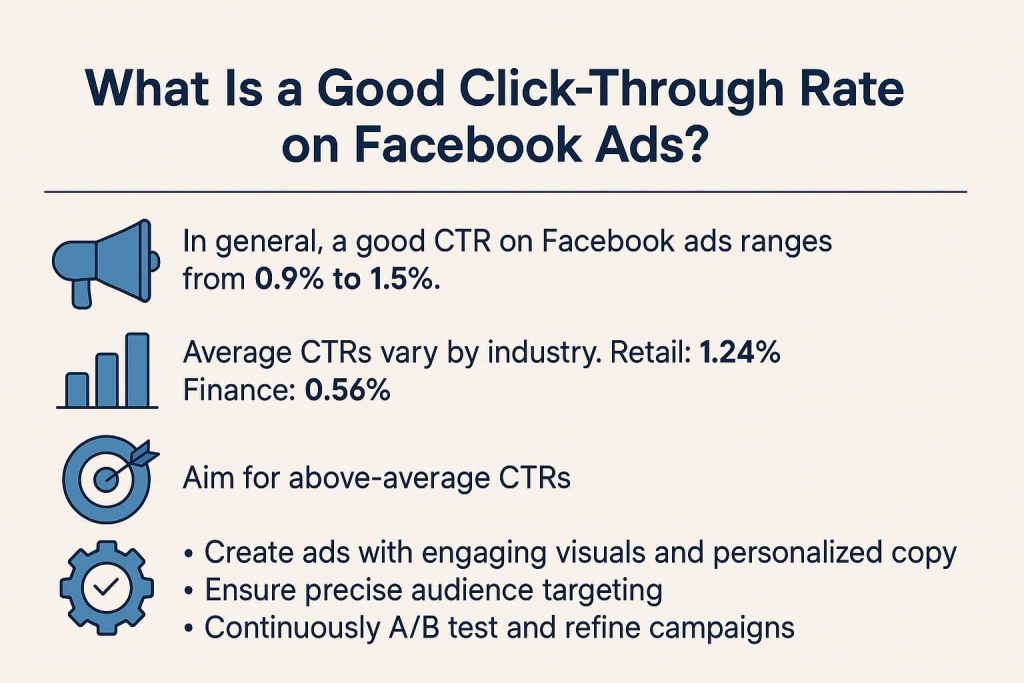
For example, in competitive industries like retail, a good CTR hovers around 1.24%, while finance tends to see lower numbers, closer to 0.56%.
Generally, a good CTR on Facebook ads ranges from 0.9% to 1.5%. While these averages offer a useful benchmark, my goal is to consistently aim for above-average CTRs to ensure my ads truly resonate with my target audiences.
To achieve this, I focus on creating ads with engaging visuals and carefully crafted, personalized copy. I also make sure my audience targeting is precise.
Continuous A/B testing helps me refine my Ads campaigns based on real engagement rates and performance data, allowing me to maximize the effectiveness of each campaign.
How to Tracking Your Facebook Ads CTR
Tracking the CTR of my Facebook Ads is crucial to understanding how well my campaigns are performing. I always start by heading into Facebook Ads Manager, a powerful tool that gives me a clear view of key metrics like link clicks and Average Click-Through Rates.
It’s important for me to set benchmarks based on my campaign goals and industry standards, so I can regularly measure my results against them.
When I notice a dip in CTR, I immediately review the ad’s targeting, copy, or visuals to ensure they still resonate with my audience. Staying adaptive to trends helps me fine-tune my campaigns for better engagement.
Additionally, integrating tools like Google Analytics allows me to track user behavior after they click on my ads, offering deeper insights into how effectively I’m driving real action beyond just the clicks.
Tips to Get a Good CTR for Facebook Ads
If you’re aiming to boost your CTR on Facebook Ads, here are a few strategies that have worked well for me:
- Understand Your Target Audience: A well-defined target audience is key. Facebook’s precise targeting tools let me hone in on specifics like age, interests, and location, ensuring my ads reach potential customers who are more likely to engage. The more refined the targeting, the better the chances for higher clicks.
- Leverage Powerful CTAs: The call-to-action (CTA) can make or break an ad. With nearly 30 CTA options in Facebook Ads, I always choose one that aligns with my campaign goals, like “Shop Now” for product promotions or “Learn More” for lead generation. Making sure the CTA is visually prominent is equally important for driving action.
- Test Various Ad Formats: To see what works best for my target audience, I experiment with multiple formats, such as video ads, carousel ads, and dynamic ads. Each format can capture attention differently—video ads tend to boost engagement, while carousel ads are perfect for showcasing multiple products in one go.
- Implement Remarketing Campaigns: Retargeting is an effective way to reconnect with potential customers who have shown interest but haven’t converted. Running remarketing campaigns helps remind them of the product or service they previously viewed, increasing the likelihood of clicks.
- Optimize for Conversions: In Facebook Ads Manager, I make sure to optimize my ads for conversions. This allows Facebook’s algorithm to serve the ad to users most likely to click, based on their past behavior, which is key to improving overall ad performance.
By using these advertising strategies, I’ve seen noticeable improvements in my marketing campaigns and a steady increase in my Facebook Ads CTR.
How Do You Optimize Facebook Ads for Conversions?
To optimize my Facebook ads for better conversions, I begin by focusing on reaching the right people.
Facebook’s tools like Custom Audiences and Lookalike Audiences allow me to target users who’ve interacted with my business before or share characteristics with my top customers.
This precision ensures I’m not wasting budget on uninterested users, ultimately boosting conversion rates.
Next, I pay close attention to timing. Using Facebook Ads Manager, I identify peak engagement periods and schedule my ads to run during these times.
By doing this, I increase the likelihood of my ads being seen when people are ready to take action, improving both my conversion rates and reducing the cost per link click.
A/B testing is another key element in my strategy. I tweak different aspects of my ads—such as the headline or call-to-action—testing one change at a time.
This helps me understand what resonates most with my audience, allowing me to fine-tune my advertising campaign and drive better results over time.
Finally, I use Facebook’s Pixel to track and analyze conversions. It gives me real-time insights into how users behave on my site after clicking an ad, which allows me to optimize the conversion path and enhance overall performance.
By focusing on targeting, timing, A/B testing, and tracking with Facebook’s Pixel, I’m able to consistently optimize my Facebook ads, increase conversion rates, and make sure every dollar spent aligns with my marketing goals and audience sizes.
Conclusion
In conclusion, achieving a solid Facebook CTR demands a thoughtful mix of strategic targeting, compelling content, and ongoing optimization.
By understanding the significance of CTR and setting realistic industry averages as benchmarks, I can steadily improve the performance of my Facebook Ads.
Custom Audiences play a vital role in refining my targeting, ensuring that my ads reach the right people, especially during special promotions.
I also focus on optimizing conversions—whether through precise audience targeting, scheduling ads during peak times, or running A/B tests to fine-tune each campaign element.
By consistently tracking my Facebook CTR, I can pinpoint areas that need improvement and refine my strategy for future campaigns.
With this approach, I not only boost engagement on the social media platform but also drive meaningful results, maximizing the return on investment of my advertising efforts.






Responses