
Pest Control Advertising: The Ultimate Guide to Growing Your Pest Control Business!


Is your phone silent while homeowners desperately seek pest control? If you’re not visible online, you’re invisible to customers. Imagine being the first name they find when panic strikes. With the right strategy, you can dominate search results and fill your schedule. Ready to attract more leads?
Content Overview:
Start Here: Growing Your Pest Control Business!
Is your pest control phone line eerily quiet, even while homeowners in your area are desperately searching for someone to evict their unwelcome pests? In the pest control industry, even the best exterminators struggle to thrive if customers can’t find you.
Today, your next client isn’t flipping through the Yellow Pages – they’re scrolling on Google or social media, looking for fast relief from infestations. In fact, 88% of people seeking pest control services start their research on search engines, which means if you’re not visible online, you’re invisible to a huge chunk of your market.
Now imagine being the first name that pops up when a panicked homeowner types “ant infestation help” or a restaurant manager searches “emergency exterminator near me.” With the right advertising strategy, this could be your reality. Pest control advertising isn’t just about throwing money at ads –
It’s about targeting the right customers at the right moment.
Done correctly, your ads can position you as the go-to problem solver, whether someone finds a rogue cockroach in their kitchen at 2 AM or a business discovers termites in their building. Effective advertising puts your pest control business in front of those who need it most, exactly when they need it.
Think about the impact on your business if you could consistently attract 50 new leads every month instead of 5. With a smart mix of Google search ads, catchy social media campaigns, and even some out-of-the-box marketing stunts, you could fill your schedule with appointments and build a local reputation that swats the competition.
The good news is, you don’t need a massive budget to see results – you just need the right techniques and a bit of creativity (plus some expert guidance) to start seeing a steady stream of clients. From showing up on the first page of Google to running a funny ad that everyone in town shares, the possibilities to grow your pest control business are exciting and achievable.
In this comprehensive guide:
I’ll walk you through proven advertising strategies to grow your pest control business. You’ll learn how to start advertising from scratch, make the most of Google Ads and social media ads, and even explore creative tactics that make your business unforgettable. I’ll also share real examples of innovative and humorous pest control ads to spark your inspiration.
By the end:
You’ll know exactly how to turn your advertising budget into new customers – and if you need a helping hand, I’ll show you how MY digital marketing expertise can amplify your success. Let’s dive in and get your pest control business buzzing with new leads!
How to Start Advertising Your Pest Control Business
Starting to advertise your pest control business can feel overwhelming, especially if you’re a new or growing company. The key is to have a game plan. Rather than spending money haphazardly, take a step-by-step approach to set yourself up for success.
1. Define Your Advertising Goals
Begin with the end in mind. Ask yourself what you want to achieve with your advertising. Are you trying to get more leads for general pest control services? Promote a new service like termite inspections? Or expand into a new area of town? Be specific.
For example, your goal might be “Generate 50 new termite inspection leads in the next 3 months”. Clear goals will help you choose the right advertising methods and measure your success. Make sure each goal is measurable and has a timeframe (e.g. “gain 10 new monthly maintenance contracts by year-end”).
Having a concrete target will guide all your advertising decisions and let you know if you’re on the right track or need to adjust.
2. Decide Where You Want to Advertise
With goals in hand, figure out which platforms will help you reach them. There are plenty of places to advertise — from online channels like Google and Facebook to traditional methods like flyers and local newspapers.
For a new pest control business wanting to build awareness, visually rich platforms can cast a wide net; for example, Instagram story ads or Google Display ads can get your name in front of lots of local eyeballs quickly.
On the other hand, if you want immediate leads and phone calls, Google’s Local Services Ads (which we’ll cover shortly) might be your best bet because they connect you with customers actively searching for pest control right now,
You don’t have to pick only one platform — often a mix works best. The idea is to advertise where your customers are looking. Homeowners might be on Facebook or Google; property managers might respond to LinkedIn or industry websites. Consider your audience’s behavior and choose the channels that fit your goals.
3. Set Your Ad Budget
Advertising isn’t free, but the good news is you control the budget. Decide early on how much you can comfortably spend on ads per month. If you’re just starting out, it’s perfectly fine to start small – even a few dollars a day.
For instance, you might begin with a budget of $5-$10 per day on a Google Ads campaign and see how many leads it brings. The key is to view this spending as an investment in acquiring customers. Determine your customer acquisition cost: how much are you willing to pay to get one new customer?
If a single new quarterly pest control contract is worth $300 to you, paying $30 in advertising to land that customer might be a great trade-off. Also, consider how many new customers you need each month to hit your revenue goals. Multiply that by your target cost per customer to ballpark a monthly budget.
Remember, advertising is flexible – you can always ramp your budget up once you see a campaign is performing well, or scale it back if it’s not delivering results.
Tip: When starting, spread a small budget across a couple of different ads (say, one on Google, one on Facebook) and track which performs better, then allocate more to the winner.
4. Design Your Ads for Impact
With your platforms chosen and budget set, it’s time to create the ads themselves. Effective pest control ads usually share a few characteristics. First, keep it focused: highlight one main message or offer per ad so customers instantly know what you’re about.
For example, one ad might focus on “$50 off first rodent treatment,” while another ad spotlights “24/7 emergency pest removal.” Use simple, high-quality visuals – perhaps a picture of a happy family in a pest-free home, or a close-up of the specific pest you deal with (nothing grabs attention like a creepy ant trail or a big spider, right?).
Ensure your branding (logo, colors, slogan) is consistent across all ads so people start to recognize you. Most importantly, a clear call-to-action (CTA) should be included. This could be “Call now for a free quote,” “Book an inspection online,” or “Message us to schedule service.”
Don’t leave people guessing what to do next – tell them how to get in touch. A well-designed ad will catch the eye, make it crystal clear what you offer, and prompt the viewer to take the next step.
5. Track Your Ad Performance
Once your ads are running, the work isn’t over – now you monitor and tweak. Almost every advertising platform provides performance data. Use Google Ads’ dashboard or Facebook Ads Manager to see how many people saw your ads, clicked them, and (most critically) contacted you or booked a job.
Tracking is essential to know what’s working. If your Google ad got 100 clicks but no calls, maybe the ad text or the landing page needs improvement. If your Facebook ad got you 10 leads for $50, that’s $5 per lead – is that within your target acquisition cost?
By keeping an eye on these numbers, you can refine your campaigns. Turn off ads or keywords that aren’t pulling in results, and put more budget into the ones that are performing well. Over time you’ll discover which messages resonate most and which platforms give you the best return.
Advertising is part art and part science: track your results and be ready to make changes, and you’ll steadily increase your ROI (return on investment). Before we move on, remember that advertising works best alongside other marketing efforts.
Make sure your website and Google Business Profile are up to date, since many ads will lead people there. A fast, informative website and some solid reviews on your Google profile can significantly boost the conversion of your ad traffic into paying customers. Now, with the basics covered, let’s explore the major advertising channels in detail, starting with the big one: Google.
Google Ads for Pest Control Services
When homeowners or businesses discover a pest problem, their first move is often to search on Google. That’s why Google Ads is one of the most powerful tools for pest control advertising – it puts your business right at the top of those search results.
“We’ve used Google Ads since day one. My business wouldn’t be where it is today without them,” says one pest control company owner. Let’s break down how you can use Google’s advertising platform effectively for your pest control services.
Types of Google Ads
Google offers a few ad formats, but the most relevant for pest control are Local Services Ads, Search Ads, and Display Ads.
Local Services Ads appear at the very top of Google results with a “Google Guaranteed” badge – these are fantastic for local businesses like pest control because you only pay when a customer calls or messages you through the ad.
Search Ads are the text ads that show up above or below the organic search results. You bid on keywords (like “exterminator near me”) and your ad can show when people search those terms.
Display Ads are banner or image-based ads that appear on websites or YouTube, which can build awareness by showing your message to people as they browse online.
Keyword Targeting
For search ads, keyword selection is make-or-break. Start by brainstorming what your customers might search for when they need pest control. Likely terms include “[Your City] pest control,” “exterminator near me,” “remove mice,” “termite treatment,” etc.
Use tools like Google’s Keyword Planner to find popular search terms in your area. Include specifics for your services – e.g. “bed bug exterminator” or “wasp nest removal” – to catch people with urgent, specific needs.
Pro tip: Don’t forget to add negative keywords – terms you don’t want your ad to show for.
For example, add “DIY” as a negative keyword so your ads don’t appear for searches like “DIY pest control,” which likely come from people not looking to hire a service. This helps ensure you’re paying only for clicks from serious customers, not casual information-seekers.
Another example: if you don’t handle wildlife removal, you might negative-match “raccoon” or “snake” to avoid irrelevant clicks. Regularly review your search query reports in Google Ads to see if your ads showed up for any weird or unrelated searches, then update your keyword list accordingly.
Writing Effective Ad Copy
In a crowded search results page, your ad text needs to stand out and speak to the customer’s problem. Google Search ads have a headline (or three) and a couple of description lines. You want to use that space wisely.
Include the keywords you’re targeting in the headline – if someone searched “ant infestation removal,” an ad headline that says “Ant Infestation Removal – Fast & Safe Service” immediately catches their eye.
Emphasize what makes you the right choice: do you offer same-day service, free inspections, or child- and pet-safe treatments? Include that. For example: “24-Hour Pest Control | Same-Day Service Guaranteed” could be a strong headline set.
In the description, add a bit more detail and a call to action: “Family-owned pest control in [Town]. Fast response, affordable plans. Call now for a free quote!” The goal is to reassure the searcher that you can solve their problem quickly and effectively, and prompt them to click or call.
Also, make sure the URL/landing page you send them to is directly relevant – if the ad is about termite removal, send them to the termite services page on your site, not a generic homepage.
The more specific and relevant your ad and landing page, the higher your Quality Score with Google, which can help lower your costs per click.
Ad Extensions and Extras
Take advantage of Google Ads features like sitelink extensions, call extensions, and callout extensions.
Sitelinks are extra links that appear below your ad, leading to specific pages on your site (“Rodent Control,” “Termite Inspections,” “Customer Testimonials,” etc.) – these make your ad bigger and more useful, giving customers more options to click.
Call extensions show your phone number right in the ad, which is great for mobile users ready to tap and call. Callout extensions are short phrases that highlight perks (“Licensed & Insured,” “Eco-Friendly Solutions,” “Over 100 ★★★★★ Reviews”).
Using these extensions can increase your click-through rate by offering more info and establishing trust and credibility at a glance.
For example, “Free Estimate,” “Se habla Español,” or “Serving [Your City] Since 2005” could be compelling callouts depending on your market.
Budget Management
Google Ads lets you set daily budgets and max bids, but it’s easy to overspend if you’re not careful. Start with a modest budget (maybe $20-$50/day across your campaigns) and see how it performs. Keep an eye on your campaign daily for the first couple of weeks.
If you notice one campaign or keyword is eating most of the budget without results, pause it or lower its bid. On the flip side, if a particular ad group (say, “bed bug exterminator”) is delivering leads at a low cost, you might increase its budget or bid to reach more people.
Geotargeting is important for budget optimization too – ensure your ads are only showing in the geographic areas you service. There’s no sense paying for clicks from 100 miles away if you don’t serve that area. You can set radius targeting around your city or specify ZIP codes.
Also, consider the timing: you can schedule ads to run only during business hours or when you’re available to answer the phone. If you have a 24/7 call service, great – if not, maybe pause ads at midnight so you’re not missing calls.
Essentially, monitor your spend vs. returns closely. A big advantage of Google Ads is the ability to adjust on the fly – you can increase, decrease, or pause spend at any time. Use Google’s reports to calculate your cost per conversion (what you spend on ads to get one lead or customer).
As long as that cost per conversion is lower than the profit you earn per customer, your ads are doing well.
If not, refine your keywords and ads, or reconsider your bidding strategy (for example, switching to an automated bid strategy like “Maximize Conversions” or “Maximize Leads” can let Google’s AI optimize bids for you.
In summary, Google Ads is a high-intent channel – you’re reaching people who actively need pest control. By targeting the right keywords, writing compelling ads with clear offers, and managing your budget smartly, you can make Google Ads a steady source of new customers.
Next, let’s look at the other side of online advertising: social media.
Social Media Ads for Pest Control Services
Social media isn’t just for food photos and family updates – it’s a powerful advertising arena for pest control services.
Platforms like Facebook and Instagram give you the chance to get in front of your ideal customers as they scroll through their feeds, even if they’re not actively searching for pest control at that moment.
Why Social Media for Pest Control?
Think about it: homeowners in your area are likely browsing Facebook or Instagram daily. They might not have a pest problem today, but when they do, you want your name to be the one they remember. Social media ads are great for building brand awareness and staying top-of-mind.
They also allow for more visual and creative storytelling than a text-based search ad. You can show pictures or videos of your team in action, dramatic before-and-after images of an infestation cleanup, or even educational infographics about seasonal pests.
Another plus: social platforms allow fine-grained targeting so you can show your ads specifically to, say, homeowners aged 30-65 in [Your City] or property managers and business owners in your service area.
Facebook Ads
Facebook is often the first choice for local service advertising. To start, you’ll need a Facebook Business Page for your pest control company (if you don’t have one, set that up – it’s free and also adds credibility).
With Facebook Ads Manager, you can create campaigns with various objectives (like brand awareness, website traffic, or lead generation). For a pest control business, a common goal is Lead Generation, which lets people send you their contact info through a simple form without leaving Facebook.
You can also run ads that drive visitors to your website or encourage people to send you a Facebook Message. Targeting on Facebook is powerful: you can target by location (e.g., people living within 20 miles of your office), by demographics (such as age, and homeownership status), and by interests.
People who have shown interest in home improvement, and real estate, or even who follow local community pages might be good to include. You could target “homeowners” specifically – Facebook has behavior categories that indicate likely homeowners.
Also, consider life events; for example, folks who recently moved into a new home might soon discover pest issues and not know who to call yet. Tailor your ad content to the audience: an ad for new movers might say “New home? Make sure it’s pest-free – schedule a home pest inspection today.”
If you also do commercial pest control, you can run separate ads targeting business owners or property managers (interests like “restaurant owner,” “facility management,” or simply target employers by industry).
Facebook even allows Lookalike Audiences – you can upload your customer list and have Facebook find people similar to them to target.
In terms of content, Facebook ads can be images, carousels (multiple images), or videos. A photo of pests might grab attention (people might cringe, but they’ll notice it – just don’t make it too horrifying to avoid being off-putting).
Alternatively, show a happy family in a clean home with a message like “Keep your home pest-free and comfortable.” You can also get creative or humorous (more on that in a bit) because entertaining ads are more likely to be remembered and shared.
Always include a call-to-action button like “Learn More,” “Book Now,” or “Get Offer.” For example, a Facebook ad could say: “Spiders or ants bugging you? 🕷️🦟 ABC Pest Control can help! Get $20 off your first service. [Learn More]” – offering a small discount for new customers can entice people to click.
Instagram Ads
Instagram is owned by Facebook, so you’ll use the same Ads Manager to create Instagram ads. Instagram is a visual platform, so high-quality imagery or video is a must.
Short video clips can be especially effective – you might show a quick timelapse of an ant colony being removed or a 15-second clip of your technician sealing up a home’s exterior to prevent rodent entry, with captions like “Prevent pests before they invade.”
Because Instagram is popular with a slightly younger crowd (20s-40s) and is entirely visual, consider running ads in Instagram Stories or Reels.
For example, an Instagram Story ad could be a before-and-after series: first story panel shows a kitchen crawling with roaches (caption: “Ew! Gross!”), next panel shows the same kitchen spotless (caption: “All clear, thanks to [Your Company]”).
You can target the same way as on Facebook, focusing on local area and relevant demographics. Hashtags in ads aren’t as crucial as in organic posts, but you might include one or two like #PestFreeHome in the ad text for flavor.
Ensure your Instagram ads feel native to the platform – polished but not overly salesy. A pro tip: user-generated content (with permission) can work well; if a customer wrote a great review or took a photo of your technician at work, consider turning that into an ad to add authenticity.
Targeting Homeowners vs. Commercial Clients
The question specifically mentions targeting homeowners and commercial clients, which is important because your approach might differ.
For homeowners, emphasize the peace of mind and comfort aspects: protecting their family, safeguarding their property’s value, keeping the home safe for kids and pets.
For commercial clients (like restaurants, hotels, apartments, or offices), the messaging should focus on reliability, compliance, and preventing revenue loss.
For instance, an ad targeting restaurant owners might highlight “Keep your kitchen pest-free and pass inspections with flying colors – schedule regular service with us.”
You might use LinkedIn for a more professional approach to reach business owners or facility managers, but you can also target them on Facebook by their listed job titles or industry categories.
Additionally, consider joining and posting in local Facebook community groups or Nextdoor for organic reach – many neighborhoods have groups where locals ask for recommendations.
While not paid ads, being active there (without spamming) and occasionally mentioning your services or sharing a helpful pest prevention tip can indirectly lead to referrals and business.
Measuring Social Ad Success
Just like with Google, pay attention to how your social media ads perform. Facebook will show you metrics like reach (how many saw it), clicks, click-through rate, and conversions (if you set up a pixel on your site to track actions like contact form submissions).
If one ad isn’t getting any clicks or leads, try changing the image or tweaking the text. Social media trends can change quickly – sometimes a fun, casual tone works better; other times a straightforward, sincere message does.
Don’t be afraid to experiment with A/B tests (Facebook allows you to test two variants of an ad to see which performs better). Over time, you’ll learn what your audience responds to.
Perhaps people engage more with a “Did you know?” style pest fact post that then leads into your service offering, or maybe they love seeing your friendly team’s faces in the ad.
The goal is to balance staying on potential customers’ radar without annoying them. If someone clicks “Hide ad,” that’s a sign you might be overdoing it or targeting the wrong folks.
In short, social media ads allow your pest control business to build relationships and awareness in a more casual environment than search ads.
By targeting wisely and crafting ads that resonate with homeowners’ fears or make busy business owners think “I can’t let pests hurt my reputation,” you’ll generate interest that converts into customers when the need arises.
Out-of-the-Box Marketing Strategies for Pest Control Ads
Beyond the standard Google and Facebook routes, there’s a whole world of creative, unconventional marketing strategies that can set your pest control business apart.
These “out-of-the-box” ideas often make a big impression on potential customers precisely because they’re unexpected.
Guerrilla Marketing Stunts
This means doing something attention-grabbing in the real world. For example, one famous campaign for Terminix in Dallas involved a billboard filled with live cockroaches crawling inside giant letters spelling “E.coli” – gross, yes, but it dramatically drove home the point about pests carrying disease.
While you might not go that far, you could create a buzz with smaller-scale stunts. Perhaps place fake (but realistic-looking) plastic insects in a public area with a little tag: “If pests are this close, call XYZ Pest Control!”
Or commission a local artist to paint a mural of, say, a giant ant on a building you service, with your company logo and a funny tagline. The idea is to get people talking.
Even something like an exterminator dressed as a giant insect mascot handing out flyers downtown can turn heads and make your brand memorable (humor goes a long way in marketing!). Just be sure any stunt aligns with your brand image and is done in good taste (no actually releasing critters, of course).
Creative Direct Mail or Flyers
Traditional flyers and mailers still work, especially for local service businesses, but you can elevate them beyond a plain postcard.
For instance, send out a “scratch-and-sniff” mailer that smells like…not roaches or anything (ew) – maybe like cedar or mint (natural pest repellents) – with a message about how you can make pest problems disappear.
Or include a small novelty item: a tiny plastic bug with a note, “Don’t let the real ones invade – call us!” Door hangers shaped like a giant bug or mouse can also be funny and effective. The goal is to make the marketing engaging and shareable.
If someone gets a clever mailer, they might show their neighbor, which doubles your reach. Always include a clear call to action like a seasonal discount or a referral code to track how well these work.
Partner with Local Businesses
Teaming up can get you in front of new customers in creative ways. For example, partner with local real estate agents or home inspectors – when they have a client buying a home, they can include your brochure or a coupon for a free pest inspection.
In return, you could mention their services to your customers who might be moving. Or collaborate with a landscaping company or cleaning service to offer a combined spring-cleaning package: “Spruce up your home and evict the pests – 10% off pest control + landscaping bundle.”
Think about businesses that serve the same homeowners you do and find fun cross-promotion angles. Another idea: sponsor a section of a local home and garden show or community fair.
Instead of just a boring booth, create an interactive experience – maybe a “Guess the Pest” game where people identify pests from up-close photos (the winner gets a free home inspection). This not only markets you but also educates the public and shows you’re an expert.
Community Involvement and Education
Position yourself as a friendly neighborhood expert. Host a free “Bug Prevention 101” workshop at the local library or community center. Parents might show up to teach their kids, or new homeowners may come to learn.
It sounds counterintuitive to teach people how to prevent pests (couldn’t that reduce the need for your service?), but in reality, it builds trust. When they do have a problem they can’t handle, who will they call? The helpful expert gave them tips for free.
You can also create a fun event like a “Kid’s Bug Safari” – a safe, supervised little hunt in a park teaching which bugs are harmful and which are benign. Give the kids coloring books with your mascot or logo.
Community events get your name out there and often earn goodwill (and sometimes local media coverage, which is free publicity).
Branded Merchandise with a Twist
Everybody has pens and magnets from companies – and you should have those too (a magnet with your contact info on a fridge is great long-term advertising). But consider something more novel that people won’t throw away.
Branded fly swatters with a funny slogan like “If you have to use this, call us next!” are perfect – they’re directly related to your service and useful. How about small bottles of hand sanitizer labeled “After squishing the bug, sanitize – and then call [Your Company] to handle the rest!”
Or sticky notepads that say “Squash tasks (and bugs) one at a time.” These items keep your brand in people’s minds and show you have personality. People appreciate a company with a sense of humor and creativity.
The key with all these out-of-the-box strategies is to be memorable.
Pest problems are common, and customers have many options – so anything you do that sticks in their memory means when an infestation strikes, they’ll recall your funny ad, clever flyer, or community presence and reach out to you first.
Don’t be afraid to think differently; pest control may be a serious service, but your marketing can still be fun and approachable.
Examples of Creative Pest Control Ads
Sometimes the best way to spark your own advertising ideas is to see what others have done. Let’s look at a few creative pest control ads that broke the mold and got people’s attention:
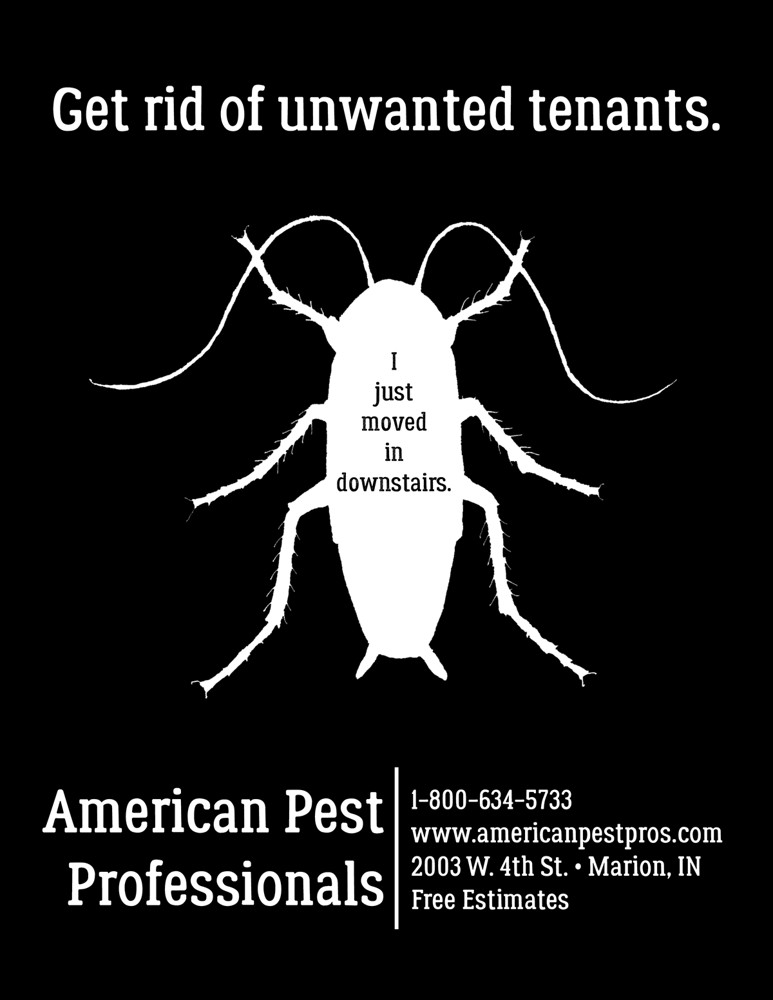
An example of a creative pest control ad by American Pest Professionals: it frames cockroaches as “unwanted tenants,” grabbing attention with a bit of humor and a clear call to action to “get rid” of them.
The image above was part of an American Pest Professionals campaign. By referring to bugs as “unwanted tenants” living in your home, it cleverly taps into a landlord’s mindset – evict those freeloading roaches!
It’s a simple black-and-white design, but the bold statement “Get rid of unwanted tenants.” paired with the silhouette of a cockroach (saying “I just moved in downstairs.” as if it’s a neighbor) makes you do a double-take.
It’s creative because it reframes a pest problem in a way homeowners can relate to (nobody wants freeloaders in their house, human or insect). This kind of ad not only catches attention but also makes the viewer smirk, which is a great way to be memorable.
Another inventive example comes from Accurate Pest Control Services. Picture a photo of a bed bug, with a target crosshair graphic over it. The ad’s message essentially said, “We’ll target and eliminate your pests,” without a lot of words.
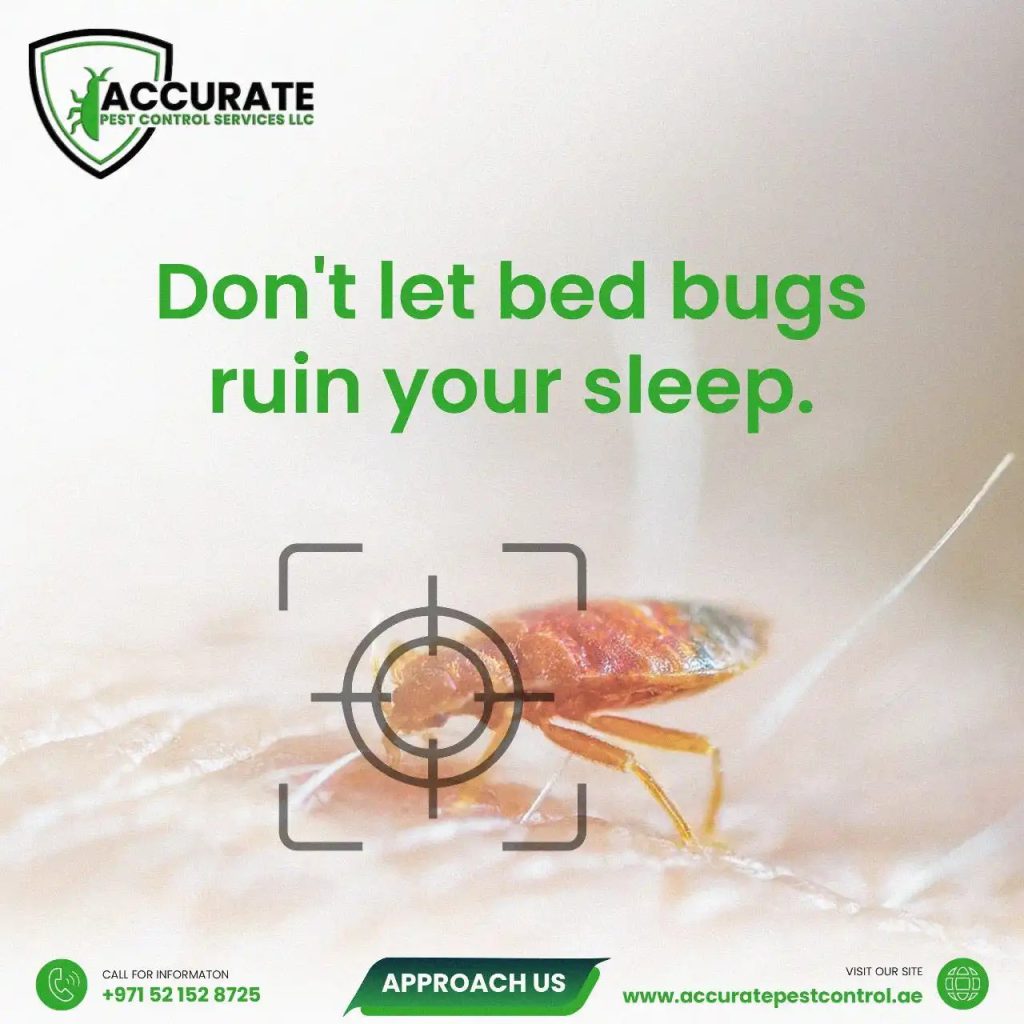
The visual did most of the talking. This works because it’s instantly clear – pests are the target, and Accurate Pest Control never misses. It’s a creative way to imply precision and effectiveness. It also invites the viewer to imagine those pests in the crosshairs of a scope, which is satisfying for anyone who’s ever lost sleep from a bed bug or flea issue.
For a larger-scale example, Preferred Pest Control took creativity to billboard size. Their billboard showed two giant, realistic spiders crawling on it, with the tagline “There’s never just one.”
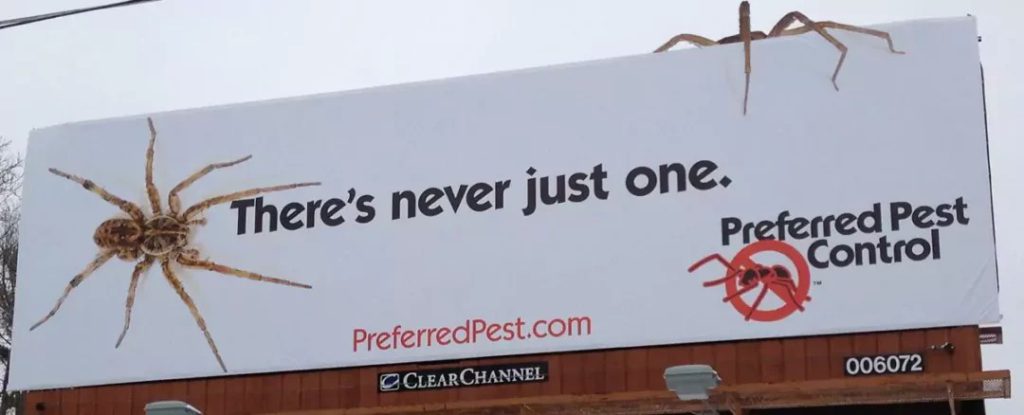
Drivers on the highway seeing that likely got a little shiver! The genius of that ad is in its minimalism and shock value – one short sentence and the visual of big spiders (some even looked like they were 3D and half on, half off the billboard).
It plays on the common knowledge that if you see one spider or roach, there is probably more hiding.
This kind of creative advertising not only grabs attention (you can’t miss huge spiders on a billboard) but also taps into a bit of fear to prompt action – it practically urges, “Don’t wait until your home is overrun; call us at the first sight of a bug, because there’s never just one!”
The takeaway from these examples is that creative ads often use visual metaphors or humor related to pests. They step outside the standard “Here’s our service, call us” format.
Whether it’s comparing pests to unwanted roommates, using imagery like targets, or startling folks just a bit with giant creepy crawlies, creative approaches can make your advertising more effective by being more engaging.
When planning your own ads, think about what common thought or emotion you can tap into – annoyance at pests, fear of an infestation, the relief of a pest-free home – and present it in a fresh way.
Examples of Funny Pest Control Ads
Humor can be a powerful tool in advertising, even for a serious service like pest control. A funny ad can disarm potential customers (no pun intended) and make your business likable and approachable.
Plus, people love to share a good laugh, so a humorous pest control ad can even go viral in your local community. Let’s check out a couple of funny pest control ads that hit the mark.
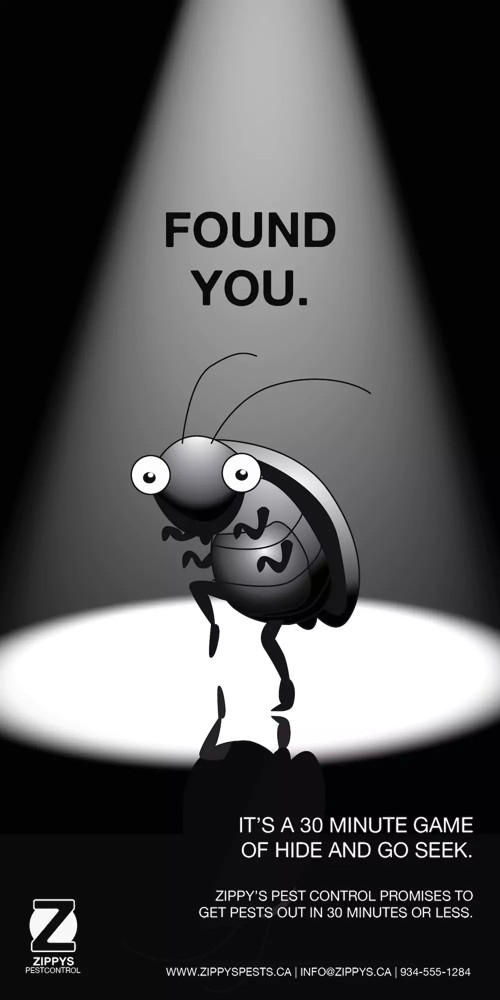
A humorous pest control ad (“Found you.”) uses a hide-and-seek theme with a cartoon cockroach, showing that the company will catch the pest every time – and guarantee to do it within 30 minutes.
In the ad above, a pest control company designed a playful graphic of a cockroach caught in a spotlight with the words “FOUND YOU.” above it. The fine print humorously says, “It’s a 30-minute game of hide and go seek. Zippy’s Pest Control promises to get pests out in 30 minutes or less.”
This ad works on multiple levels: it turns a dreaded scenario (a roach hiding in your home) into a funny game, and it also manages to slip in a strong selling point – a 30-minute or less pest removal guarantee – under the guise of the joke.
The cartoon style makes it lighthearted, and the idea of playing hide-and-seek with pests is something viewers will remember (and likely chuckle at). It tells the audience that this company has a sense of humor and confidence in its fast service.
Another example of humor comes from an ad by Seva Facility Services. They created an image of a giant cockroach lounging in a living room armchair, reading a newspaper, with the headline “When you are not in the house, THEY become new owner…” and a call-to-action that says “Call us today for cockroach treatment.”

The visual is so absurd it’s hilarious – a cockroach acting like it owns the place. It taps into that feeling many homeowners have when they discover a pest: “These bugs think they run my house when I’m away!” By exaggerating that scenario, the ad uses humor to make a serious point.
It assures the customer that Seva can kick out those bold bugs who are making themselves at home. Ads like these get shared around precisely because they make people laugh.
Someone might see it online and tag a friend, “Haha, this is what I was dealing with last week!” – and thus, the ad spreads, getting the company’s name out even further.
When using humor, a few pointers: know your audience. What’s funny to one person might not be to another. In pest control, common experiences (like the feeling of surrendering your house to the bugs, or the eternal battle of homeowner vs. pest) are usually safe comedic ground.
Avoid anything that could be in poor taste or offend. The goal is a light chuckle and a positive association with your brand. Also, tie the humor to your value proposition.
Both examples above marry the joke with the pitch (roach as owner underscores the need to reclaim your home; hide-and-seek leads to a speed guarantee). This way the humor isn’t just random, it actually reinforces your selling point.
If you’re not naturally comedic, you can hire talent to help. As one pro tip in the industry suggests, you could hire a freelance designer or marketer who specializes in humorous ads
There are even Fiverr or Upwork freelancers who have done witty campaigns for small businesses. A small investment in a cleverly funny ad can pay off big in memorability.
Finally: Funny pest control ads, when done right, make your company relatable and memorable. People are less intimidated about calling an exterminator when your brand makes them smile first.
So don’t hesitate to let your sense of humor show in your advertising – it might just be the thing that makes your phone ring.
How Saeed Hasani Helps Grow Your Pest Control Business
By now we’ve covered a lot of ground – from Google and Facebook to creative billboards and funny ads. You might be thinking, “This sounds great, but I’m busy running a pest control business… how do I find the time to do all this marketing stuff?”
That’s where Saeed Hasani comes in. As a digital marketing expert with experience in the pest control industry, Saeed helps business owners like you develop and execute winning advertising strategies, so you can focus on what you do best (eliminating pests!) while the marketing side is handled by a pro.
Customized Marketing Strategy: Saeed understands that no two pest control businesses are the same. Maybe you specialize in eco-friendly pest solutions, or perhaps you cater more to commercial clients than residential.
The first thing Saeed will do is work with you to create a tailored marketing plan that fits your goals, your budget, and your target market. Remember those steps we discussed in “How to Start Advertising” – defining goals, choosing platforms, and setting budgets?
Saeed will guide you through those, drawing on his expertise to advise what makes sense for your specific situation.
For example, if your goal is to dominate termite services in a certain city quadrant, he might suggest a heavy focus on Google Search Ads for “termite treatment” keywords plus some neighborhood-targeted flyers.
If your business is new and unknown, he might emphasize social media campaigns to build awareness, paired with Local Services Ads to quickly generate trusted leads via Google’s Guaranteed program.
Google Ads and SEO Mastery: One of Saeed Hasani’s specialties is Google marketing – both paid ads (PPC) and organic search (SEO). On the Google Ads front, Saeed can set up and optimize your campaigns, making sure your money is spent efficiently.
He’ll do the keyword research to bid on terms that your customers are searching for (and avoid the ones that waste money). Plus, he’ll craft compelling ad copy, set up all those helpful extensions, and continually tweak the campaigns for better performance.
This means you get more calls and leads for the same budget, thanks to professional optimization. On the SEO side, Saeed can help improve your website so that over time you rank higher in organic Google results for phrases like “pest control in [Your Town].”
While SEO is more of a long game, it’s incredibly valuable (imagine getting leads without paying for each click!).
Through content creation (like helpful blog posts about pest prevention), technical website fixes, and review generation strategies, Saeed’s SEO work can complement your ads – so you’re visible in both the paid and unpaid sections of search results.
Social Media and Content Marketing: Don’t have the bandwidth to post on Facebook or Instagram regularly? Unsure what to even post? Saeed’s agency has you covered.
They will manage your social media advertising campaigns from start to finish – designing eye-catching image ads, writing persuasive captions, and targeting the right audiences as we talked about earlier.
But beyond paid ads, they can also help with your organic social media presence, keeping your pages active with engaging content.
Perhaps they’ll share seasonal tips (“Spring is here – watch out for ants, here are 3 things you can do…”), team introductions (humanizing your business), or customer testimonials. This builds your brand personality online.
Additionally, Saeed can introduce content marketing tactics – maybe a monthly email newsletter with pest control tips for your clients, or informative articles on your website that establish you as an authority (for example, a guide on “How to Pest-Proof Your Home for Winter”).
All this content not only helps with SEO but also nurtures leads (somebody who reads your “top 5 pest prevention tips” blog might remember you when they have a pest issue later).
Conversion Optimization and Tracking: A big part of effective marketing is not just getting traffic, but turning that traffic into customers. Saeed will ensure that your website and landing pages are set up to convert visitors into leads.
That might involve creating a dedicated landing page for each ad campaign – say, a special page for “Rodent Removal Service” that an ad will point to, with a clear call-to-action and maybe a quick contact form.
He’ll also help implement tracking tools (like Google Analytics and Facebook Pixel) so every call, form fill, or chat is traced back to the ad or source that brought it. This data is gold – it shows what’s working best.
And Saeed is data-driven; he’ll provide you reports that break down your advertising ROI, so you can literally see how every dollar is helping your business grow.
If something’s not working as well, he’ll spot it and adjust the strategy. Basically, you get the benefit of a full marketing department keeping an eye on your campaigns.
Experience in Pest Control Niche: Perhaps one of the biggest advantages of working with Saeed Hasani is that he has extensive experience in the pest control niche specifically.
Marketing isn’t one-size-fits-all – pest control advertising has its quirks (seasonal spikes, the urgent nature of calls, the importance of local reputation). Saeed has worked with pest control companies and knows those quirks inside out.
He stays updated on industry trends – like the latest changes in Google Local Services Ads, or new features on Yelp or Nextdoor that pest pros can use.
Because of this, he can also offer advice beyond just ads, like how to encourage happy customers to leave reviews (hugely important for your online credibility) or how to price a promotional offer competitively.
Essentially, he’s not just a marketer, he’s a partner who wants to see your pest control business thrive and knows the roadblocks and opportunities in your field.
To sum it up, Saeed Hasani provides a done-for-you digital marketing solution tailored to pest control businesses.
Whether you need a boost in lead generation, a stronger online presence, or a creative campaign that sets you apart, Saeed and his team handle the strategy, the legwork, and the optimization.
You get more calls and contracts, without having to navigate the complex world of online advertising alone. It’s like having an expert exterminator for your marketing problems – identifying what’s bugging your current strategy and eliminating it, so your business can grow unhindered.
Conclusion
Pest control advertising may seem challenging at first, but with the right approach, it can become a powerful tool for growing your business. Start by defining your goals and target audience to ensure every ad has a clear purpose.
Use Google Ads to capture high-intent searches and social media ads to build brand awareness and engage with your community.
Creative marketing can help you stand out, making your ads more memorable and effective. Track your results consistently—knowing your return on investment allows you to refine your strategy and maximize profits.
Marketing is the key to connecting with potential customers and keeping your business thriving. Investing in a solid advertising plan, especially in digital marketing, provides great value and targeted reach. Whether you take small steps yourself or seek expert help, the important thing is to start.
Every day without advertising is a missed opportunity. By implementing these strategies, you’ll attract more leads, keep your technicians busy, and grow your business year after year.





Responses