
SEO for Chiropractors: 8 Powerful Steps to Avoid Costly Mistakes


SEO for chiropractors helps a chiropractic practice become easier to discover when people search for a provider, a location or information about care. The goal is not simply to rank for more keywords. It is to connect relevant local searches with accurate practice information, useful pages and a clear way to request an appointment.
For most practices, the starting point is a verified Google Business Profile, a website that explains the clinic’s actual services and location, and a consistent process for maintaining accurate information and collecting genuine patient feedback. This guide to SEO for chiropractors explains eight steps to build that foundation, including how to adapt it for multiple locations and measure results without relying on traffic alone.
Content Overview:
What Is SEO for Chiropractors?
Search engine optimization is the work of improving a website and related online information so search engines can discover, understand and present them to relevant searchers. SEO for chiropractors includes two connected areas: local visibility in Google Search and Maps, and organic website visibility for questions about the practice, its services and its locations.
Someone searching for a chiropractor near their workplace may already be comparing providers. Someone reading about what happens at a first appointment may be earlier in the decision process. Effective SEO for chiropractors addresses both needs without assuming that everyone looking for health information requires chiropractic treatment.
SEO for chiropractors can help people find a clinic that fits their preferences, verify practical details and contact the practice. It cannot guarantee a particular ranking, generate demand for services that people are not seeking, or compensate for a poor booking experience. Unlike paid search advertising, organic visibility is not purchased on a per-click basis, but it still requires time, staff attention and investment.
How to Build an SEO Strategy for Your Chiropractic Practice: 8 Essential Steps
Before starting SEO for chiropractors, identify the person responsible for the website and each business listing. Collect access to the content management system, Google Business Profile, Google Search Console and any existing analytics. Agree on which appointments or inquiries the practice wants to measure and how to protect patient information.
- Audit and establish a baseline. Document existing local visibility, indexed pages, profile completeness, technical issues and qualified inquiries. A digital marketing audit can organize these findings and reveal gaps in tracking.
- Verify eligible Google Business Profiles. Claim or recover the practice’s existing profiles, correct details and ensure each eligible location is represented accurately.
- Research relevant keywords. Group searches by location, actual service, patient question and stage of decision-making.
- Build useful location and service pages. Give every real clinic an informative page and explain the services genuinely available there.
- Improve technical and on-page SEO. Remove barriers to crawling and indexing, improve navigation and make pages usable on mobile devices.
- Earn genuine patient reviews. Establish a fair, privacy-conscious workflow for inviting voluntary feedback and responding appropriately.
- Strengthen citations and local links. Correct inconsistent business listings and build relevant relationships that can earn legitimate references.
- Measure and refine. Compare visibility, inquiries and appointments against the baseline, prioritizing the issues that affect real outcomes.
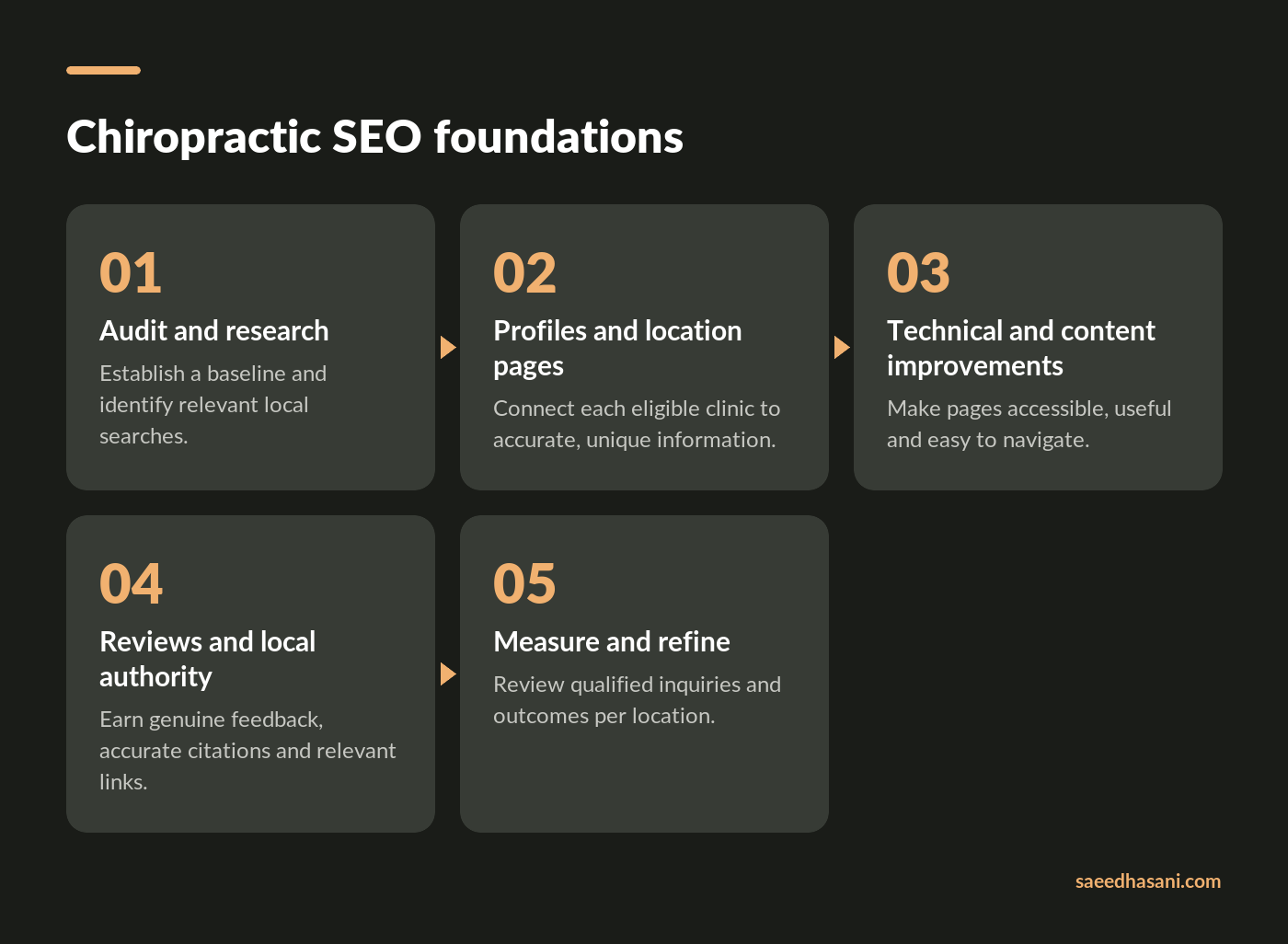
These eight steps for implementing SEO for chiropractors are organized into five foundations in the infographic. They are an implementation sequence, not eight independent ranking tricks. Fix foundational information before investing heavily in new content or advanced optimization. For a multi-location practice, use a shared standard but track each location separately.
Start With Local SEO for Chiropractors
Local SEO for chiropractors focuses on people looking for care in a geographic area. A local results panel, often called the map pack, may show nearby practices together with their business details. Website results offer another route to the same practice and can appear for a wider range of searches.

According to Google’s guidance on local ranking, local results depend mainly on how relevant the business is to the search, how far it is from the searcher and how well known it is. Complete information can improve relevance, while legitimate references and customer feedback can help establish reputation. A practice cannot control where a prospective patient is searching from or purchase a higher organic local ranking.
When planning local SEO for chiropractors, review nearby competitors using a consistent set of location-specific searches. Record their categories, the information available on their location pages and the clarity of their booking options. Do not copy competitor names, services or claims. Use the review to identify information your own practice is genuinely able to provide.
SEO for chiropractors with multiple locations requires treating each eligible location as a distinct entity. A clinic’s address, opening hours, local contact details and services should be correct everywhere. Do not create listings for virtual offices, areas with no staffed eligible location or duplicated profiles. In a multi-doctor practice, check Google’s rules for individual practitioners before creating additional profiles. A practitioner listing is not automatically appropriate for every team member.
Google Business Profile Optimization
In local SEO for chiropractors, a Google Business Profile, previously called Google My Business, helps people discover a practice and check its address, opening hours, contact information, reviews and website. It is one of the most practical starting points for SEO for chiropractors because incomplete information can create friction even when the practice appears in search.
- Claim and verify the existing profile through Google Business Profile Manager; avoid creating a duplicate when ownership is unclear.
- Use the practice’s real-world business name, not a name expanded with city names or promotional keywords. Choose an accurate primary category and only relevant additional categories.
- Check the address, phone number, opening hours and special holiday hours. Use a location-specific website page and booking destination when available.
- List actual services accurately. Add recent, permission-cleared photos of the entrance, reception and team without revealing patients or sensitive details.
- Monitor suggested edits, outdated information and incoming reviews. Assign a responsible staff member for every location.
To support SEO for chiropractors with practical profile-management ideas, see how to improve Google Business Profile engagement. Updates and useful photos help prospective patients understand what to expect, but do not assume that posting on a fixed schedule alone will increase rankings.
How to Do Keyword Research for Your Chiropractic Practice
Keyword research for SEO for chiropractors starts with the language patients actually use, not a list of broad medical terms. Identify what people want from a search: a nearby provider, a specific available service, information about an appointment, or the contact details of a known practice.
When researching SEO for chiropractors, use Google Search Console to find existing impressions and clicks, Keyword Planner for search estimates and a research tool such as Semrush for competition and related queries. Compare search results manually before assigning a phrase to a page. A high-volume question may attract visitors from outside the area, while a smaller local query may be more relevant to the practice. Keyword difficulty estimates are not guarantees.
The following 20 chiropractic keyword examples are illustrative, not measured search volumes. Replace the placeholders with the real practice name or city and retain only phrases that reflect actual services and qualified clinical guidance.
| Intent | Example search phrases | Suitable page |
|---|---|---|
| Local discovery | chiropractor near me; chiropractor in [city]; chiropractic clinic [city]; chiropractic office near me | Location page |
| Service-based | chiropractic consultation [city]; chiropractic assessment near me; spinal adjustment [city]; chiropractic appointment [city] | Relevant service page |
| Condition-based | chiropractor for back pain [city]; chiropractor for neck pain [city]; chiropractic assessment for lower back pain; chiropractor for sports-related discomfort | Clinician-reviewed service or educational page, where appropriate |
| Informational | what happens at a chiropractic appointment; what to bring to a chiropractic consultation; how to choose a chiropractor; questions to ask a chiropractor | New-patient page or article |
| Branded | [practice name] hours; [practice name] address; [practice name] appointment; [practice name] practitioners | Location, contact or team page |
For SEO for chiropractors, assign one primary intent to each page. Closely related keyword variations can belong on the same page rather than being split into nearly identical articles. Revisit the keyword map when services, locations or patient needs change. Do not imply that a particular treatment is effective for every condition simply because the corresponding keyword has search demand.
Build a Dedicated, Unique Location Page for Each Clinic
A multi-location strategy for SEO for chiropractors means every genuine clinic location should have an individual page with information useful to a prospective patient. A location page is not a template with a different city name inserted. It should explain who works at that clinic, what is offered there, how to reach the location and how to contact the practice.
Include the real address, opening hours, direct phone number where possible, practitioner details, service availability, directions, parking and accessibility information, and a working appointment request. Add original photos of the facility if permission and privacy requirements allow. Check that the corresponding Google Business Profile links to the correct location page.
SEO for chiropractors should also connect these pages to a locations hub, the homepage and relevant service pages through clear internal links. Do not leave a new location page reachable only through a sitemap or external listing. A visitor should be able to navigate to it without searching for its exact URL.
When implementing SEO for chiropractors on condition-specific or service pages, explain the actual scope of the clinic’s services, the assessment process and any appropriate limitations. For health topics, the clinical team must verify the content and avoid claims of guaranteed relief or treatment suitability. Create separate pages only when they address genuinely distinct needs. Near-identical pages for cities where the practice has no location or unique offering can create a poor user experience and resemble doorway pages.
Fix On-Page SEO Basics Across Every Location Page and Service Page
On-page and technical SEO for chiropractors make useful content accessible to both people and search engines. Start with a crawl of the site, identify broken links and incorrect redirects, review canonical URLs, verify the XML sitemap, and check whether important pages are accidentally excluded from indexing.
For on-page SEO for chiropractors, each important page should have a descriptive title tag, a clear H1, logical subheadings, a readable URL and an accurate meta description. A service page should make its actual subject clear without repeating the city or keyword unnaturally. Use descriptive internal links and image alternative text where it helps accessibility; decorative images do not need keyword-filled descriptions.
Mobile SEO for chiropractors requires checking the mobile version as carefully as desktop. Can a visitor read the text comfortably, tap the phone number and reach the correct appointment form? Compress large images, avoid unnecessary scripts and ensure buttons and form labels are accessible. Test performance with PageSpeed Insights and use Search Console to investigate indexing or mobile-related issues. A crawler such as Screaming Frog can help find broken pages, missing titles and conflicting directives.
Structured data can describe real business information and eligible page content, but it must match what visitors can see. It is not a shortcut to rankings or rich results. A technical audit and a content audit solve different problems; understanding the distinction between technical SEO and content SEO helps a practice prioritize the right fixes.
The Role of Content Marketing in SEO
Content marketing within SEO for chiropractors is most useful when it answers questions that patients genuinely ask and helps them make informed decisions. SEO for chiropractors does not require publishing large numbers of generic health articles. A smaller collection of accurate, useful pages can be more valuable than a calendar full of duplicated topics.
Start with questions about the first visit, how the practice operates, what information patients should bring, and the services that are actually available. Educational articles about health topics should be reviewed by a qualified clinician, include the appropriate sources and explain uncertainty, suitability and limitations. Distinguish general education from personalized advice. Never use a blog post to imply a diagnosis or promise a particular result.
Show who wrote and reviewed clinical content and when it was last reviewed where relevant. Do not invent qualifications, patient cases, testimonials or treatment outcomes. AI-assisted writing should be checked for factual accuracy and meaningful value by the responsible team. An automatically generated page is not evidence of expertise.
For sustainable SEO for chiropractors, audit older articles and service pages before adding new ones. Consolidate overlapping pages where appropriate, update outdated office details and link educational articles to relevant practice pages when the link helps the reader. Content creation should support trust and a logical patient journey, not just keyword counts.
Build a Review System That Runs Independently for Each Location
In local SEO for chiropractors, genuine reviews help prospective patients assess a practice and can contribute to local reputation. A review system is an ongoing part of SEO for chiropractors, not a campaign to manufacture a particular rating. For multiple clinics, ensure the review request points to the correct location and the responsible staff can monitor feedback.
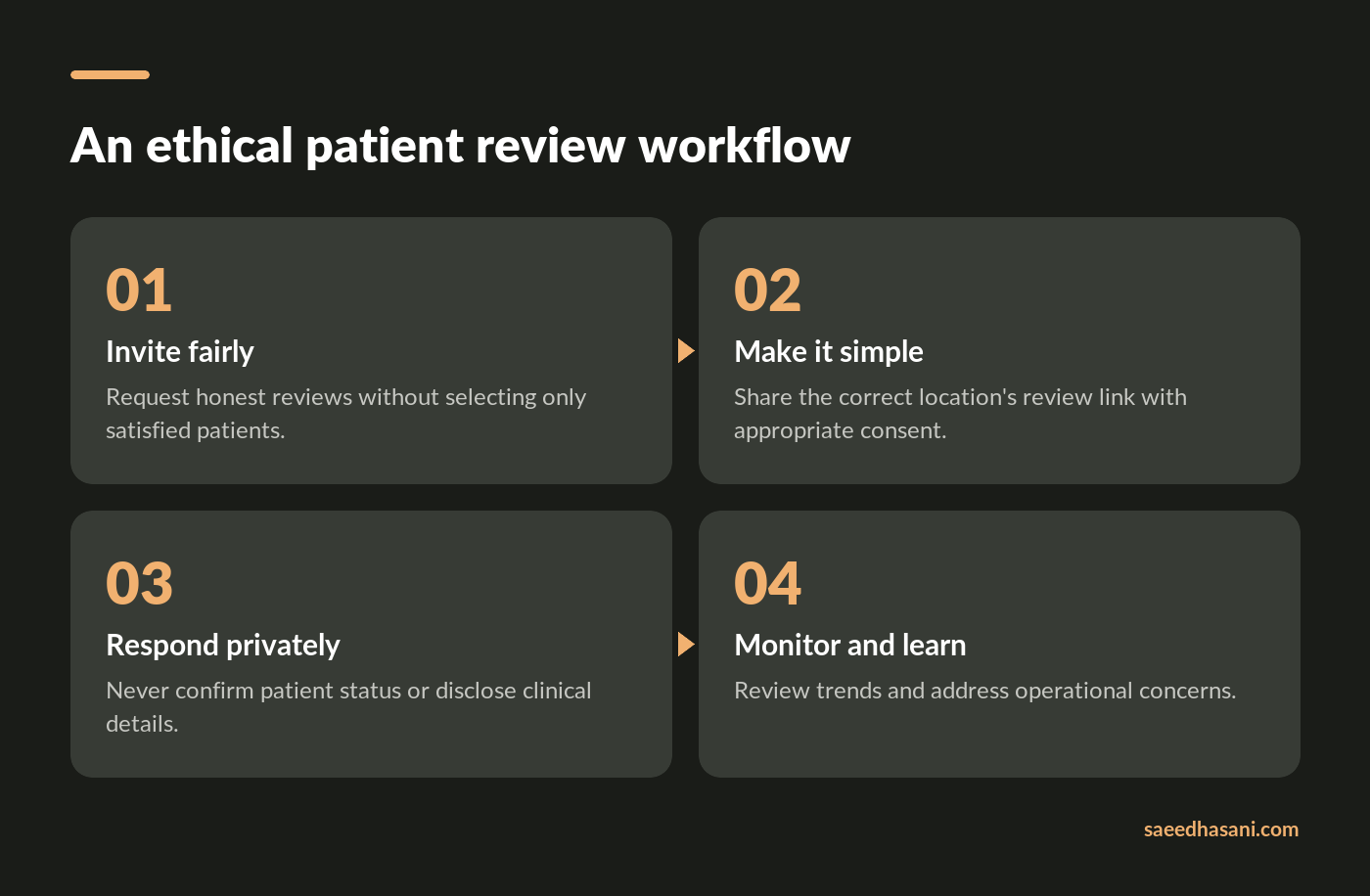
Invite honest reviews consistently from patients who can appropriately be contacted. Use an authorized communication channel and avoid conditioning any benefit on feedback. Do not offer discounts or gifts for reviews, send requests only to people expected to leave positive reviews, pressure patients or ask employees to create false reviews. Review platforms have specific policies; the process should follow those policies.
Replies to reviews require particular care in healthcare. Do not confirm that the reviewer is a patient, disclose clinical information, refer to appointment details or argue about a treatment in public. A neutral acknowledgment and an invitation to discuss concerns through an appropriate private channel can be safer than addressing the substance of the complaint online.
Review monitoring can reveal service issues such as confusing directions or difficulties booking. Automation may make invitations more consistent, but the practice remains responsible for consent, privacy and oversight. There is no universal number of new reviews per month that guarantees a ranking improvement.
Audit and Standardize NAP Consistency Across Online Directories
In local SEO for chiropractors, NAP stands for name, address and phone number. Consistent information across relevant directories makes it easier for people to reach the right clinic and helps reduce uncertainty about the practice’s identity. Begin with the official website and Google Business Profile, then compare the information with relevant listings.
Check services such as Apple Maps and Bing Places, appropriate healthcare directories and local business associations where the clinic is legitimately listed. Prioritize accuracy and relevance over the sheer number of directory submissions. Remove or correct outdated addresses, duplicate profiles and disconnected telephone numbers.
For multi-location SEO for chiropractors, keep a separate record for each clinic with the correct location URL and contact details. Citation-audit tools such as BrightLocal or Whitespark can help identify differences. If using call-tracking numbers, preserve clear contact information and ensure that the number reaches the intended location. Do not introduce conflicting public details simply to improve attribution.
Earn Local Backlinks That Build Authority for Each Specific Location
Backlinks are links from other websites. A citation may mention a practice without linking to it. Both can help people find information, but the goal of off-page SEO for chiropractors should be to build legitimate local recognition rather than accumulate links from unrelated sites.
To support off-page SEO for chiropractors, identify genuine relationships with local chambers of commerce, professional associations, community organizations or relevant events. A local newspaper may reference a useful educational initiative, an association may maintain a legitimate member directory, or a community group may link to a clinic’s event information. Only pursue opportunities that reflect real participation or useful content.
For each location, look for relevant organizations in its own community rather than sending all references to the group homepage. Where appropriate, a specific location URL helps a reader reach the relevant clinic. Avoid purchased ranking links, automated spam submissions, invented awards and exchanges whose purpose is to manipulate rankings. Evaluate a link’s relevance, audience and editorial legitimacy rather than a third-party authority score alone.
GEO: How Patients Search With AI
Alongside traditional SEO for chiropractors, generative engine optimization (GEO) describes efforts to make reliable information discoverable in AI-generated search answers. Some people may ask AI tools to compare nearby healthcare providers or explain what happens during an appointment. AI systems can produce incomplete or inaccurate information, so their recommendations should not be treated as verified clinical guidance.
For SEO for chiropractors, a useful GEO foundation is the same accurate business identity, accessible website, clear service descriptions, clinician-reviewed educational content and independent references that support conventional search. Maintain consistent practitioner and location information, use structured data accurately and review which pages are available to relevant search crawlers.
Monitor representative searches for inaccurate descriptions and missing location details. AI answers vary by query, user context and platform; a mention in one answer is not evidence that every patient will see the same recommendation. GEO should complement rather than replace website SEO and local listings. Do not promise that a practice will be cited or recommended by ChatGPT or other AI systems.
Track Local SEO Performance Per Location and Adjust Monthly
Successful SEO for chiropractors is measured by useful discovery and appropriate inquiries, not simply a rising traffic graph. Establish baseline metrics for each location and agree on what counts as a qualified inquiry and a confirmed new-patient appointment. Use the same reporting definitions over time.
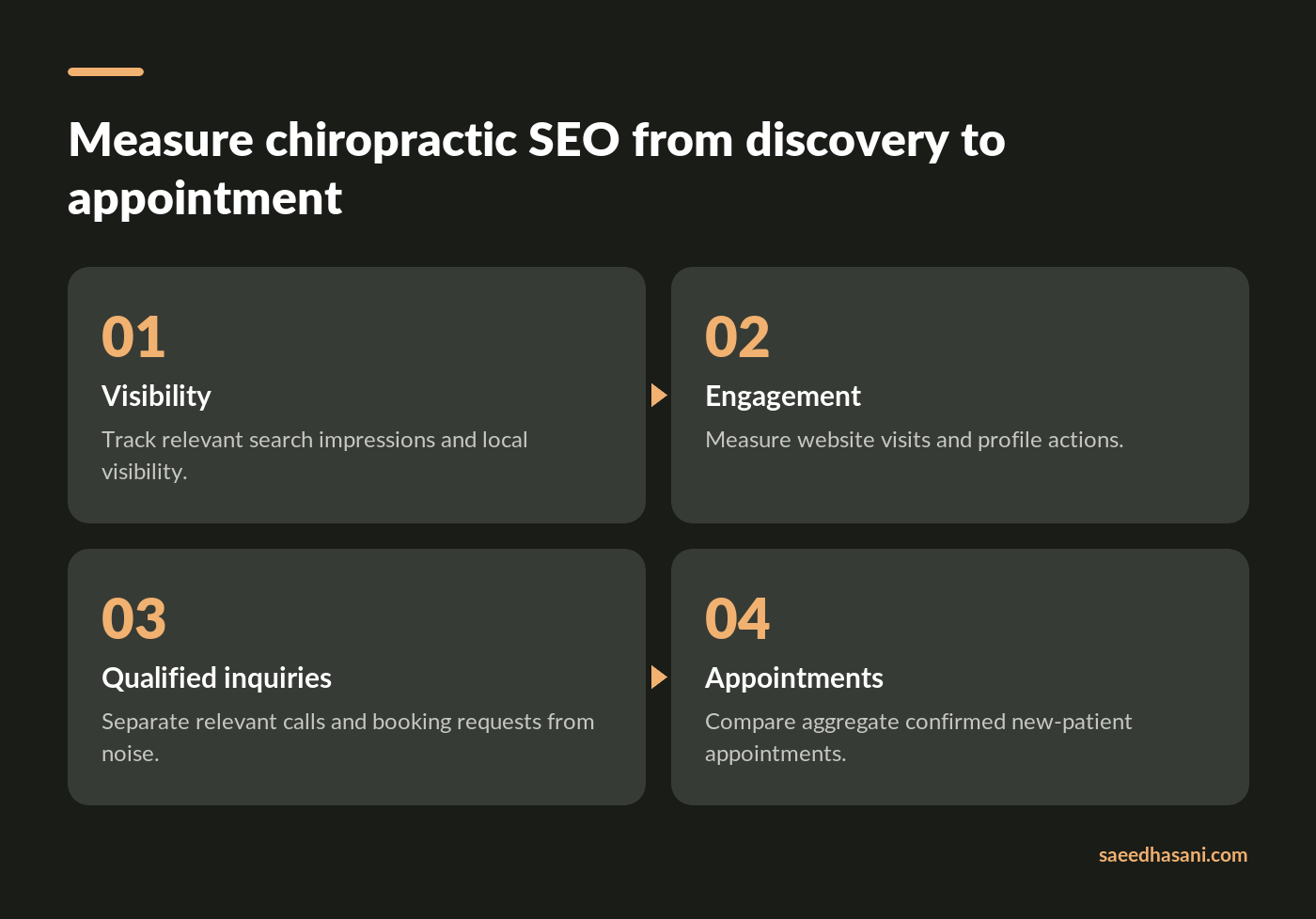
| Stage | Metric or source | Interpretation |
|---|---|---|
| Visibility | Search Console impressions and queries; local rank tracking | Is the practice appearing for relevant searches? |
| Engagement | Search clicks, profile interactions and website visits | Are searchers exploring the relevant clinic? |
| Qualified inquiries | Aggregate appropriate calls and booking requests | Are visitors taking a meaningful next step? |
| Appointments | Aggregate confirmed new-patient bookings | Is discovery leading to actual appointments? |
Google Business Profile performance, Search Console and appropriately configured analytics can provide different parts of this picture. A local rank tracker may show how positions vary across a geographic grid. Do not interpret a single search position as the ranking experienced by everyone in a city. Use dashboards to compare periods and locations, not to hide differences in demand or data quality.
Calls are not necessarily new patients, form submissions are not necessarily bookings, and a click may be one of several interactions before a person contacts the practice. Compare reports with aggregate appointment records where lawful and feasible. Account for seasonality, changes in hours, advertising and tracking changes before attributing every increase to SEO.
Measurement of SEO for chiropractors deserves a separate healthcare privacy review. Do not send patient names, medical details, appointment information or other sensitive data to ordinary marketing analytics platforms. Have the clinic’s privacy and legal advisers review any tracking vendors, call recording, consent and data flows, including applicable US healthcare and state privacy requirements. Collect only the minimum information necessary for the marketing objective.
When to Hire and How to Evaluate a Chiropractic SEO Agency
When deciding how to manage SEO for chiropractors, consider that a single-location practice with a reliable website and staff time may be able to manage some elements of SEO internally. A larger group may need help coordinating profiles, technical issues, location pages, content review and measurement. A hybrid approach can leave operational details and clinical review with the practice while an external specialist handles agreed marketing tasks.
When comparing providers of SEO for chiropractors, ask for relevant case studies with a documented starting point, timeframe and definition of results. Review credible references and whether the agency understands healthcare content, local profile policies and privacy-sensitive reporting. Do not take self-published rankings or isolated success stories as proof of typical results.
Compare proposals using the same scope: number of locations, technical and content audits, implementation responsibilities, review support, reporting, account access, contract terms and ownership of website content. Ask which tasks the practice must perform and how the agency will prioritize work when resources are limited. Keep ownership of the website, profiles and essential accounts with the practice.
Pricing for SEO for chiropractors depends on the starting condition of the site, competition, number of locations, required implementation and reporting scope. Compare deliverables and resources rather than expecting a universal monthly fee. Assess return using actual acquisition costs, qualified appointments and sustainable revenue, without assuming a fixed treatment plan or guaranteed patient value.
How Long Does Chiropractic SEO Take?
SEO for chiropractors is an ongoing process. A practice may be able to correct inaccurate opening hours or repair a broken booking link quickly, but profile verification, indexing, organic visibility and reputation development operate on different timelines.
Competition, existing website quality, location, technical accessibility, available resources and demand all affect the pace of progress. A new page might be discovered promptly or take considerably longer to be indexed. Even an indexed page is not guaranteed to appear prominently. Avoid providers who promise a fixed date for first-page or map-pack rankings.
Plan an initial audit and setup period, followed by regular maintenance and measurement. Multi-location practices should assign responsibility for each clinic and reserve time to review listings, feedback, page changes and results. Prioritize broken contact and booking paths, incorrect details and blocked pages before less consequential enhancements. Use a consistent monthly review to decide what to improve next.
Frequently Asked Questions
Why Is My Second Chiropractic Location Not Ranking?
Check whether it has its own eligible, verified profile, unique location page, accurate address and phone information, and internal links. Shared homepages and copied location descriptions can make it harder to distinguish clinics. Distance, competition and other factors also affect local results, so these checks do not guarantee rankings.
Which Steps Can I Defer When Opening a New Location?
Prioritize accurate business information, the appropriate profile verification, a usable location page and a responsible staff owner. Advanced rank tracking, a large content calendar and comprehensive citation audits can be phased in according to budget and needs. Do not defer essential accuracy, privacy or accessibility checks.
What Should I Do If a Location Page Is Not Indexed?
Check internal links, the sitemap, HTTP status, canonical tag, noindex directives and crawl restrictions. Use Search Console’s URL Inspection tool to investigate and request indexing where appropriate. If the page is accessible but not indexed, review its usefulness and originality. An indexing request does not guarantee inclusion.
Is Local SEO Worth Doing If I Already Run Google Ads?
Yes, if organic discovery is relevant to the practice’s goals. Ads and SEO are different channels: paid placements depend on campaigns and budgets, while organic visibility relies on relevance and other search factors. Measure each channel separately and consider how they contribute to the same appointment journey.
How Much Does SEO Cost for a Multi-Location Chiropractic Group?
There is no universal price. Costs vary with clinic count, local competition, website repairs, listing cleanup, content needs and reporting. Request a scope that separates initial implementation from ongoing work and compare what each location actually receives.
Can I Manage Chiropractic SEO Myself?
Yes. Practice owners or trained staff can handle accurate listings, appropriate review invitations and basic content maintenance. Technical changes, healthcare content review and privacy-sensitive tracking may require specialized support. The right approach depends on the practice’s resources and needs.







Responses