
Straddle Positioning in Marketing: 4 Powerful Checks to Avoid Costly Mistakes


Straddle positioning in marketing is a strategy in which a single offer competes credibly in two categories or competitive frames of reference. Rather than choosing between two valued benefits, the brand demonstrates that it can deliver both. A benefit that distinguishes the offer in one category may be an expected feature in the other.
For a small business, the appeal is clear: a broader competitive opportunity without necessarily creating a second product. But customers must believe that the offer meets the standards of both categories. This guide explains the concept, historical examples, four practical checks, and ways to validate the strategy before expanding it.
Content Overview:
What Is Straddle Positioning?
Positioning defines how a target customer understands an offer relative to the alternatives available to them. Straddle positioning in marketing extends that logic across two frames of reference. A frame of reference identifies the relevant category or set of competitors against which customers assess the offer.
The framework depends on two types of brand associations, discussed in Kotler, Keller and Chernev’s Marketing Management: points of parity and points of difference.
- Points of parity (POPs): benefits or attributes customers consider necessary for a brand to be a credible option in a category. Parity does not require identical products.
- Points of difference (PODs): benefits that customers value, associate with the offer and perceive as distinguishing it from relevant alternatives.
Consider an illustrative project management platform that offers both straightforward task tracking and rigorous reporting. Compared with basic task tools, straightforward tracking is expected and rigorous reporting may distinguish the platform. Compared with reporting-intensive enterprise tools, reliable reporting is expected and ease of use may be its distinguishing benefit.
Whether this is truly straddle positioning in marketing depends on customer evidence. It is not sufficient for a company to describe its product as simple and powerful. Customers must recognize the platform as a credible alternative in both frames and believe its distinctive benefit in each.
Examples of Straddle Positioning
A classic illustration of straddle positioning in marketing is BMW’s historical US positioning. Marketing Management uses the brand to explain how luxury and driving performance could reinforce each other. The relevant comparison changes depending on which category the buyer considers.
| Competitive frame | Point of parity | Point of difference |
|---|---|---|
| Luxury cars | Luxury | Performance |
| Performance cars | Performance | Luxury |

This historical illustration of straddle positioning in marketing is not a claim that every BMW model currently outperforms or is more luxurious than every competitor.
Subway provides another textbook example of straddle positioning in marketing. In a quick-service restaurant frame, taste was treated as an expected benefit and a healthier image as a differentiator. In a health-oriented restaurant frame, the emphasis reversed: health-related positioning provided credibility while taste could distinguish the sandwiches. This describes positioning associations rather than a nutritional judgment about any current menu item.
Other illustrations include the Mahindra Scorpio’s combination of comfort and adventure-oriented appeal, or Domino’s combination of pizza quality and convenient delivery. The latter demonstrates the logic of combining an expected product attribute with a service benefit; it is a strict two-frame straddle only if buyers actually compare the offer across distinct competitive categories. Do not treat every combination of two benefits as proof of straddle positioning in marketing.
What Does Positioning Mean in Marketing?
Positioning is the strategic choice of how an offer should be understood relative to competitors by a particular audience. The concept became prominent through work on how brands occupy distinct places in customers’ minds. It is ultimately a decision about customer relevance and competitive advantage, not merely an advertising slogan.
Straddle positioning in marketing fits within the segmentation, targeting and positioning (STP) framework. Segmentation identifies groups with different needs; targeting selects the groups the business can serve; and positioning establishes the intended perception. A brand strategist can use this sequence to align the proposed market position with business capabilities and the intended audience.
| Concept | Role |
|---|---|
| Positioning | Defines the competitive context and meaningful distinction. |
| Value proposition | Explains the value a customer receives. |
| Differentiation | Identifies meaningful distinctions from alternatives. |
| Branding | Builds the identity and associations through which customers recognize the business. |
| Messaging and narrative | Communicate the strategic position through language, evidence and stories. |
Apple’s emphasis on the experience of its products is a familiar illustration of brand positioning; it does not by itself establish a straddle strategy. The distinction matters because positioning guides what a business builds and delivers, while messaging describes those choices. If operations cannot support a claimed benefit, changing the headline will not resolve the underlying mismatch.
What Are the Different Types of Positioning in Marketing?
Market positioning concerns the place an offer occupies among competing alternatives. Brand positioning establishes the broader associations customers attach to a brand. Product positioning focuses on the relevance of a particular product to a particular audience. The three levels should complement one another, but they need not be identical across every product.
Positioning can focus on functional benefits such as reliability, symbolic benefits such as identity or status, or experiential benefits such as the feeling of using a product. Brand positioning can also communicate attributes, the benefits resulting from them, and the values or beliefs that the brand represents.
Businesses may position offers around price and value, quality, a particular use case, a specific user group or a competitor comparison. Each approach can work within a single category. A company can also emphasize several features while remaining firmly in one frame. Straddle positioning in marketing is distinct because it establishes credibility across two competitive contexts rather than simply adding another product attribute.
A small bookkeeping service, for example, might position itself as a dependable monthly bookkeeping provider with convenient communication. That remains a single-category strategy. If it also competes credibly with financial reporting providers, delivering verified reporting capabilities alongside accessible bookkeeping, straddle positioning in marketing may become worth investigating.
How to Develop a Positioning Strategy: 4 Essential Checks
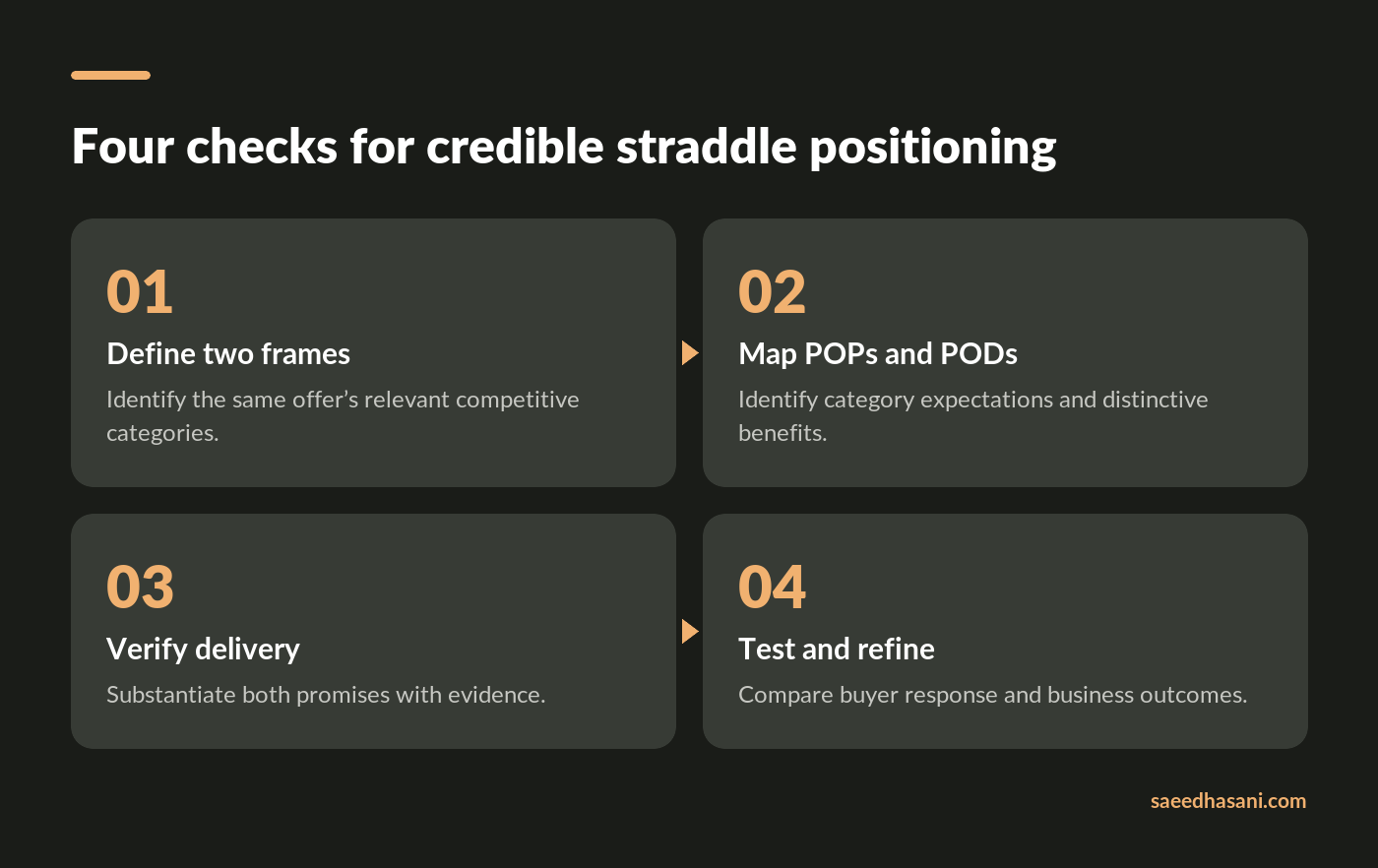
The following four checks help translate the concept of straddle positioning in marketing into a decision process. They draw on the general positioning principles of comparing alternatives, distinctive attributes, value, customer fit and market category.
- Define two frames. Identify the target customer, buying situation and two categories of alternatives they genuinely consider. Interview customers and review the alternatives they mention during sales conversations. Do not select a second category simply because it has a large market.
- Map POPs and PODs. List the minimum standards for each category and the benefits your offer can meaningfully differentiate on. Identify where the same benefit changes role across the two frames. Check whether customers value it and whether competitors can deliver it equally well.
- Verify delivery. Gather product specifications, demonstrations, customer feedback, service records and other relevant evidence. Ask those responsible for delivery whether both promises can be sustained at the intended price and service level. Resolve genuine trade-offs before making claims.
- Test and refine. Compare customer understanding and commercial outcomes under consistent conditions. Record who was tested, which category was emphasized, what was held constant and what success would look like. Narrow or revise the position when the evidence calls for it.
April Dunford’s positioning framework provides a complementary lens for straddle positioning in marketing: identify competitive alternatives, unique capabilities, customer value, the customers who care most about that value and the market category that makes it understandable. The goal is to discover a fit between these elements rather than merely list features.
Check Whether the Same Offer Earns Both Frames
Begin by identifying the real alternatives. Ask prospective buyers what they would do if your offer were unavailable. Some might use another service, hire an employee, purchase software or do the work themselves. The categories customers compare may differ from the categories a marketing team initially assumes.
For straddle positioning in marketing, establish a baseline for each category. A hypothetical reporting tool may need scheduled reports to qualify as a reporting product, while ease of setup may be critical in a simple task-management frame. If the reporting feature is unreliable, strong ease of use does not make the reporting promise credible.
Research into consumer behavior helps distinguish stated preferences from observed decisions. Ask about recent purchases, rejected alternatives, trade-offs and required evidence. Supplement interviews with customer support patterns and product usage where appropriate.
Growth strategy provides another useful constraint for straddle positioning in marketing. The Ansoff matrix distinguishes market penetration, market development, product development and diversification. A new category may require different capabilities or an investment that cannot be justified by the current offer. A centrality-distinctiveness map can reveal how typical a brand is within a category and how strongly it stands apart.
The goal is not to be everything to everyone. A business that attempts to be simultaneously the cheapest option and the most personalized premium service may find its operating model cannot deliver both sustainably. Check capacity, costs, quality and customer expectations before treating the gap as a market opportunity.
Test the Category Message Without Changing Everything at Once
A positioning statement can help a team clarify the intended customer, category, distinctive benefit and evidence supporting the claim. When testing straddle positioning in marketing, a useful internal statement follows this pattern: for a defined customer who has a particular need, our offer is a relevant category alternative that delivers a meaningful benefit because of a demonstrable capability.
Imagine a hypothetical reporting platform targeting small-business marketing managers. A task-management message could lead with easy campaign coordination and highlight reporting as the additional benefit. A reporting-platform message could lead with reliable campaign reporting and highlight simple coordination as the additional benefit. Both describe the same product and both require evidence.
Test straddle positioning in marketing without changing the offer, price, landing page functionality and audience simultaneously. For example, create two versions of a landing page headline with consistent supporting evidence and a clear next action. Compare results among similar buyers and use interviews to discover whether they understood the same value you intended to communicate.
Look beyond clicks. An attractive message that generates more visits but fewer qualified inquiries may attract the wrong audience. A buyer who interprets a reporting tool as a full-service analytics consultancy may have misunderstood the offer. Record that mismatch and revise the category language or scope rather than declaring the test a success solely because traffic increased.
How to Measure the Effectiveness of Your Positioning
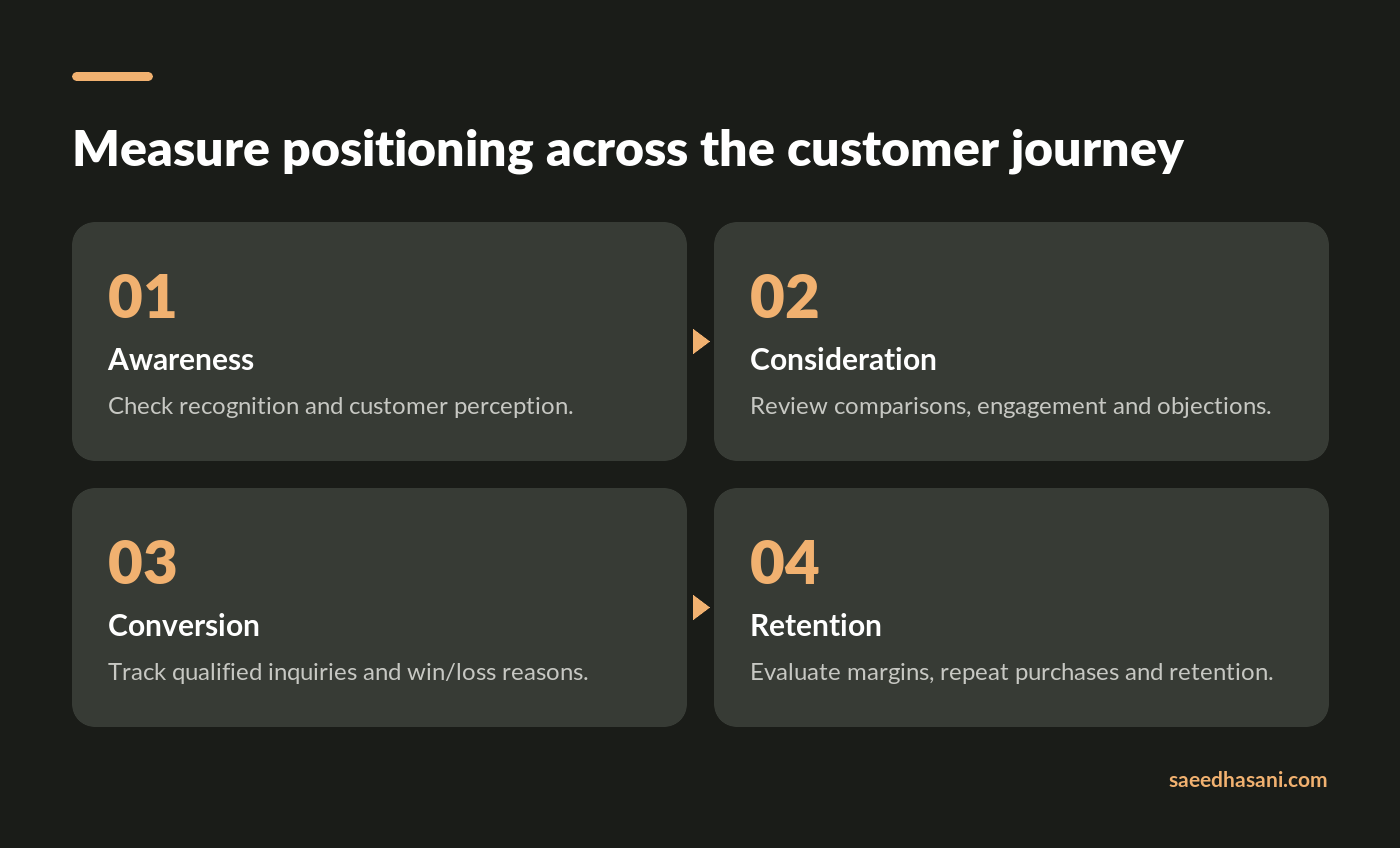
Positioning is not a one-time launch decision. Evaluate straddle positioning in marketing throughout the customer journey and connect changes in perception to the outcomes the business actually wants. A digital marketing audit can help establish the baseline and validate tracking.
| Stage | Evidence to collect | Question to answer |
|---|---|---|
| Awareness | Customer interviews, relevant search visibility and brand recall | Do buyers recognize the offer in both frames? |
| Consideration | Relevant page engagement, competitive comparisons and objections | Do buyers understand the distinct benefit? |
| Conversion | Qualified inquiries, demonstrations and sales win/loss reasons | Does the position attract buyers the company can serve? |
| Revenue and retention | Pipeline, closed sales, margins, repeat purchases and retention | Can the business fulfill the promises sustainably? |
Use consistent definitions of a qualified lead and comparable reporting windows. Tag campaigns by the competitive frame they emphasize, but recognize that multiple interactions can contribute to a sale. Compare the two messages using actual sales conversations and customer experiences rather than assigning every revenue change to straddle positioning in marketing alone.
Monitor organizational adoption as well. Sales representatives should be able to explain both category comparisons accurately, product teams should understand which capabilities support the position, and customer service should meet the resulting expectations. Establish a recurring feedback loop that includes win/loss analysis, customer interviews and operational evidence.
Decide Whether to Keep, Narrow, or Split the Position
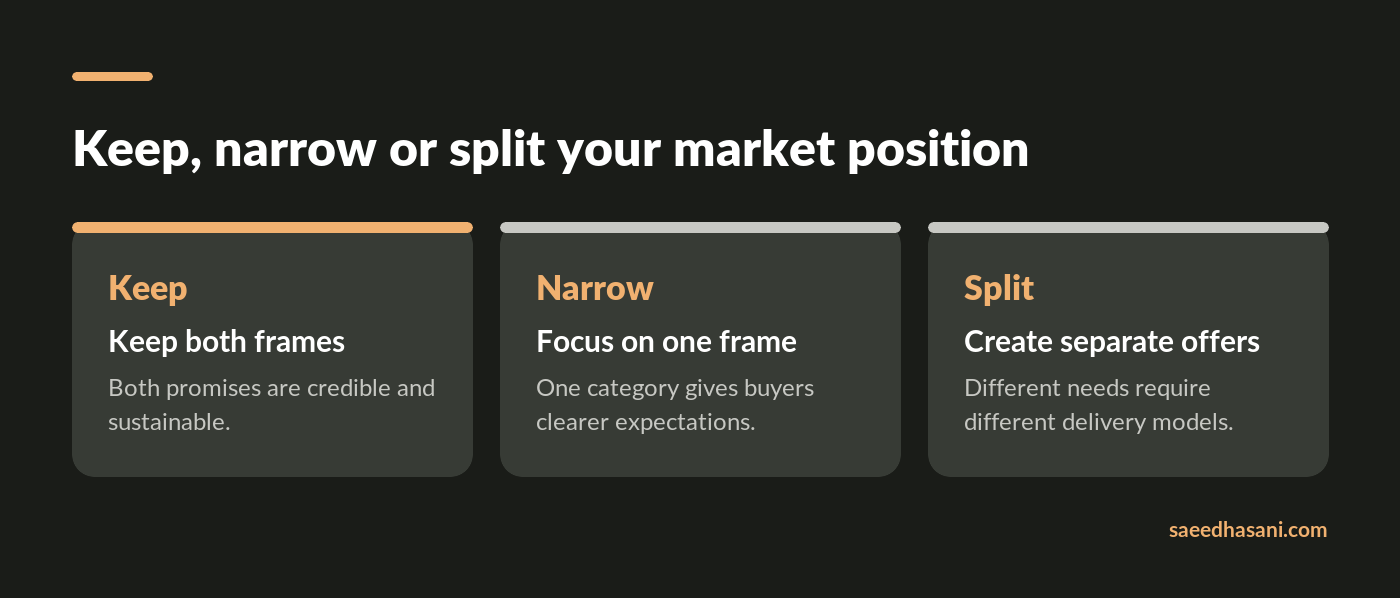
The outcome of a positioning test is not automatically a broader strategy. Straddle positioning in marketing should remain in place only when both categories make sense for the offer, both promises are credible, and the economics support delivering them.
- Keep: buyers understand both frames, evidence supports the benefits, and the business can deliver them consistently.
- Narrow: one category creates substantially clearer expectations or the other introduces trade-offs the business cannot support.
- Split: the groups require meaningfully different products, service levels or price structures, making separate offers a more coherent choice.
Consider repositioning when customer expectations change, competitors alter category standards, delivery capabilities improve or straddle positioning in marketing repeatedly creates confusion. Review the current baseline, investigate the cause, choose the updated frame, align product and operational teams, then introduce and evaluate the new messaging.
Coca-Cola’s Mother Energy Drink relaunch in Australia illustrates repositioning through changes to the actual product and its communication. It is not a case of straddle positioning in marketing; its relevance is the lesson that a different message may require a different customer experience.
What Is a Perceptual Map and Why Is It Useful for Brands?
A perceptual map plots customer perceptions of brands along two meaningful dimensions. For a business exploring straddle positioning in marketing, the dimensions might represent ease of use and depth of functionality, or perceived comfort and performance. The dimensions should come from buyer research rather than a desire to make your brand look distinctive.
Choose relevant competitors, collect comparable customer ratings, and plot average perceptions while keeping track of differences across segments. A map helps visualize where the offer is currently understood and where the competitive categories overlap. A centrality-distinctiveness map instead uses typicality and distinctiveness as the axes.
An empty space on a map is a hypothesis, not proof of unmet demand. Customers might not value the combination, or the market may be empty because the required capabilities are expensive to deliver together. Before investing in straddle positioning in marketing, validate the opportunity with customer interviews, feasible delivery plans and commercial evidence.
Frequently Asked Questions
Can a Small Business Use Straddle Positioning?
Yes. Straddle positioning in marketing is available to small businesses provided they can substantiate both benefits and relevant customers compare the offer in both categories. Focus on a specific audience and feasible capabilities rather than trying to cover an entire market.
How Is Straddle Positioning Different From Repositioning?
Straddle positioning in marketing establishes credibility in two competitive frames at once. Repositioning changes an existing market perception or frame of reference. A company may reposition an offer to develop a straddle strategy, but the concepts are not interchangeable.
What Happens When the Two Benefits Conflict?
Assess the trade-off in actual delivery and customer expectations. If both benefits cannot be delivered credibly and economically, narrow the position or develop separate offers. Straddle positioning in marketing works best when the benefits reinforce rather than undermine each other.







Responses